Chatbot for Hotels: The Direct Booking and Guest Journey Playbook
Learn how a hotel chatbot answers guests, captures direct bookings and supports every stay stage, with ROI maths, comparisons and a safe setup plan.


A guest comparing two hotels at 11:40 pm rarely sends both properties a patient email.
They ask whether breakfast is included, whether the family room fits a cot, how far the hotel is from the station, and whether they can arrive after midnight. If one hotel answers immediately and the other promises a reply tomorrow, the faster answer can shape where the booking begins.
The same pressure continues after the reservation. Parking, accessibility, restaurant hours, luggage storage, local transport and check-out questions arrive across the website, WhatsApp and the reservations inbox. Reception staff answer them between arrivals, calls, complaints and the guests already standing in front of them.
A chatbot for hotels can close that response gap. Its role is not to impersonate a receptionist or pretend it has live room inventory. It should answer from approved property information, capture booking intent, route requests, take only authorised connected actions, and bring a person in when judgement matters.
This guide builds that operating model through the Four-Desk Guest Routing Framework. We will calculate ROI from explicit inputs, explain the best channel mix, compare FastBots with HiJiffy, Asksuite and Myma AI, and finish with a seven-step launch plan.
What is a hotel chatbot?
A hotel chatbot is a conversational interface trained on a property's rooms, amenities, policies, dining information, directions, local guide and guest FAQs. It lets a traveller ask a natural-language question and receive a relevant answer without searching through several pages or waiting for reception.
The chatbot is the interface. It behaves more like an AI agent when it maintains context, qualifies a group enquiry, handles an email thread, routes an issue or takes an authorised action through a connected system.
That distinction matters. A website chatbot can answer "Is parking free?" from a policy page. It cannot know that room 214 needs towels, change a reservation or confirm live availability unless the necessary system is connected and the specific action is permitted. The presence of a chat box does not create a property management system integration.
FastBots can use one trained knowledge source across a hotel website and channels such as WhatsApp, Instagram and Messenger. On the Business plan and above, the same trained content can also support a reservations or guest-service inbox through Email Replies.
The measurable cost of slow and repeated guest questions
Hotel enquiries create three different costs: interruption, lost booking intent and avoidable service friction.
Start with interruption. Use four inputs:
- Routine written enquiries per week.
- Percentage answered from information the hotel already publishes.
- Average staff minutes needed to read, find and send the answer.
- Fully loaded hourly staff cost.
Suppose an 80-room hotel receives 240 written enquiries a week across web chat, social messaging and email. If 60% are routine and each takes four minutes, the load is:
240 enquiries x 60% x 4 minutes = 576 minutes, or 9.6 staff hours a week.
At $24 per hour, that is about $230 of weekly capacity. It does not mean the hotel can remove 9.6 paid hours. It means the same team could spend that time on arrivals, service recovery, group sales and guests who need a person.
Lost booking intent needs separate measurement. Review after-hours questions that mention dates, room type, party size, weddings, corporate stays or direct-booking benefits. Track how many receive a useful first response, how many become qualified enquiries and how many convert. Do not value every chat as a booking.
Service friction is visible in repeated pre-arrival and in-stay questions. Count how often guests ask for information that is unclear, contradictory or difficult to find. A chatbot can answer the question, but the pattern also tells the hotel what to fix on its website, confirmation email or guest guide.
The Four-Desk Guest Routing Framework
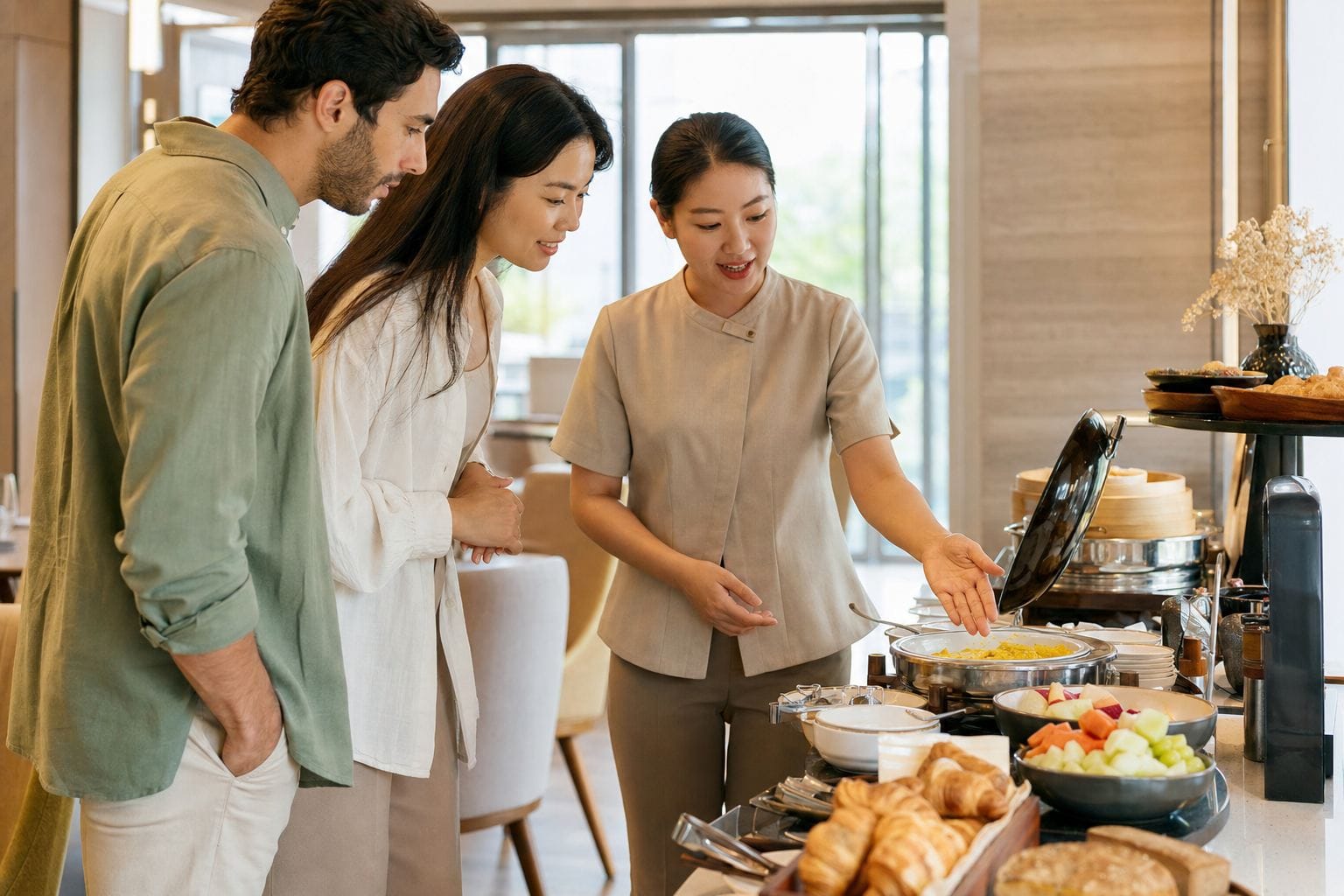
Hotel chatbots are often sold as digital concierges that do everything. A safer design gives every message one of four destinations: the Information Desk, Reservations Desk, Service Desk or Recovery Desk.
1. Information Desk: answer from approved facts
This desk handles stable, documented questions: check-in and check-out times, breakfast hours, parking, pet rules, accessibility, room features, luggage storage, restaurant opening, local transport and nearby attractions.
The bot should answer briefly, identify uncertainty and link to the next useful page. It should not turn a simple parking question into a sales script.
Useful measures include routine-answer rate, correction rate, unanswered topics and the percentage of sessions that reach a room, booking or contact page.
2. Reservations Desk: qualify intent without inventing inventory
Pre-booking questions often contain commercial intent. The AI agent can collect dates, party size, room preferences, accessibility needs and contact details, then direct the guest to the booking engine or route the enquiry to reservations.
FastBots has no native PMS, channel-manager or booking-engine integration. It must not claim that a room is available, quote a live rate or call a request confirmed from static training content.
If the hotel connects a compatible app through Zapier MCP, the agent can take an authorised action during the conversation. The action set depends on the connected app. A booking is confirmed only when the source system returns a successful confirmation.
Measure qualified enquiries, booking-page visits, confirmed connected actions and direct bookings attributed in the source system.
3. Service Desk: route practical requests with context
Before and during a stay, guests ask about early arrival, airport transfers, restaurant reservations, extra bedding, housekeeping, spa availability and local recommendations.
Some requests need only an answer. Others should become a structured message or connected task containing the guest's name, stay details, request and urgency. Payment details, identity documents and room-access credentials should remain in the hotel's secure process, not ordinary chat.
The chatbot should be clear about state. "I have sent your request to reception" is different from "Your transfer is booked." The second statement requires confirmation from the transport or hotel system.
Measure requests routed with complete details, staff follow-up time and the number of guests who had to repeat information.
4. Recovery Desk: recognise when hospitality needs a person
Complaints, safety concerns, medical issues, security incidents, disputed charges, room-access problems and emotionally charged conversations require human judgement.
The AI agent can acknowledge the issue, preserve context and alert the right team. It should not negotiate compensation, decide liability, reveal security procedures or keep a frustrated guest trapped in automation.
On the Business plan and above, FastBots Live Chat lets a team member take over a website conversation. Email Replies can also use human approval, so sensitive drafts wait for a reviewer rather than sending automatically.
Measure escalation speed, successful handover and whether the guest had to repeat the story. A high escalation rate is not automatically bad if the system is correctly identifying risk.
The framework is deliberately operational. Information Desk removes search friction. Reservations Desk protects booking accuracy. Service Desk gives requests a route. Recovery Desk protects the human relationship.
What FastBots can actually do for a hotel
FastBots can train a chatbot on a hotel's website, PDF guides, documents, spreadsheets and other approved sources. A property can include room descriptions, amenities, parking, accessibility, breakfast, spa, dining, events, policies and local-area material.
The same bot can then:
- Answer website questions around the clock.
- Reply across WhatsApp, Instagram, Messenger and Telegram from the same knowledge.
- Detect and answer in around 95 languages through multilingual support.
- Collect contact details and a booking or group-enquiry brief.
- Send captured lead information to staff or another system through Zapier or Make.
- Take configured mid-conversation actions through Zapier MCP.
- Hand a website chat to staff through Live Chat on Business and above.
- Run an AI email agent for one or more inbound addresses on Business and above.
- Let hotel staff approve, edit or auto-send email replies.
- Read supported inbound email attachments and use their contents in a draft reply.
- Search, filter and export conversation history for review.
There are important boundaries. FastBots does not answer phone calls, provide native SMS, connect natively to hotel PMS or channel-manager systems, or read live availability by default. It does not directly control locks, issue room keys or process card payments.
This makes FastBots strongest for hotels that want a flexible, knowledge-trained text layer without buying a full hospitality communications suite. A hotel that needs deep native PMS automation, OTA inbox consolidation or voice answering may prefer a specialist platform.
Why hotels need a channel plan, not only a website widget
The guest journey moves between channels. Discovery may start on the website. A pre-arrival question arrives on WhatsApp. A group enquiry lands in email. An in-stay guest uses whichever route was easiest to find.
Give each channel a clear role:
- Website chat handles comparison questions at the point of booking intent.
- WhatsApp suits pre-arrival and practical guest conversations where it is already an approved contact channel.
- Instagram and Messenger capture questions created by destination and property content.
- Email fits group stays, weddings, corporate accounts and requests with documents or longer detail.
- Live Chat is the human route for website conversations that need judgement.
- Phone remains essential for guests who prefer voice and urgent cases because FastBots does not answer calls.
One knowledge source reduces inconsistency, but channel instructions can still differ. Website replies should be concise. Email can be more formal and complete. Safety and booking rules must remain the same everywhere.
This channel mix also supports direct-booking intent without pretending to replace the booking engine. The chatbot can explain documented direct-booking benefits, answer the question blocking the decision and send the guest to the hotel's real booking page.
Transparent ROI for a hotel chatbot
Use three value buckets and keep the assumptions visible.
Capacity recovered
Return to the example of 144 routine enquiries a week. If the chatbot resolves 60% without staff intervention, it removes about 86 manual responses.
At four minutes each, that is 5.7 hours recovered a week. At $24 per hour, the capacity value is about $137 weekly, or roughly $594 monthly.
Direct-booking contribution
Assume the chatbot creates 12 qualified after-hours booking enquiries a month. If three become direct bookings and each contributes $180 after variable costs, that is $540 in modelled monthly contribution.
Do not count the full room revenue and do not assume every person who clicked the booking page converted. Attribute the booking in the booking engine or CRM.
Cost and break-even
FastBots Essential currently costs $39 per month and includes two chatbots, 2,000 message credits and supported integrations, including Zapier MCP. Business is $89 per month and adds Live Chat, Auto Retrain and Email Replies. Check current FastBots pricing before buying because plans and limits can change.
Using capacity alone, the subscription break-even is:
$39 / $24 hourly capacity value = 1.63 hours recovered per month.
Add setup, testing, channel fees, connected-app costs and monthly content maintenance before reporting a return. Then track capacity and booking contribution separately. Our chatbot ROI guide provides a fuller measurement model.
Seven steps to set up FastBots for a hotel
1. Audit real guest questions
Sample website forms, emails, messages and reception notes from several weeks. Group them into the four desks. Mark the channel, language, response time and outcome.
2. Build one approved property pack
Gather room descriptions, policies, parking, accessibility, breakfast, dining, spa, events, local transport and area guides. Remove expired offers and conflicting documents.
3. Write explicit source and safety rules
Tell the chatbot to answer only from approved hotel information. It must not invent availability, rates, confirmations, payment instructions, security processes or compensation.
4. Train and test the Information Desk first
Crawl the relevant site pages and upload the smallest complete document set. Test routine questions, awkward phrasing, multiple languages and contradictions before connecting actions.
5. Design reservations and lead capture
Collect only what staff need: dates, party size, room preference, purpose and contact details. Use lead-generation workflows to route the brief without making the conversation feel like a long form.
6. Connect channels and actions one at a time
Add the highest-volume written channel first. For Zapier MCP, test success, failure, duplicate submission and timeout states. The agent must never report success before the connected system does.
7. Rehearse the stay and review conversations
Test late arrival, accessible-room questions, a sold-out date, a disputed charge, a medical issue, a room-access problem, a group booking and a guest asking for a person. Review early conversations daily, then maintain a weekly unknown-answer and correction report.
Hotels managing multiple buildings or long-term residents may also find the property-management chatbot guide useful. Short-stay operators can compare the workflow with the Airbnb owner chatbot guide.

FastBots vs HiJiffy, Asksuite and Myma AI
The best choice depends on whether the hotel needs a flexible text assistant or a hospitality platform with native system depth.
| Platform | Current public position and pricing | Strongest fit | Honest limitation |
|---|---|---|---|
| FastBots | Multi-channel knowledge-trained chatbot. Essential from $39/month; Business from $89/month | Independent hotels and B&Bs wanting web, messaging and email coverage with low setup friction and optional connected actions | No voice, native SMS, PMS, channel-manager or booking-engine integration |
| HiJiffy | Hospitality Guest Communications Hub with multilingual support, guest-journey automation and hospitality system integrations. Pricing is quote-based | Hotels wanting specialist pre-stay, in-stay and post-stay automation with PMS and booking-engine connections | More specialised implementation than a general no-code chatbot, with no public entry price |
| Asksuite | Hospitality omnichannel platform with 50+ languages, automatic quotes, booking workflows and 400+ booking-engine integrations. Pricing is customised | Reservation teams and hotel groups needing deep booking conversion and hospitality-specific automation | Quote-based product whose breadth may exceed the needs of a small property |
| Myma AI | Hotel AI assistant across web, WhatsApp, SMS, email, voice and OTA channels, with native PMS and booking-engine connections. Pricing is quote-based | Hotels wanting a purpose-built communications suite with voice and native hotel-system integration | No public entry price and a heavier platform than a simple website and messaging layer |
FastBots is not the automatic winner. Choose HiJiffy, Asksuite or Myma AI when native hotel integrations, proactive journey campaigns, OTA messaging or phone automation are core requirements.
Choose FastBots when the main problem is repetitive written questions, multilingual coverage, direct-enquiry capture and a shared knowledge source across several text channels. Some hotels may combine tools, but every overlapping channel needs a clear owner to prevent duplicate or contradictory replies.
Common mistakes to avoid
Training on public rates as if they were live inventory. A crawled page can become stale. Send the guest to the booking engine or use a verified connected action.
Calling a captured request a confirmation. Use precise states: details collected, request sent, action submitted or booking confirmed by the source system.
Automating every complaint. Acknowledgement and routing are useful. Compensation, liability and service recovery need a person.
Adding every channel on launch day. Start where written demand is highest, learn from real conversations and expand in a controlled order.
Ignoring language quality on sensitive topics. Multilingual support is valuable, but hotels should test safety, accessibility and cancellation wording in important guest languages.
Leaving old offers in the knowledge base. Give one person ownership of source updates. Auto Retrain helps on Business and above, but governance still matters.
Measuring message volume instead of outcomes. Track staff capacity, useful answers, corrections, qualified enquiries, confirmed bookings and handover speed.
Frequently asked questions
Can a hotel chatbot confirm room bookings?
FastBots can link to the hotel's booking engine or capture dates and contact details. It can take a configured action through Zapier MCP when a compatible app is connected, but it has no native PMS or booking-engine integration. Confirmation must come from the source system.
Can it show live rates and availability?
Not from static training content. A chatbot can explain published room information and send the guest to a live booking page. Live rates and availability require a connected system that exposes those actions or data.
Can FastBots answer hotel phone calls?
No. FastBots is a text platform and does not provide voice or phone answering. Hotels whose main problem is call volume should compare specialist voice products.
Which hotel channels can FastBots cover?
The same trained bot can serve the website, WhatsApp, Instagram, Messenger, Telegram and other supported messaging channels. Email Replies on Business and above adds an AI email agent for inbound mailboxes.
Does it support international guests?
Yes. FastBots detects the inbound language and supports around 95 languages. Hotels should still test important policy, accessibility and safety answers in the languages they receive most often.
Can the chatbot handle guest complaints?
It can acknowledge the message, capture context and route it to the right person. It should not decide compensation, argue with the guest or keep a serious complaint inside automation.
How much does a hotel chatbot cost?
FastBots has a free plan for testing. Essential is $39 per month. Business is $89 per month and adds features including Live Chat, Auto Retrain and Email Replies. Specialist hotel platforms commonly use custom quotes.
How quickly can a hotel launch one?
A basic website bot can be trained and embedded quickly, but a safe hotel launch needs a source audit, multilingual testing, escalation rules and rehearsal. Connected reservation or service actions require additional testing.
Give every guest question the right desk
The goal is not a hotel with fewer human conversations. It is a hotel where routine questions stop competing with the moments that deserve human attention.
Use the Information Desk for verified facts, the Reservations Desk for qualified booking intent, the Service Desk for structured requests and the Recovery Desk for fast human judgement. Keep live inventory, payments, security and confirmations inside the systems that own them.
Build a FastBots chatbot for your hotel and test it first on the questions your front desk answers every day.