Chatbot for Florists: Turn Enquiries Into Quote-Ready Orders
Learn how a florist chatbot answers delivery questions, captures wedding briefs and routes enquiries without inventing stock, prices or bookings.


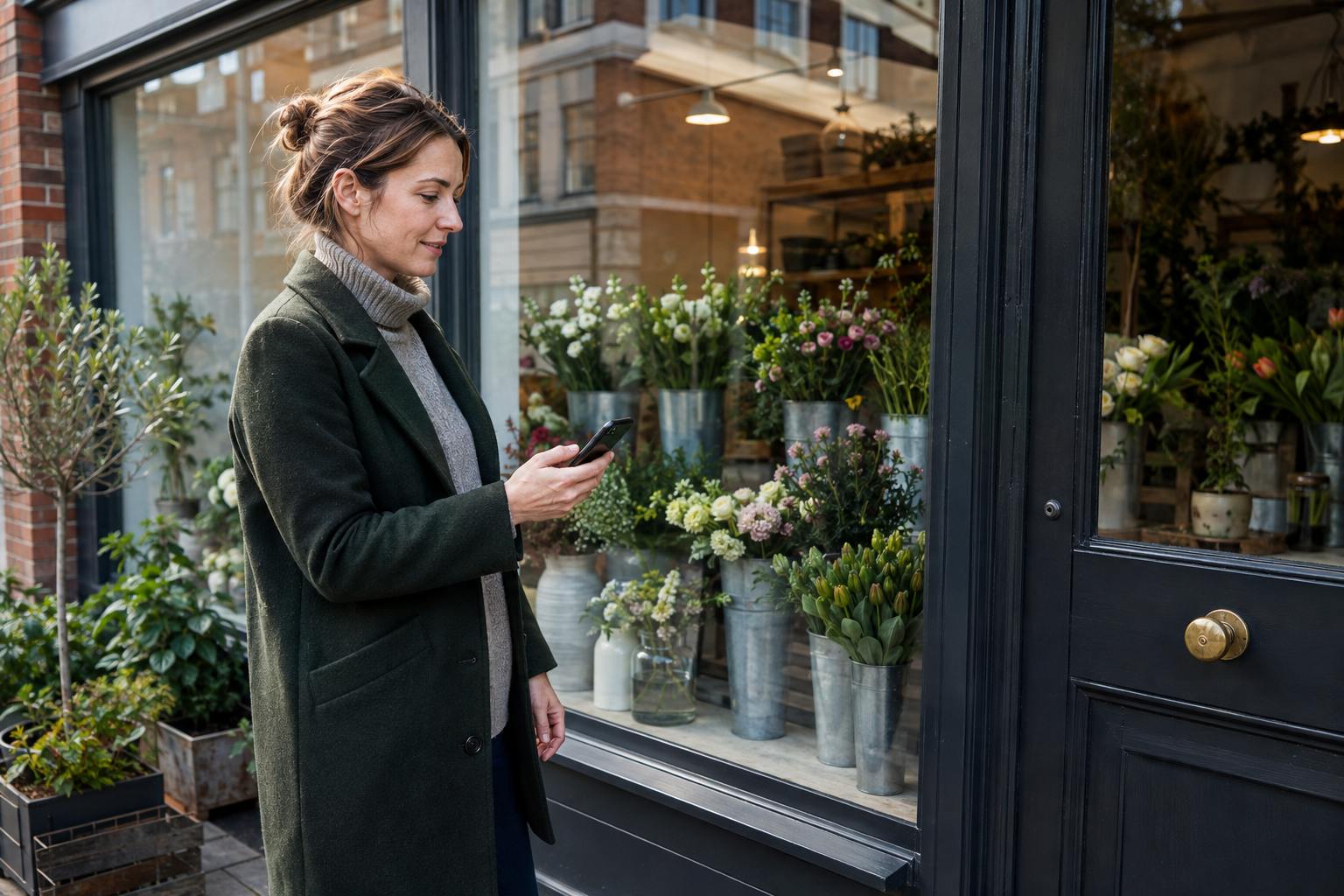
A customer needs flowers delivered today. They find your shop before breakfast and ask whether you cover the recipient's postcode, whether the order can arrive before 3 pm and whether you can avoid lilies. At the same time, a wedding enquiry lands on Instagram with a date, three inspiration photos and the words, “How much would something like this cost?”
Both messages matter. They are not the same job.
The same-day customer needs a fast answer and a route to a stock check. The wedding client needs a structured brief before a florist plans recipes, quantities and labour. Leave both waiting and another shop may earn the conversation. Answer too confidently and you risk promising unavailable stems, an impossible delivery window or a price nobody has calculated.
A useful chatbot for florists works between those two failures. It answers from information you approve, asks questions suited to the occasion and hands a complete enquiry to the right person. It does not pretend that a product page proves today's stock, that a requested date is reserved or that an inspiration image can be reproduced exactly.
The chatbot is the conversational interface. It acts more like an AI agent when it maintains context, routes a lead, escalates a sensitive request or takes an authorised action through a connected system. This guide introduces the STEM Handoff: Source, Timing, Event scope, Money range and Manual confirmation. We will use it to design the workflow, choose channels, calculate realistic value, set up FastBots in seven steps and compare four different product approaches.
What can a chatbot for florists actually do?
A florist chatbot is a trained conversational layer for the questions that arrive before an order, consultation or human reply. It can learn from selected website pages, delivery policies, care guides, wedding service descriptions, seasonal notes, price ranges and approved FAQs.
FastBots for florists can use that information across a website chatbot and supported messaging channels. A customer can ask about delivery areas on your site, continue with a wedding question on Instagram or use WhatsApp for direct follow-up without your team maintaining a different script for each inbox.
Useful jobs include:
- explaining delivery areas, opening hours, cutoffs and approved care guidance;
- distinguishing everyday bouquets, sympathy work, subscriptions and event florals;
- collecting an occasion, delivery date, recipient area, budget range and contact route;
- building a wedding brief with the date, venue, guest count, colour direction and required pieces;
- sharing the correct consultation or checkout link;
- capturing unresolved questions for human review;
- taking an authorised action through a compatible app connected via Zapier MCP, provided the source system confirms success.
Flowers are perishable. Stock, wholesale availability, production capacity and delivery slots change. A trained answer can repeat your published policy, but it cannot see today's cooler without a dependable live source.
FastBots is not a florist POS, inventory platform, ecommerce checkout, payment processor, delivery-routing service, phone agent or native SMS tool. It should not accept money, confirm a bespoke quote, reserve a wedding date, promise an exact flower variety or state that a same-day order is accepted unless the relevant person or connected source has confirmed it.
The hidden cost of mixed-speed florist enquiries
Florist communication interrupts physical work, and different enquiries need different depths of reply. A four-minute delivery question can arrive beside a wedding brief that takes 25 minutes to clarify.
Build a simple capacity model. Suppose a shop receives 260 written enquiries a month across website, Instagram, WhatsApp and email. If 55% concern published information and each takes four minutes to read, check and answer, the routine load is:
260 enquiries x 55% x 4 minutes = 572 minutes, or about 9.5 hours.
Now add 30 wedding or event enquiries. If two thirds arrive without enough information and the clarification loop takes 12 minutes each, that adds:
30 event enquiries x 67% x 12 minutes = 241 minutes, or about four hours.
That is roughly 13.5 hours before quoting or design work begins. At a loaded staff value of $26 an hour, the capacity involved is $351. It is not automatically payroll saving, but it may return time to design, customer service or higher-value enquiries.
Do not inflate the value by calling every chat a sale. Measure routine questions resolved from approved content, complete event briefs, qualified consultations, accepted same-day requests, wrong-answer reports and staff minutes per enquiry. A captured lead is not an order. A consultation is not a booked wedding. The useful event is the verified next step.
The STEM Handoff for florist conversations
The STEM Handoff gives a florist chatbot five jobs. Each job produces information a real florist can use and ends before the system reaches a promise it cannot support.
1. Source the answer
Every answer starts with an approved source. Delivery zones should come from the current delivery page. Care advice should come from maintained guidance. Wedding minimums, consultation steps and package ranges should come from a document the team owns.
Define which source wins when information conflicts. A dated holiday-cutoff sheet may override a general delivery page. A weekly availability note may override an evergreen seasonal guide. If the chatbot has no source for a claim, it should say that the team needs to check.
Sympathy enquiries need warmth, but warmth cannot become false certainty. The bot can explain the process and collect funeral-home details. A person still confirms suitable flowers, timing and tribute wording.
2. Capture the timing
Ask when the flowers are needed before asking ten questions about colour. Timing changes the whole workflow.
For a same-day request, capture the recipient area, preferred window, occasion, restrictions and reply route. Explain whether the published cutoff permits an enquiry without claiming the order is accepted.
For a wedding, capture the event date and venue first. A requested date is not an availability check, and availability is not a hold. Use clear states such as date requested, availability needs review, consultation offered and date reserved in the booking system.
3. Define the event scope
“Wedding flowers” is not a usable brief. The chatbot should reveal the physical scope in manageable steps: personal flowers, ceremony arrangements, reception centrepieces, installations, delivery, setup, room turnaround and collection.
It can also ask for venue, guest count, table count, colour direction and inspiration. Those details help the florist decide whether the enquiry fits, but they do not create a recipe. Keep substitution, mechanics and design interpretation with the florist.
This is how the new article stays distinct from our guides for wedding planners, event businesses and photographers. Their handoffs revolve around planning, venue coordination or shoots. The florist handoff must describe perishable materials and physical floral pieces.
4. Ask for a money range
Ask for a budget range that matches the service. A same-day customer may choose a catalogue band. A wedding client may select an overall floral budget and identify the pieces that matter most.
Explain what the range means. It is an intake signal, not a quote. Published starting prices can be repeated if they are current and properly qualified. A bespoke price still depends on design, quantities, mechanics, labour, delivery, setup, collection, tax and supplier availability.
Answer useful pricing questions before contact capture, then explain why a range helps the florist prepare the consultation.
5. Reserve the promise for manual confirmation
The final handoff should state what is known, what is requested and what remains unconfirmed. For example:
Maya is asking about wedding flowers for 18 July at Cedar Hall, 90 guests. She needs bouquets, buttonholes, aisle flowers and 10 low centrepieces. Her palette is cream, soft green and burgundy, with a $4,000 to $5,000 overall range. She uploaded two inspiration images. Date, flower availability, design feasibility and price are unconfirmed. Email follow-up requested.
If you connect a compatible CRM, calendar, spreadsheet or order system through FastBots and Zapier, the AI agent can take only the actions you configure. It might create a lead, check a record or request a consultation slot. Tell the customer an action succeeded only when the connected system returns success. A normal Zapier or Make workflow may be enough when the job is simply to send the captured lead after the chat.
Give each channel one florist job
Assign each channel a role based on how customers discover the shop and who owns the next step.
Website chat for delivery and service questions
The website is the strongest starting point for delivery areas, cutoffs, care guidance, sympathy processes, subscriptions and wedding-service explanations.
Use FastBots customer support to answer routine questions from your approved material and capture the exceptions. Put the widget on high-intent pages, then test mobile use near checkout and enquiry forms.
Instagram DMs for discovery-led questions
Flowers are visual, so many conversations begin after somebody sees a bouquet or installation. FastBots on Instagram can answer inbound DMs from trained content and collect the brief.
It should not promise to reproduce the exact flowers in a photograph. Ask what the customer likes about it, such as colour, looseness, scale or mood, then capture the request for review. If comment triggers, broadcasts and social growth sequences dominate the job, a social-first automation product may fit better.
WhatsApp for direct enquiries and handoff
FastBots on WhatsApp suits urgent delivery questions and event follow-up. An inbound customer's WhatsApp display name and phone number are captured into FastBots Leads, reducing form friction.
That record is not permission for unrelated marketing. It is also not an accepted order. State the next step clearly: “I have sent your request to the shop for a stock and delivery check” is different from “Your flowers will arrive today.”
Email for longer briefs and attachments
Wedding enquiries and reference images often live in email. FastBots Email Replies, available on Business and above, can read supported attachments, maintain the thread and draft or send from approved knowledge.
Start with human approval for weddings, complaints, substitutions, refunds, high-value orders and sensitive sympathy cases. Email Replies can support a small team, but it is not a complete helpdesk with SLA tracking, internal notes and a macros library.
Use different paths for different florist enquiries
One giant conversation flow creates needless questions. Start by identifying the job, then keep each route short.
Same-day and everyday orders
Ask for the occasion, delivery postcode, desired date or window, budget band, flower or fragrance restrictions and a contact route. Answer only from current delivery and product information. If stock is not live, call the result a request for confirmation.
Sympathy flowers
Use gentle language. Ask whether the flowers are for a home, funeral director, service or memorial, then collect destination and date. Offer a person when wording, cultural practice or timing needs care.
Weddings and events
Collect date, venue, guest count, floral pieces, colour direction, inspiration and budget. Keep availability, recipe, substitutions and final pricing visibly unconfirmed until reviewed.
Corporate and subscription work
Ask for the site, frequency, style, size, access, invoicing contact and budget. Do not calculate tax, schedules or contract terms without a dependable configured source.
A transparent ROI model for a florist
Build the model from your own enquiry volume and gross contribution. Keep capacity value separate from additional orders so the same improvement is not counted twice.
Consider an illustrative month:
- 260 written enquiries arrive.
- Routine answers and clarification consume 13.5 hours.
- The chatbot removes or shortens 50% of that work.
- Reclaimed capacity is valued at $26 an hour.
- Faster, structured follow-up produces six additional consultation-ready enquiries.
- One extra everyday order contributes $35 after direct flower and delivery costs.
- One additional wedding consultation converts every four months, contributing $1,200 after direct materials and event labour. Spread monthly, that is $300.
Capacity value is:
13.5 hours x 50% x $26 = $175.50.
Additional gross contribution is:
$35 + $300 = $335.
Combined monthly value is $510.50 before software, setup and review costs. At the current Essential price of $39 a month, the simple net value is $471.50. If the shop needs Business at $89 a month for live chat, auto retrain or Email Replies, the simple net value is $421.50.
This is planning arithmetic, not a forecast. Replace every number with your own and include connected-app charges, usage, maintenance and review time. Use current FastBots pricing, not an old screenshot.
New FastBots accounts currently receive a 14-day full-feature trial with one chatbot and 200 one-time message credits, with no card required. Use it to test the real florist workflow, not a handful of easy demo questions. After the trial, Essential is $39 monthly and Business is $89 monthly in the checked pricing view.
Track the trial and first four to six live weeks using routine-resolution rate, complete brief rate, first-response time, accepted orders, qualified consultations, wrong-answer reports and staff minutes. Our chatbot ROI guide gives a wider measurement model.
Seven steps to set up FastBots for a florist
1. Choose one starting job
Begin with delivery FAQs plus structured enquiry capture, or with wedding qualification. Do not launch every path and channel at once. Write the allowed answers, required fields and manual confirmation points on one page.
2. Clean the florist knowledge
Gather current delivery areas, cutoffs, opening hours, care guidance, allergy notes, sympathy process, wedding service scope, published price ranges and contact routes. Remove expired holiday pages and mark seasonal information with an owner and review date.
3. Create the confirmation vocabulary
Define published information, customer requested, needs stock check, consultation offered, quote sent, payment received and confirmed order. Decide what evidence moves a conversation into each state.
4. Build short intake paths
Use the STEM fields, but ask only what the chosen route needs. Answer useful questions before asking for contact details. Let the customer switch from everyday, sympathy, wedding and subscription paths without starting again.
5. Train and test the website bot
Test at least 40 real questions, including missing postcodes, past cutoffs, impossible dates, out-of-season flowers, pet-safety questions and requests for guarantees. Check fallbacks and links on mobile.
6. Add one channel or connected action
Choose the busiest written channel next. If Instagram drives weddings, start there. If WhatsApp owns delivery enquiries, use that. For a connected action, grant the smallest useful permission and test stale data, missing fields, duplicate leads, failed writes and timeouts.
7. Review conversations against shop outcomes
Each week, compare a sample of chats with accepted orders and consultations. Update repeated gaps and tighten phrases that outrun the evidence. Use FastBots lead generation for follow-up, but keep the shop system authoritative.
FastBots vs Hire Mika vs Manychat vs Zennvue
These products do not solve the same florist job. Compare the operating model, channels, source of truth and what happens after the conversation.
| Platform | Strongest florist fit | Channels and workflow | Checked pricing shape | Important limitation |
|---|---|---|---|---|
| FastBots | One trained answer and intake layer across website and written messaging | Website, WhatsApp, Instagram, Messenger and Telegram; Email Replies and live chat on Business; configured actions through Zapier MCP | 14-day trial with one chatbot and 200 credits; Essential $39 monthly; Business $89 monthly | No native florist POS, live stock, checkout, payment, delivery routing, phone or SMS |
| Hire Mika | Florist-specific website product discovery and shopping guidance | Website catalogue search, product cards, lead capture, booking and listed Shopify or WooCommerce stock sync | Starter listed at $25 monthly for about 200 AI conversations and up to 2,500 SKUs | Narrower florist retail proposition; check whether its catalogue and commerce integrations match your exact store |
| Manychat | Social-first florists using DMs, comments, broadcasts and campaigns | Instagram, Messenger, TikTok and Telegram, with WhatsApp, SMS and email among Pro channel choices | Pro listed at $29 monthly on annual billing for 2,500 active contacts and three channels | Cost and access vary by contacts, region and channel; web knowledge support is not the main buying reason |
| Zennvue | Wedding florists wanting CRM, proposals, contracts, payments and event records together | Marketplace and wedding-vendor workspace with governed AI around the booking lifecycle | Starts at $49 monthly with a 30-day trial requiring a card | More wedding operating system than multichannel florist support layer; may be excessive for everyday retail enquiries |
FastBots is the natural candidate when one approved knowledge base must answer across a website and several written channels, with flexible handoff into other systems. Hire Mika is more specialised when florist catalogue discovery and commerce sync are the central job. Manychat deserves attention when Instagram engagement and campaign automation drive the funnel. Zennvue fits a wedding florist who wants the broader proposal-to-payment workspace.
Count contacts or conversations, AI usage, seats, channels, integrations, review and exit costs. Test every product with a delivery question, an out-of-stock trap, a wedding brief, a sensitive sympathy enquiry and a failed action.
Common florist chatbot mistakes
Treating seasonal knowledge as live stock
“Peonies are usually available in spring” is guidance. “We have peonies ready today” is live stock. Give fast-changing information an owner and a dependable source, or escalate it.
Turning inspiration into a promise
An uploaded image communicates preference, not an exact recipe or guaranteed result. Ask what the customer likes about it and leave feasibility with the florist.
Letting the bot quote bespoke work
A wedding price includes mechanics, labour, delivery, setup, breakdown and supplier conditions. Collect a range and scope, then hand off.
Capturing contact details without context
A name and number beside “wedding flowers” creates another interrogation. Preserve date, venue, scope, style, budget and the unanswered question in the handoff.
Automating sensitive moments too aggressively
Sympathy, complaints, substitutions and missed deliveries need careful language and easy human escalation. Start Email Replies in approval mode and make the transfer obvious.
Launching everywhere before the answers work
Fix the website source and fallback behaviour first. Then reuse the trained bot on the channel that adds the most value. Four inconsistent automations are not multichannel service. They are four new places to apologise.
Frequently asked questions
Can a florist chatbot take flower orders?
It can answer approved questions, collect order details and send the customer to your checkout or team. FastBots does not natively process payment or create a confirmed florist order. A connected action may submit information to a compatible system, but confirmation should come from that source.
Can it check which flowers are in stock today?
Only when you provide a dependable current source or a compatible live lookup through a configured connection. Otherwise it should explain published seasonal guidance, collect the request and ask the shop to confirm stock.
Can it quote wedding flowers?
It can share approved starting prices or ranges and build a detailed brief. It should not issue a final bespoke quote unless your configured process and authorised source explicitly support that action. Human review is the safer default.
Does FastBots work with Instagram and WhatsApp?
Yes. FastBots can reply to inbound Instagram DMs and WhatsApp messages using the bot's trained content. Instagram requires an eligible business or creator setup. WhatsApp also creates a lead record from the inbound user's display name and phone number.
Can somebody take over the conversation?
Yes. Live chat on Business and above lets a team member claim a conversation when judgement is needed. Design the fallback so customers know whether they are waiting for an immediate takeover or a later reply.
Can it reply to florist emails and read attachments?
Email Replies on Business and above can handle inbound threads and supported document or image attachments. It can auto-send or hold drafts for review. Use review mode for wedding references, complaints, substitutions and sensitive orders.
Does FastBots integrate with florist POS software?
There is no native florist-POS integration. If your system is compatible with Zapier, Make or an app exposed through Zapier MCP, you may be able to pass data or take a configured action. Verify the exact app, fields and permissions before promising a workflow.
How should a florist test a chatbot?
Use real edge cases, not only perfect FAQs. Test closed delivery zones, past cutoffs, unavailable flowers, ambiguous inspiration, pet-safety questions, date-hold requests, complaints, duplicate leads and failed actions. Review the answer, the saved context and what the customer believes happened.
Turn more florist enquiries into usable next steps
A florist chatbot should not try to replace design judgement, customer care or the physical craft. Its best job is simpler and more valuable: answer what is known, reveal what matters and hand the florist a complete request with every promise still attached to evidence.
Start with one route, apply the STEM Handoff and measure the outcome in your shop. You can build a FastBots chatbot for your florist business, test the complete workflow during the current full-feature trial and decide whether the recovered time and better briefs justify keeping it.