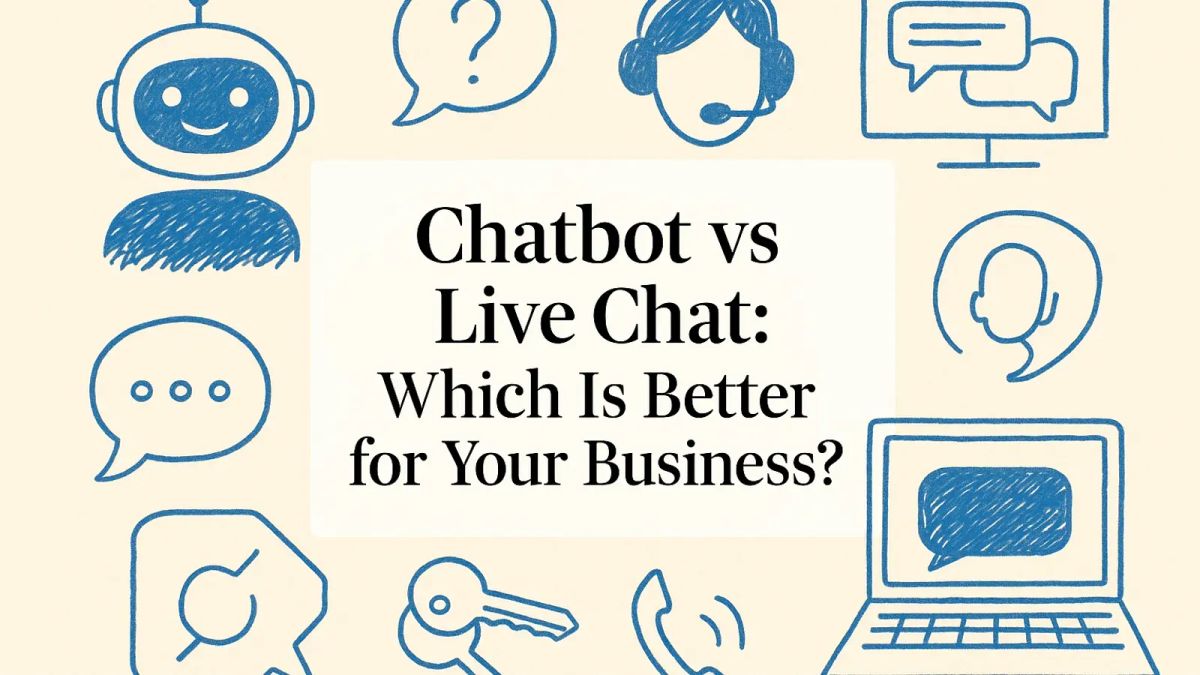
Chatbot vs Live Chat: Which Is Better for Your Business?
AI chatbots handle the volume with 24/7 instant responses. Live chat brings the human touch. The best strategy? Use both. Here's how to decide.
If you're trying to decide between an AI chatbot and live chat for your website, here's the short answer: you probably need both. AI chatbots handle the volume — instant responses, 24/7 availability, and consistent answers to common questions. Live chat brings the human touch — empathy, complex problem-solving, and the ability to read between the lines. The best customer support strategies in 2026 combine both into a seamless experience where the chatbot handles the first wave and escalates to a human agent when needed.
TL;DR — Chatbot vs Live Chat at a Glance
- AI chatbots are best for: 24/7 availability, handling high volumes, answering FAQs, reducing costs, and qualifying leads automatically
- Live chat is best for: complex issues, emotionally sensitive situations, high-value sales conversations, and building personal relationships
- The winning move: Use both together — let the chatbot handle routine queries and hand off to live agents for everything else
- Platforms like FastBots.ai offer both AI chatbot and live chat handover in a single solution, starting from $39/month
What Exactly Is an AI Chatbot?
An AI chatbot is software that uses artificial intelligence — specifically natural language processing (NLP) and large language models (LLMs) — to understand and respond to customer messages automatically. Unlike the clunky rule-based chatbots of five years ago, modern AI chatbots can understand context, handle follow-up questions, and provide genuinely helpful answers based on your business data.
How Modern AI Chatbots Work
Today's AI chatbots use a technique called retrieval-augmented generation (RAG). In plain terms, this means the chatbot searches through your specific business content — your website pages, help articles, product documentation, PDFs — and uses that information to generate accurate, contextual answers.
This is fundamentally different from older chatbots that relied on pre-written decision trees. A RAG-powered chatbot can answer questions it's never been specifically programmed for, as long as the answer exists somewhere in your training data.
What AI Chatbots Can Do Today
Modern AI chatbots go well beyond simple FAQ responses:
- Answer complex, multi-part questions by pulling information from multiple sources
- Support 95+ languages automatically, without separate language configurations
- Operate across channels — your website, WhatsApp, Telegram, Slack, Facebook, and Instagram
- Qualify leads by asking the right questions and collecting contact details
- Hand off to human agents when the conversation requires a personal touch
- Learn from your data — train on your website, documents, spreadsheets, and even YouTube videos
The gap between what an AI chatbot and a human agent can handle has narrowed dramatically. But it hasn't closed entirely — which is exactly why the chatbot vs live chat debate still matters.
What Is Live Chat?
Live chat is real-time, text-based communication between a customer and a human agent through a chat widget on your website or app. It's been around since the early 2000s, but it's evolved considerably — modern live chat platforms include features like co-browsing, screen sharing, canned responses, and integration with CRM systems.
The Human Element
The core advantage of live chat is simple: there's a real person on the other end. That person can:
- Read emotional cues in how a customer writes and respond with appropriate empathy
- Make judgement calls about discounts, exceptions, or creative solutions
- Build genuine rapport that turns a frustrated customer into a loyal one
- Handle truly unique situations that no amount of training data could anticipate
The Limitations
But live chat also comes with inherent constraints that no amount of technology can fully solve:
- Availability is limited — you need agents online, which typically means business hours only (unless you're paying for 24/7 staffing)
- Each agent handles 2-4 conversations simultaneously at most, creating capacity ceilings
- Response times vary depending on queue depth and agent workload
- Quality is inconsistent — it depends on the individual agent's knowledge, mood, and training
- It's expensive — a full-time customer support agent in the UK costs £25,000-£35,000+ per year, and you need multiple agents to cover a full schedule

AI Chatbot vs Live Chat: A Detailed Comparison
Let's break this down across the metrics that actually matter for your business.
Availability and Response Time
AI Chatbot: Available 24 hours a day, 7 days a week, 365 days a year. Response time is instant — typically under 2 seconds. Doesn't take breaks, doesn't call in sick, and handles Monday morning spikes exactly the same as a quiet Wednesday afternoon.
Live Chat: Available only when agents are online. Most businesses offer live chat during business hours (typically 9am-6pm). Outside those hours, customers either wait or get no response at all. During peak times, wait times can stretch to 5-15 minutes — and according to Forrester, 53% of customers will abandon a purchase if they can't get quick answers.
Verdict: Chatbot wins decisively. If a customer has a question at 11pm on a Saturday, an AI chatbot answers it. Live chat leaves them waiting until Monday.
Handling Volume and Scalability
AI Chatbot: Can handle thousands of simultaneous conversations without any degradation in speed or quality. Whether you have 10 visitors or 10,000, every single one gets an instant response.
Live Chat: Each human agent typically handles 2-4 conversations at once. To scale, you need to hire more agents — which takes time and money. Seasonal spikes (Black Friday, product launches) can overwhelm your team.
Verdict: Chatbot wins. Scalability is essentially unlimited, and you don't need to predict demand months in advance to staff accordingly.
Quality of Responses
AI Chatbot: Consistently accurate for questions that fall within its training data. Every customer gets the same correct answer to "What's your refund policy?" — no interpretation differences, no bad days. However, chatbots can struggle with ambiguous questions, sarcasm, or highly specific situations they haven't been trained on.
Live Chat: Variable quality depending on the agent. A great agent can provide a wonderful experience; a new or poorly trained agent can provide a terrible one. But for complex, nuanced situations — a billing dispute, a technical problem requiring troubleshooting, or a customer who's genuinely upset — a skilled human agent is far better than any chatbot.
Verdict: Depends on the query. For straightforward questions, chatbots are more consistent. For complex or emotional situations, humans are irreplaceable.
Cost Efficiency
This is where the numbers tell a compelling story.
AI Chatbot costs:
- Platforms like FastBots.ai start at $39/month (Essential plan) with 2,000 messages included
- The Business plan at $89/month includes 5,000 messages and multiple chatbots
- Even the Premium plan at $199/month with 10,000 messages costs less than a single part-time agent
Live chat agent costs:
- A single full-time support agent in the UK: £25,000-£35,000/year (roughly $32,000-$45,000)
- In the US: $35,000-$50,000/year
- Plus benefits, training, management overhead, and technology costs
- And you need multiple agents to provide reasonable coverage hours
The maths is straightforward: An AI chatbot can handle 80% of customer queries for a fraction of the cost of a single agent. For a small business handling 100 enquiries a day, an AI chatbot could save £50,000+ per year compared to staffing live agents around the clock.
Verdict: Chatbot wins on pure cost. But the real value comes from using chatbots to handle the bulk of queries while reserving human agents for the conversations that genuinely need them.
Customer Satisfaction
This is where it gets interesting — because the data isn't as one-sided as you might expect.
Research from Gartner suggests that by 2027, self-service and chat (both AI and human) will surpass traditional channels like phone and email as the top customer service technologies. Customers increasingly prefer text-based channels because they're convenient, asynchronous, and don't require being put on hold.
However, satisfaction varies by context:
- For simple queries (order status, opening hours, product information): customers are satisfied with AI chatbots, often preferring them because the answer is instant
- For complex issues (billing disputes, technical problems, complaints): customers strongly prefer human agents — according to a PwC study, 82% of consumers want more human interaction in future customer service
- For emotional situations (service failures, urgent problems): nothing replaces human empathy
Verdict: Draw — but only if you get the escalation right. The key is ensuring your chatbot knows when to hand off to a human, and that the handoff is seamless.
Personalisation
AI Chatbot: Can be personalised through training data and custom prompts. You can set the tone, personality, and knowledge base. Some platforms allow chatbots to greet returning visitors by name, remember previous conversations, and tailor responses based on the page the customer is browsing.
Live Chat: Agents can access CRM data, order history, and previous conversation notes to personalise their responses. A great agent makes the customer feel known and valued in a way that feels organic rather than scripted.
Verdict: Both can personalise effectively, but in different ways. Chatbots personalise at scale; humans personalise with depth.
When to Use an AI Chatbot (and When Not To)
AI Chatbots Excel At:
- Answering frequently asked questions — pricing, shipping, returns, product specs
- Providing 24/7 first-response coverage so no customer inquiry goes unanswered
- Qualifying and capturing leads — asking the right questions, collecting email addresses, routing prospects to sales
- Handling multi-channel support — the same chatbot can work on your website, WhatsApp, Instagram, and more
- Deflecting simple tickets so your human agents can focus on high-value conversations
- Onboarding new customers — guiding them through setup, features, and getting started
- Supporting international customers in their own language without hiring multilingual agents
AI Chatbots Struggle With:
- Emotionally charged conversations where the customer needs to feel heard, not just answered
- Complex multi-step troubleshooting that requires creative problem-solving
- Situations requiring judgement calls — approving refunds, making exceptions, offering deals
- Highly ambiguous requests where the customer can't clearly articulate what they need
- Brand-sensitive interactions where a wrong tone could cause reputational damage
When to Use Live Chat (and When Not To)
Live Chat Excels At:
- High-value sales conversations — a human agent can close a deal that a chatbot might lose
- Complex technical support requiring back-and-forth troubleshooting
- Complaint resolution where empathy and authority to make decisions are crucial
- VIP customer service for your most valuable accounts
- Situations requiring creativity — finding workarounds, suggesting alternatives, thinking outside the box
Live Chat Struggles With:
- High volumes of repetitive queries — agents get bored and response quality drops
- After-hours coverage without expensive overnight staffing
- Consistency — different agents give different answers to the same question
- Scaling quickly — you can't instantly hire and train 20 new agents for a product launch
- Cost control — every conversation has a direct labour cost attached
The Hybrid Approach: Why "Both" Is the Right Answer
Here's the thing: framing this as chatbot versus live chat is a false dichotomy. The most effective customer support operations in 2026 use both — and the results speak for themselves.
How a Hybrid System Works
- Customer initiates a conversation through your website widget, WhatsApp, or other channel
- The AI chatbot responds instantly, answering the query from your knowledge base
- If the chatbot can resolve the issue (and it will, for 60-80% of queries), the customer gets their answer in seconds
- If the query is complex or the customer asks for a human, the chatbot seamlessly hands the conversation to a live agent — including the full context of what's been discussed
- The human agent picks up where the chatbot left off, already knowing what the customer needs
This eliminates the worst aspects of both systems: the chatbot handles volume and availability, while humans handle complexity and empathy.
Real Benefits of the Hybrid Model
- Faster resolution times — simple queries are resolved instantly, and agents aren't slowed down by repetitive questions
- Lower costs — you need fewer agents because the chatbot handles the majority of conversations
- Higher customer satisfaction — customers get instant answers for simple queries and human help for complex ones
- Better agent experience — support agents focus on meaningful work instead of answering "What are your opening hours?" for the hundredth time
- 24/7 coverage — the chatbot never sleeps, and agents handle the complex issues during business hours
What This Looks Like in Practice
A mid-size e-commerce business might receive 200 customer enquiries per day. Without a chatbot, that requires 4-5 live chat agents working in shifts. With a hybrid approach:
- The AI chatbot handles 150 of those enquiries (75%) autonomously
- 50 enquiries are escalated to human agents
- The business now needs 1-2 agents instead of 4-5
- Estimated annual saving: £60,000-£90,000
And the customers? They're happier too, because simple questions get instant answers instead of sitting in a queue.
How to Implement a Hybrid Chatbot + Live Chat System
Step 1: Audit Your Current Support Volume
Before implementing anything, understand what your customers actually ask about. Pull data from your existing support channels:
- What are the top 20 most common questions?
- What percentage could be answered from existing documentation?
- Which queries genuinely require human judgement?
Most businesses find that 60-80% of their enquiries are repetitive and could be handled by a well-trained AI chatbot.
Step 2: Choose the Right Platform
Look for a platform that offers both AI chatbot and live chat handover in a single solution. Key features to prioritise:
- Custom training on your data — the chatbot should learn from your website, documents, and FAQs, not just generic AI knowledge
- Multi-channel deployment — website, WhatsApp, social media
- Seamless human handover — with full conversation context passed to the agent
- Analytics and insights — understand what the chatbot handles well and where it struggles
- Easy setup — you shouldn't need a developer to get started
FastBots.ai ticks all of these boxes. You can train a chatbot on your own data in minutes, deploy it across multiple channels, and enable live chat handover when needed — all from $39/month.
Step 3: Train Your Chatbot Thoroughly
The quality of your AI chatbot depends entirely on the quality of its training data. Upload:
- Your complete website content (FastBots can crawl your entire site automatically)
- Help centre articles and FAQs
- Product documentation and specifications
- Pricing information
- Returns and shipping policies
- Any PDFs, spreadsheets, or documents that contain information customers ask about
The more comprehensive your training data, the fewer conversations need to be escalated to human agents.
Step 4: Define Clear Escalation Rules
Set up your chatbot to hand off to a human agent when:
- The customer explicitly asks for a human
- The chatbot's confidence in its answer drops below a certain threshold
- The conversation involves a complaint or negative sentiment
- The query relates to billing, refunds, or account-specific issues
- The chatbot has failed to resolve the query after 2-3 attempts
Step 5: Monitor, Analyse, and Improve
After launch, regularly review:
- Chatbot resolution rate — what percentage of conversations does the chatbot fully resolve?
- Escalation reasons — why are conversations being handed to humans? Can you add training data to reduce these?
- Customer satisfaction scores — are customers happy with the chatbot experience?
- Agent workload — how much time are agents saving?
Continuous improvement is key. Each month, identify the top 10 queries being escalated unnecessarily and add better training data to handle them.
Chatbot vs Live Chat: Industry-Specific Considerations
E-Commerce and Retail
Best approach: AI chatbot for order tracking, product questions, and return policies. Live chat for sizing advice, complex returns, and VIP customers.
E-commerce businesses benefit enormously from chatbots because the same questions come up constantly: "Where's my order?", "What's your return policy?", "Do you ship to [country]?". A chatbot handles these instantly, while live agents focus on high-value conversations that actually drive revenue.
SaaS and Technology
Best approach: AI chatbot for onboarding guidance, feature questions, and basic troubleshooting. Live chat for technical support, enterprise sales, and account issues.
For SaaS companies, chatbots are particularly powerful for reducing churn — they can proactively help users who seem stuck, answer "how do I..." questions instantly, and guide new customers through setup.
Healthcare
Best approach: AI chatbot for appointment booking, opening hours, general health information, and insurance queries. Live chat for clinical questions, patient concerns, and sensitive health matters.
Healthcare providers need to be careful about the boundary between information and advice. Chatbots should clearly state they're providing general information, not medical advice, and escalate clinical questions to qualified staff.
Financial Services
Best approach: AI chatbot for account enquiries, product information, and application status. Live chat for fraud concerns, complex financial advice, and complaints.
Banks and financial institutions use chatbots extensively for routine queries but must ensure sensitive conversations about money are handled by trained humans with appropriate authority.
Professional Services
Best approach: AI chatbot for service descriptions, pricing enquiries, and booking consultations. Live chat for scoping projects, discussing requirements, and building client relationships.
For agencies, consultancies, and professional service firms, the chatbot handles the top of the funnel while humans close the deals.
Common Mistakes to Avoid
Mistake 1: Deploying a Chatbot Without Proper Training Data
An AI chatbot is only as good as the information it's trained on. If you feed it a thin FAQ page and expect it to handle complex product questions, customers will quickly become frustrated. Invest time in comprehensive training data before launch.
Mistake 2: Making It Hard to Reach a Human
Nothing frustrates customers more than being trapped in a chatbot loop with no escape. Always provide a clear, easy way to reach a human agent. Customers should never feel like you're hiding behind automation to avoid talking to them.
Mistake 3: Using Live Chat Without After-Hours Coverage
If your live chat widget shows "We're offline" for 16 hours a day, you're missing most of your potential conversations. An AI chatbot fills this gap perfectly — capturing leads and answering questions even when your team is asleep.
Mistake 4: Treating Them as Separate Systems
The power of the hybrid approach comes from integration. Your chatbot and live chat should share the same platform, the same conversation history, and the same customer data. When an agent takes over from a chatbot, they should see everything that was discussed — not start from scratch.
Mistake 5: Setting and Forgetting
Both chatbots and live chat need ongoing optimisation. Review conversations regularly, identify gaps in your chatbot's knowledge, retrain agents on common issues, and continuously improve the customer experience.
The Future of Chatbot and Live Chat
The line between AI chatbots and live chat is blurring rapidly. Here's where things are heading:
- AI-assisted agents — chatbots will increasingly work alongside human agents, suggesting responses, pulling up relevant information, and handling the research while the human focuses on communication
- Emotional intelligence — AI chatbots are getting better at detecting sentiment and adjusting their tone accordingly, though they're still far from matching human empathy
- Voice and video integration — text-based chat (both AI and human) will integrate with voice and video channels for a truly omnichannel experience
- Proactive engagement — chatbots will initiate conversations based on customer behaviour (e.g., "I noticed you've been on the pricing page for a while — can I help?")
- Hyper-personalisation — as AI models improve, chatbots will deliver increasingly tailored experiences based on customer history, preferences, and behaviour
The businesses that thrive will be those that view AI chatbots and live chat not as competing technologies, but as complementary tools in a unified customer experience strategy.
Frequently Asked Questions
Is a chatbot better than live chat?
Neither is universally better — it depends on the situation. AI chatbots are better for 24/7 availability, handling high volumes, and answering common questions instantly. Live chat is better for complex issues, emotional situations, and high-value sales conversations. Most businesses get the best results by using both together in a hybrid approach.
Can an AI chatbot fully replace live chat agents?
Not yet, and probably not for a long time. While AI chatbots can handle 60-80% of customer enquiries autonomously, there will always be situations that require human empathy, judgement, and creative problem-solving. The goal isn't to replace agents — it's to free them from repetitive work so they can focus on conversations that genuinely need a human touch.
How much does an AI chatbot cost compared to live chat?
AI chatbot platforms typically cost between $39-$399 per month depending on usage and features. A single full-time live chat agent costs $35,000-$50,000+ per year in the US, or £25,000-£35,000+ in the UK. For most businesses, an AI chatbot handling the majority of queries plus 1-2 human agents for complex issues is far more cost-effective than a full team of live agents.
What is live chat handover and why does it matter?
Live chat handover is when an AI chatbot seamlessly transfers a conversation to a human agent, passing along the full context of what's been discussed. This matters because it eliminates the frustration of customers having to repeat themselves. Good handover means the agent knows exactly what the customer needs before they type a single word.
How do I know if my business needs a chatbot, live chat, or both?
Consider your support volume and complexity. If you receive more than 20 customer enquiries per day and many are repetitive (FAQs, order status, product questions), you'll benefit from an AI chatbot. If you handle complex sales, technical support, or sensitive customer issues, you need live chat too. Most businesses with any significant customer interaction should use both.
Do customers prefer talking to chatbots or humans?
It depends on the situation. For quick, straightforward queries, many customers actually prefer chatbots because the response is instant — no waiting in a queue. For complex or frustrating issues, customers overwhelmingly prefer human agents. The key insight: customers don't care whether they're talking to AI or a human, they care about getting their problem solved quickly and effectively.
Can I use an AI chatbot on WhatsApp and other messaging platforms?
Yes. Modern chatbot platforms like FastBots.ai support deployment across multiple channels including websites, WhatsApp, Telegram, Slack, Facebook Messenger, and Instagram. The same chatbot, trained on the same data, works across all channels — so customers get consistent answers regardless of how they reach you.
How long does it take to set up an AI chatbot?
With modern no-code platforms, you can have a functional AI chatbot live on your website in under 10 minutes. The chatbot automatically crawls your website to build its knowledge base. More comprehensive training — uploading documents, refining responses, and setting up multi-channel deployment — might take a few hours. Compare that to the weeks or months needed to hire and train live chat agents.
Making Your Decision
The chatbot vs live chat debate isn't really a debate at all — it's a false choice. The question isn't which one to use, but how to combine them effectively.
Start with an AI chatbot to handle the volume and provide 24/7 coverage. Add live chat handover for the conversations that need a human touch. Monitor, optimise, and continuously improve.
If you're ready to implement a hybrid approach, FastBots.ai makes it straightforward. Train a chatbot on your own data in minutes, deploy across your website and messaging channels, and enable seamless live chat handover — all from a single platform. Start your free trial today and see how many of your customer queries can be resolved instantly.