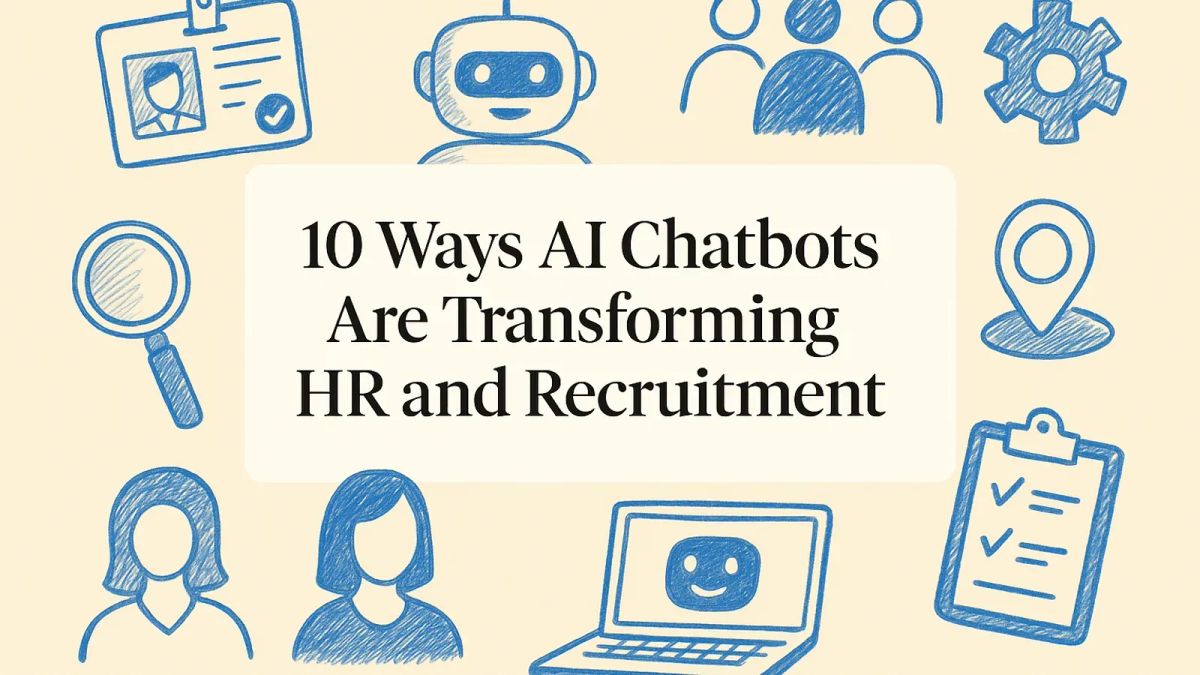
10 Ways AI Chatbots Are Transforming HR and Recruitment
AI chatbots automate the repetitive side of HR — screening candidates, scheduling interviews, answering policy questions, and onboarding new hires. Here are 10 practical ways they transform HR operations.
If you're an HR professional drowning in repetitive admin tasks — screening hundreds of CVs, answering the same benefits questions for the twentieth time this week, or chasing candidates to schedule interviews — an AI chatbot might be exactly what your department needs.
HR chatbots aren't some futuristic concept. They're already handling up to 90% of initial candidate enquiries at companies worldwide, cutting time-to-hire by 30–50%, and freeing up HR teams to focus on the work that actually requires a human touch: building relationships, making hiring decisions, and shaping company culture.
In this guide, we'll walk through ten practical ways AI chatbots are transforming HR and recruitment right now, with real-world examples and actionable steps you can take today. Whether you're a small business with a one-person HR team or a large enterprise processing thousands of applications, there's something here for you.
TL;DR: AI chatbots automate the repetitive side of HR — screening candidates, scheduling interviews, answering policy questions, and onboarding new hires. They work 24/7, respond instantly, and free your HR team to focus on strategic, people-centred work. Platforms like FastBots.ai let you build one trained on your own HR documents in minutes, with no coding required.
1. Automated Candidate Screening and Pre-Qualification
The average corporate job posting attracts around 250 applications, according to Glassdoor. For HR teams, that means hours spent sifting through CVs before a single meaningful conversation happens.
An AI chatbot changes this by engaging every applicant immediately. It asks pre-set screening questions — years of experience, required certifications, availability, salary expectations — and scores or ranks candidates based on their responses. Qualified candidates move forward instantly; those who don't meet the criteria receive a polite, personalised rejection rather than weeks of silence.
How It Works in Practice
- Define your must-have criteria — minimum qualifications, location requirements, right-to-work status
- Set up screening questions — the chatbot asks these conversationally, not like a form
- Auto-rank responses — candidates who meet all criteria get flagged for recruiter review
- Instant feedback — every candidate knows where they stand, improving your employer brand
Why This Matters
SHRM (Society for Human Resource Management) reports that the average cost-per-hire is over $4,700. A significant chunk of that cost sits in the screening phase. By automating initial qualification, you're not just saving time — you're reducing cost-per-hire and ensuring no qualified candidate slips through the cracks because a recruiter was overwhelmed.
Actionable Takeaway:
- Audit your current screening process — how many hours per week does your team spend on initial CV reviews?
- List the five non-negotiable criteria for your most common roles
- Set up a chatbot trained on your job descriptions and screening criteria using a platform like FastBots.ai
2. 24/7 Candidate Engagement and Support
Here's the thing about job seekers: they don't just browse during office hours. Research from Indeed shows that job search activity peaks between 6 PM and midnight — precisely when your HR team has gone home.
An AI chatbot fills this gap completely. It answers candidate questions about the role, company culture, benefits, application status, and next steps at any hour of the day. No more "we'll get back to you within 3–5 business days" — candidates get answers in seconds.
What Candidates Actually Ask
Based on data from HR technology platforms, the most common candidate questions fall into predictable categories:
- Role-specific: "What does a typical day look like?" "Is this role remote?"
- Process-related: "When will I hear back?" "How many interview rounds are there?"
- Benefits and culture: "What's the parental leave policy?" "Do you offer flexible working?"
- Logistics: "Where is the office?" "Is there parking?"
A chatbot trained on your company's HR documents, job descriptions, and employee handbook can handle all of these without human intervention.
The Candidate Experience Impact
According to a Talent Board study, 82% of candidates expect an immediate response when they have a question about a role. Companies that provide this kind of responsiveness see measurably higher offer acceptance rates — candidates simply feel more valued when they're not left waiting.
Actionable Takeaway:
- Upload your employee handbook, benefits summary, and top 10 job descriptions to your chatbot's knowledge base
- Add your chatbot to your careers page so candidates can ask questions before, during, and after applying
- Monitor the most common questions in chat logs to identify information gaps on your careers site

3. Interview Scheduling That Actually Works
Interview scheduling is one of those tasks that seems simple but devours an absurd amount of time. Coordinating availability between a candidate, a hiring manager, and possibly a panel of interviewers involves endless back-and-forth emails that can stretch over days.
AI chatbots with calendar integration solve this by letting candidates self-schedule. The chatbot checks interviewer availability in real time, presents available slots, and books the meeting — all within the same conversation where the candidate was just pre-screened.
The Numbers
Scheduling automation alone can reduce recruiter admin time by up to 75% in high-volume hiring programmes, according to HR technology research. For a team scheduling 50 interviews per week, that's the difference between spending 25 hours on logistics and spending just 6.
How to Set It Up
- Connect your calendar — Google Calendar, Outlook, or any system with API access
- Define availability windows — when are interviewers free? Build in buffer time
- Automate reminders — the chatbot sends confirmation and reminder messages to both parties
- Handle rescheduling — candidates can reschedule through the chatbot without emailing HR
Tools like FastBots.ai integrate with over 8,000 apps via Zapier, making calendar connections straightforward even without technical expertise.
Actionable Takeaway:
- Calculate how many hours your team spends on interview scheduling per month
- Set up a chatbot with calendar integration for your highest-volume roles first
- Track no-show rates before and after — automated reminders typically reduce them by 20–30%
4. Employee Onboarding and Pre-boarding
The first 90 days of employment are critical. Gallup research shows that only 12% of employees strongly agree their organisation does a great job onboarding new hires. That's a problem, because poor onboarding is directly linked to higher turnover.
An AI chatbot transforms onboarding from a one-off event into an ongoing, accessible experience. New hires can ask questions about everything from "Where do I find the expense policy?" to "How do I set up my email?" without feeling like they're bothering their manager or HR.
Pre-boarding (Before Day One)
- Welcome message and introduction — the chatbot greets new hires and walks them through what to expect
- Document collection — prompts for tax forms, ID verification, bank details
- IT setup — guides on requesting equipment, accessing systems, downloading required software
- Culture preview — shares team introductions, company values, and first-week agenda
Ongoing Onboarding Support
- Policy questions — "What's the dress code?" "How many holiday days do I have?"
- Process guidance — "How do I book annual leave?" "Who approves my expenses?"
- Training reminders — nudges new hires to complete required modules
- 30/60/90-day check-ins — automated pulse surveys to catch issues early
Making It Personal
The best onboarding chatbots don't feel like they're reading from a script. When you train them on your actual employee handbook, internal wiki, and company policies, they answer in natural language that reflects your organisation's tone. A new hire at a creative agency should get a different vibe than one at a law firm — and a well-configured chatbot delivers exactly that.
Actionable Takeaway:
- Map your current onboarding journey — what questions do new hires ask most in their first week?
- Upload your employee handbook, IT setup guides, and HR policies to your chatbot
- Create a dedicated onboarding channel (e.g., via Slack integration) where new hires can ask the chatbot anything

5. HR Policy and Benefits FAQ Automation
How much time does your HR team spend answering the same questions? "How much annual leave do I get?" "What's the sick pay policy?" "Can I work from home on Fridays?"
According to research from ServiceNow, HR teams spend up to 50% of their time on repetitive enquiries that could easily be automated. That's not a good use of a skilled HR professional's time — and it's frustrating for employees who have to wait for a response to what should be a simple question.
What a Policy Chatbot Handles
- Leave policies — annual leave entitlement, sick leave, parental leave, carers' leave
- Benefits information — health insurance details, pension contributions, wellness programmes
- Payroll queries — "When do I get paid?" "How do I update my bank details?"
- Workplace policies — remote working, dress code, grievance procedures, expenses
- Compliance — data protection, whistleblowing procedures, code of conduct
The Employee Experience Angle
Employees don't want to email HR and wait two days for an answer to a simple question. They want the same instant, conversational experience they get from consumer chatbots. An internal HR chatbot delivers this — and it does it consistently, without variation in the quality or accuracy of the answer.
This is particularly valuable for organisations with multiple locations or a distributed workforce. Whether an employee is in London, Lagos, or Los Angeles, they get the same accurate, instant response.
Actionable Takeaway:
- Pull your top 20 most-asked HR questions from email/ticket data
- Upload your complete policy documents to the chatbot's knowledge base
- Deploy the chatbot on your intranet or internal communication tools like Slack or Microsoft Teams
6. Internal Knowledge Management and Training Support
Beyond HR policies, chatbots are increasingly being used as internal knowledge assistants. Think of them as a search engine for your organisation — but one that actually understands context and gives direct answers instead of a list of documents.
Use Cases
- Training material access — "Where's the onboarding video for the CRM system?"
- Process documentation — "What's the approval workflow for purchase orders over £5,000?"
- Compliance training — automated reminders and quick quizzes to reinforce learning
- Skills development — recommending relevant courses or resources based on an employee's role
Why Traditional Intranets Fall Short
Most company intranets are graveyards of outdated documents that nobody can find. A chatbot trained on the same content makes it searchable in natural language. Instead of navigating five levels of a SharePoint folder structure, an employee just asks: "What's our data retention policy for customer records?"
FastBots lets you train a chatbot on your entire website, documents (PDF, DOC, CSV, XLS), Google Sheets, and even YouTube videos. That means your training content, policy documents, and internal resources can all live in one conversational interface.
Actionable Takeaway:
- Identify the three internal knowledge areas where employees waste the most time searching
- Upload those documents to an AI chatbot and deploy it internally
- Track usage — which questions come up most often? Those are candidates for better documentation
7. Diversity, Equity, and Inclusion in Hiring
One of the most compelling arguments for AI chatbots in recruitment is their potential to reduce unconscious bias in the early stages of hiring.
Human recruiters — no matter how well-intentioned — are susceptible to bias. A University of Chicago study found that resumes with traditionally white-sounding names received 50% more callbacks than identical resumes with Black-sounding names. That's a real problem, and it persists even with bias training.
How Chatbots Help
- Consistent screening criteria — every candidate is asked the same questions in the same order
- Blind evaluation — the chatbot can assess responses without seeing names, photos, or demographic information
- Structured data — decisions are based on answers to specific competency questions, not gut feelings
- Audit trail — every interaction is logged, making it easy to review for fairness
Important Caveats
AI is not inherently unbiased. If your training data or screening criteria embed existing biases, the chatbot will reproduce them. The key is to:
- Regularly audit your screening questions for potential bias
- Use competency-based criteria rather than proxy indicators (like university prestige)
- Combine chatbot screening with human review for final decisions
- Be transparent with candidates about how AI is used in your process
This is an area where getting it right matters enormously — both ethically and legally, especially with emerging AI regulations like the EU AI Act.
Actionable Takeaway:
- Review your current screening questions — are they genuinely job-relevant, or do they introduce bias?
- Configure your chatbot to evaluate based on competencies and qualifications only
- Establish a regular bias audit process for your AI screening tools
8. Exit Interviews and Employee Feedback
Exit interviews are goldmines of honest feedback — but they're often poorly conducted, inconsistently carried out, or skipped entirely because HR is too busy.
An AI chatbot can conduct exit interviews at scale, ensuring every departing employee has the opportunity to share feedback. And because people are often more honest with a chatbot than with a human HR representative (they don't worry about burning bridges), the data you collect tends to be more candid.
What an Exit Interview Chatbot Covers
- Reason for leaving — compensation, management, career growth, culture
- Experience summary — what worked well, what didn't
- Suggestions — what would they change?
- Would they return? — a key indicator of employer brand health
- Referral willingness — would they recommend the company to others?
Beyond Exit Interviews
The same approach works for ongoing employee engagement surveys, pulse checks, and anonymous feedback collection. A chatbot deployed on WhatsApp or Telegram makes it easy for employees to share feedback from anywhere, on any device.
Actionable Takeaway:
- Design a structured exit interview questionnaire with 10–15 questions
- Train a chatbot on these questions and deploy it for all departing employees
- Analyse trends quarterly — if "management" consistently appears as a reason for leaving, that's a signal you can't ignore
9. Compliance and Legal Document Assistance
HR teams are responsible for ensuring employees understand and comply with a growing web of regulations — from GDPR and data protection to health and safety, anti-harassment policies, and industry-specific compliance requirements.
An AI chatbot serves as an always-available compliance resource. Employees can ask questions like "Do I need to complete GDPR training?" or "What's our policy on accepting gifts from vendors?" and get an accurate, sourced answer immediately.
Compliance Training Automation
- Deadline reminders — "Your fire safety training expires in 7 days"
- Quick knowledge checks — short quiz questions to reinforce key compliance points
- Document access — instant links to relevant policies and procedures
- Escalation — complex queries automatically routed to the legal or compliance team
Reducing Risk
Every unanswered compliance question is a potential risk. If an employee doesn't know the correct data handling procedure, they might make an error that leads to a regulatory fine. A chatbot that's always available, always accurate, and always up-to-date with the latest policies significantly reduces this risk.
Actionable Takeaway:
- Upload all compliance-related documents to your chatbot's knowledge base
- Set up automated reminders for training deadlines and policy acknowledgements
- Review chat logs for compliance questions that indicate gaps in employee understanding
10. Scalable Recruitment for High-Volume Hiring
If you're hiring for seasonal roles, opening a new location, or scaling rapidly, the maths changes dramatically. Processing 5,000 applications with a three-person HR team is physically impossible without automation.
This is where chatbots truly shine. They can engage every single applicant simultaneously — screening, answering questions, scheduling interviews, and managing communications — without any increase in headcount.
Real-World Scale
Consider a retail chain hiring 2,000 seasonal workers across 50 locations. Without a chatbot, each location's manager is fielding calls, reviewing applications, and scheduling interviews on top of their regular duties. With a chatbot:
- Applications are pre-screened automatically against role-specific criteria
- Qualified candidates self-schedule interviews within minutes of applying
- Location-specific questions (parking, uniform, shift patterns) are answered instantly
- Managers receive only pre-qualified candidates, ready for a brief final interview
The Cost Equation
At an average cost-per-hire of $4,700 (SHRM), even a 20% reduction through chatbot automation saves $940 per hire. Across 2,000 hires, that's $1.88 million. Even with more conservative estimates, the ROI is substantial.
Platforms like FastBots.ai offer plans starting from free (50 messages/month) up to Agency plans at $299/month, making it accessible for organisations of all sizes. The Business plan at $69/month includes 5 chatbots and 5,000 messages — enough for most mid-sized recruitment operations.
Actionable Takeaway:
- Identify your highest-volume hiring periods and roles
- Calculate your current cost-per-hire for these roles
- Run a pilot with a chatbot handling initial screening for one high-volume role, then measure the time and cost savings
How to Get Started with an HR Chatbot
You don't need an enterprise budget or a team of developers to deploy an AI chatbot for HR. Modern no-code platforms make it remarkably straightforward.
Step 1: Choose Your First Use Case
Don't try to automate everything at once. Pick the area where your HR team spends the most time on repetitive work — usually candidate screening or internal policy FAQs.
Step 2: Gather Your Knowledge Sources
Pull together the documents your chatbot needs to learn from:
- Job descriptions and person specifications
- Employee handbook and HR policies
- Benefits guides and payroll information
- Onboarding checklists and training materials
Step 3: Build and Train Your Chatbot
With FastBots.ai, you can upload these documents directly (PDF, DOC, CSV, or even entire websites via the crawler) and have a working chatbot in minutes. You can choose from multiple AI models including GPT-5, Claude 4 Sonnet, and Gemini 2.5 Pro, and customise the chatbot's personality and tone to match your organisation.
Step 4: Deploy Where Your People Are
The beauty of a multi-channel platform is that you can meet employees and candidates where they already are:
- Careers page — for candidate-facing recruitment chatbots
- Company intranet — for internal HR support
- Slack — for teams that live in Slack
- WhatsApp — for frontline workers or distributed teams
- Telegram — for international teams
Step 5: Monitor, Learn, and Improve
Check your chat history regularly. What questions are people asking? Where is the chatbot struggling? Use these insights to:
- Improve your knowledge base
- Identify gaps in your HR documentation
- Refine screening criteria based on actual candidate data
- Hand off complex queries to human HR staff via live chat
Frequently Asked Questions
Can an AI chatbot replace HR staff?
No — and it shouldn't try to. AI chatbots handle repetitive, time-consuming tasks like answering FAQs, screening candidates, and scheduling interviews. This frees HR professionals to focus on strategic work: employee relations, culture building, complex hiring decisions, and organisational development. Think of it as augmenting your team, not replacing it.
Is it legal to use AI in recruitment?
Yes, but with important caveats. Regulations like the EU AI Act and various US state laws (notably New York City's Local Law 144) require transparency about AI use in hiring and regular bias audits. Always inform candidates that AI is part of your process, ensure your screening criteria are job-relevant, and maintain human oversight for final hiring decisions.
How secure is employee data in an AI chatbot?
This depends entirely on the platform you choose. Look for SOC2 and GDPR compliance, data encryption, and clear data retention policies. FastBots.ai, for example, uses SOC2 and GDPR-compliant infrastructure with no credentials stored directly in code and secure OAuth2 mechanisms.
How much does an HR chatbot cost?
It varies widely. Enterprise solutions from vendors like Phenom or Eightfold can run into six figures annually. But no-code platforms like FastBots.ai start with a free plan (50 messages/month) and scale up — the Business plan at $69/month includes 5 chatbots and 5,000 messages, which is enough for many HR teams.
Can a chatbot handle sensitive HR conversations?
For straightforward policy questions and process guidance, absolutely. For sensitive matters like grievances, disciplinary issues, or mental health concerns, the chatbot should be configured to recognise these topics and escalate to a human HR professional immediately. FastBots.ai includes a live chat handover feature for exactly this purpose.
How long does it take to set up an HR chatbot?
With a no-code platform, you can have a basic chatbot running within an hour. Upload your HR documents, configure the chatbot's personality and tone, and deploy it on your chosen channels. Refining and optimising it based on real usage data typically takes 2–4 weeks.
Will candidates be put off by talking to a chatbot?
Research consistently shows the opposite. Candidates prefer instant responses over waiting days for an email. The key is transparency — let candidates know they're speaking with an AI assistant, and make it easy to reach a human when needed. A well-designed chatbot actually improves candidate experience scores.
Can the chatbot support multiple languages?
Yes. Platforms like FastBots.ai support 95 languages, which is particularly valuable for organisations hiring internationally or with a multilingual workforce. The chatbot can detect the candidate's preferred language and respond accordingly.
Start Transforming Your HR Operations Today
The HR teams getting the most value from AI chatbots aren't the ones with the biggest budgets — they're the ones who started with a single, well-defined use case and built from there.
Whether it's screening candidates while you sleep, answering the hundredth question about your parental leave policy, or ensuring every new hire has a consistent onboarding experience, an AI chatbot delivers measurable time and cost savings from day one.
FastBots.ai makes it easy to get started — upload your HR documents, choose your AI model, and deploy across your website, Slack, WhatsApp, or any channel your team uses. Start for free and see the difference it makes.