What is Natural Language Processing? A Beginner's Guide to How AI Understands Us

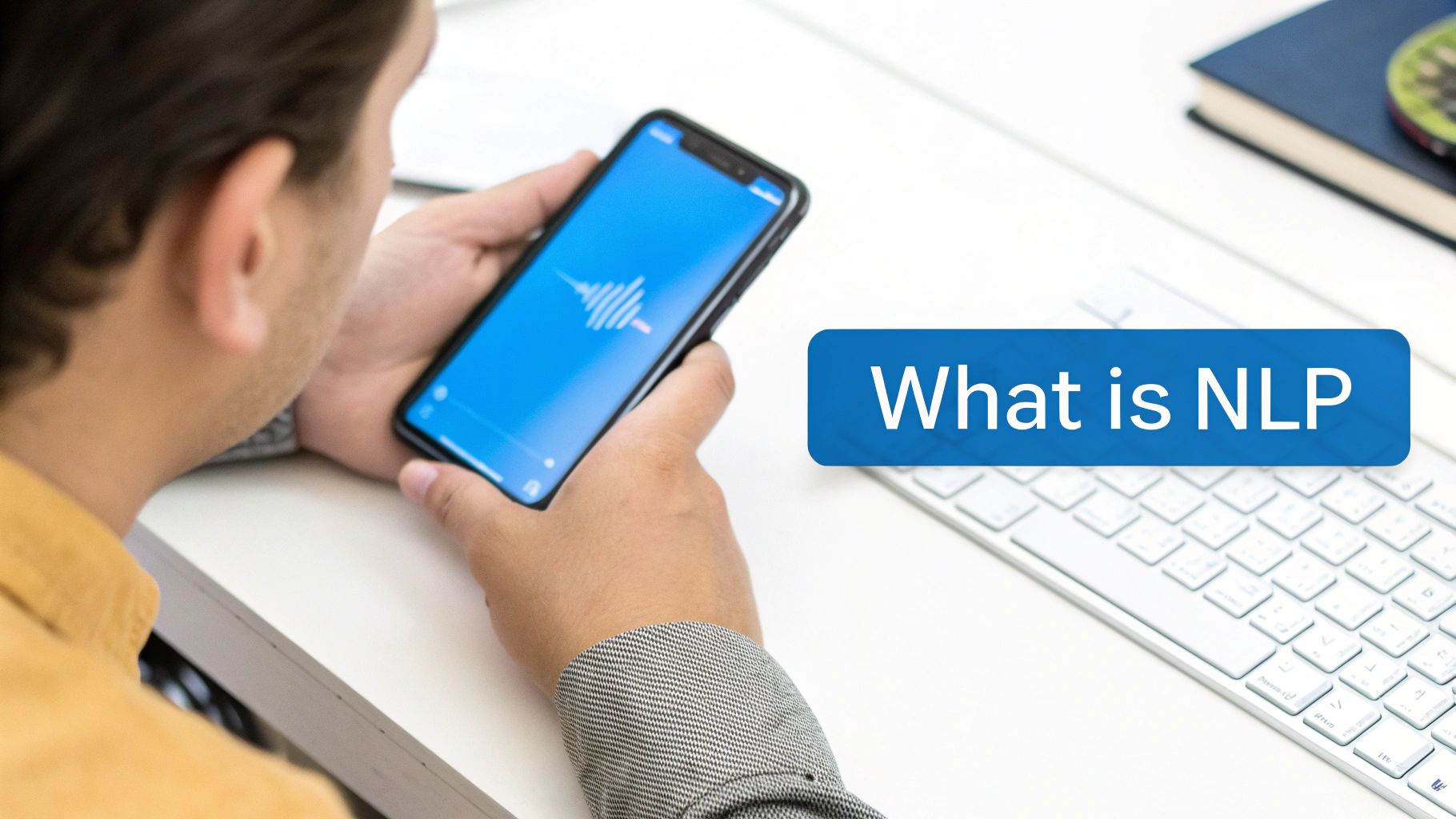
Have you ever wondered how your phone just gets what you're saying, or how a website can translate a whole page in a blink? You're seeing the magic of Natural Language Processing (NLP) at work.
In simple terms, NLP is a branch of artificial intelligence that gives computers the ability to understand, interpret, and generate human language. It's the bridge that closes the communication gap between us and our devices, making our interactions feel more natural and intuitive.
Why Natural Language Processing Matters
Beyond the textbook definition, you can think of NLP as teaching a computer to read, listen, and speak just like a person. Human language is messy. It’s full of slang, nuance, and context—all the stuff that computers traditionally stumble over. NLP gives us the tools to take our everyday communication and turn it into structured data that a machine can actually work with.
The real goal here is to make our interactions with technology feel more human. Instead of forcing you to learn a machine’s rigid command language, the machine learns yours. That fundamental shift is why you can ask your smart speaker about the weather, get a quick summary of a long article, or have a chatbot understand your customer service problem without you needing to type in specific keywords.
From Simple Words to Real Understanding
The engine behind modern NLP isn't just seeing words; it's about understanding the intent and sentiment behind them. This is all driven by huge leaps in machine learning and, more recently, massive neural networks.
You've probably heard of the powerhouses behind this shift. Many are powered by a Large Language Model (LLM), a special type of AI trained on mind-boggling amounts of text data. If you want to dive deeper, we have a whole guide explaining what a large language model is and how it makes sense of language. These models are what enable the sophisticated, human-like conversations we see in today's top AI tools.
This tech has officially moved out of the research lab and into our daily lives, changing how we deal with information. It's the silent workhorse behind a ton of applications you already use.
Core Capabilities: How Does NLP Actually Work?

When a computer "reads" a sentence, it doesn't see words or meaning—just a jumble of characters. The magic of NLP is in transforming that raw text into something structured and useful. This whole process is often called an "NLP pipeline," a series of steps where each one gets the computer a little closer to actual understanding.
Think about how you learned to read. First, you had to spot individual letters and string them together to make words. Then, you figured out how those words connect based on grammar rules. An NLP pipeline works in a surprisingly similar way.
The First Steps: Breaking Down Language
Before anything else can happen, an NLP system needs to break a sentence down into its smallest parts. This first step is called tokenization, and it’s basically just chopping up the text into individual words or "tokens." So, a sentence like "I need to reset my password" gets turned into six distinct tokens: "I," "need," "to," "reset," "my," and "password."
With the tokens ready, the system moves on to parsing. This is like a high-speed grammar check. The model examines the sentence’s structure to figure out the relationship between all the words. It pinpoints the subject, the verb, and the object, creating a sort of grammatical blueprint of the sentence.
Extracting Key Information
Once the grammar is sorted, the next job is to pull out the most important bits of information. This is where a clever technique called Named Entity Recognition (NER) shines. NER systems are trained to spot and categorize key details in a block of text, like names, places, dates, and products.
For a customer service bot, this is incredibly powerful. If you type, "My order #12345 from yesterday hasn't shipped to San Francisco," an NER model instantly flags "12345" as an order number, "yesterday" as a date, and "San Francisco" as a location. This is what allows an AI chatbot to move beyond canned responses and solve your specific problem.
Analyzing Emotion and Predicting Language
Understanding the words is one thing, but what about the feeling behind them? That’s the job of sentiment analysis, a common NLP task that figures out if a piece of text is positive, negative, or neutral. Many businesses use this to monitor customer feedback on social media, letting them quickly spot unhappy customers who need a helping hand.
Finally, we get to language modeling, which is all about predicting the next word in a sentence. This is the core tech that powers the predictive text on your phone and makes modern AI chatbots sound so convincingly human. If you're curious to learn more about the mechanics, it's worth exploring the transformer models that power modern AI.
How to Implement NLP in Your Business
The rise of powerful AI models has made natural language processing more accessible than ever before. You no longer need a team of data scientists to build a bot that understands what a customer is really asking for.
For example, many banks are seeing significant cost reductions by using virtual assistants to handle routine queries. This frees up human agents to focus on more complex customer issues. Similarly, e-commerce stores often use sentiment analysis to comb through thousands of product reviews, quickly identifying areas for improvement.
An Actionable Checklist to Apply This Tech
Thinking about how this powerful tech can help your business? It’s more accessible than you might think. Here's a quick checklist to get you started:
- Audit Your Customer Inquiries: Jot down the top 5–10 most common questions your support team gets. These are perfect candidates for automation with an NLP-powered chatbot.
- Analyze Your Content: Do you have a knowledge base, FAQs, or product manuals? LLMs can be trained on this specific data to provide instant, accurate answers about your business.
- Review Your Website's User Journey: Find the spots where customers might get stuck or abandon their cart. A proactive chatbot can pop up with help at these critical moments, which may improve conversion rates.
- Explore No-Code Platforms: You don't need to build an AI from scratch. Look into tools that let you deploy a custom-trained AI agent in minutes, often without touching a single line of code.
By thinking through these areas, you can start to see that NLP isn't just an abstract concept—it’s a practical tool that can save you time, make your team more efficient, and create a much better experience for your customers.
What to Watch Out For: Limitations and Considerations of NLP
While it’s easy to get excited about what natural language processing can do, it’s just as important to have a clear-eyed view of its limitations. NLP is an incredible tool, but it's not a magic wand. Knowing its trade-offs helps you use it responsibly and set realistic expectations.
One of the biggest hurdles is the immense challenge of true comprehension. Even the most advanced models can get tripped up by sarcasm, irony, and cultural context. These nuances often rely on shared human experiences that just can't be found in a dataset.
The Challenge of Bias in Data
A significant and widely discussed issue in NLP is algorithmic bias. NLP models learn by analyzing massive amounts of text data, much of which comes from the internet. That data, unfortunately, can reflect the historical biases and stereotypes present in our society.
If a model is trained on text that contains prejudiced language, it can learn and even amplify those biases. A classic example is a recruiting tool trained on biased hiring data that ends up unfairly penalizing resumes from certain demographics. One way to mitigate this is through careful data curation and constant model auditing.
Practical and Ethical Hurdles
Beyond comprehension and bias, there are a few practical and ethical challenges to keep in mind. Navigating these responsibly is key to building trust with your users.
- Data Quality: High-performing models need a mountain of clean, well-labeled data for training. Sourcing and preparing that data can be a massive job, especially for a specialized field.
- Privacy Concerns: Many NLP applications, like customer service chatbots, handle sensitive personal information. You absolutely must have rock-solid security in place to protect this data. You can learn more about data privacy and how to build a secure chatbot on our platform.
- Lack of Explainability: Many complex models operate as "black boxes." It can be difficult to figure out why a model made a specific decision, which can be a problem in high-stakes areas like finance or law where you need to explain your reasoning.
Understanding these limitations isn't meant to scare you off. Instead, it’s about approaching the technology with a strategic mindset, fully aware of both its incredible potential and its inherent complexities.
Next Steps: Putting NLP to Work

So, where is this technology actually showing up in the real world? The answer: just about everywhere. From the moment you unlock your phone to the way you get help online, NLP is quietly working behind the scenes.
These aren’t just experiments anymore. NLP-driven tools are now at the core of how many modern businesses operate. They help companies tune into what their customers really want, untangle complex workflows, and make sharp, data-backed decisions on a massive scale.
Revolutionizing Customer Support
One of the most obvious places you'll see NLP in action is in customer service. The chatbots of yesterday were clunky, only understanding basic keywords. Today's bots get it. They understand complex questions, remember the context of a conversation, and provide genuinely helpful answers 24/7.
This shift frees up human agents to tackle the trickier, high-value problems. You can explore the different NLP applications for chatbots and virtual assistants that are shaping these interactions. And this isn't just for huge corporations. The hospitality industry, for example, is using this tech to power things like vacation rental chatbots that can handle bookings and answer guest questions instantly.
From Fraud Detection to Market Insights
Beyond the front lines of customer service, NLP is an incredibly powerful analytical tool. Businesses use sentiment analysis to comb through a sea of social media comments and product reviews to get a real-time pulse on public opinion.
Financial institutions also rely heavily on NLP. They use it to analyze transaction details to flag suspicious behavior that a human might miss. They also use it to automate the process of sifting through mountains of legal documents to ensure compliance.
Ready to put the power of Natural Language Processing to work for your business? With FastBots.ai, you can create a custom AI chatbot trained on your own content in minutes—no coding required. Start answering customer questions instantly, 24/7, and see what AI can do for you.