A Practical Guide to Voice of Customer (VoC) for Business Growth

If you're wondering what the voice of customer is, it isn't some complicated business theory. It’s the simple, powerful act of listening to what your customers are saying—what they love, what they hate, and what they wish you’d do differently—and then actually using that feedback to make things better.
It’s all about capturing their thoughts across every single channel you use and turning all that chatter into a clear roadmap for your business. In this guide, we'll walk you through how to build a program that does exactly that.
Why the Voice of Customer Matters More Than Ever
Think of the Voice of Customer (VoC) as your commitment to hearing people out, no matter where they’re talking. It’s both an art and a science, requiring you to tune into your customer's perspective at every single touchpoint.
This isn’t just about the obvious stuff, like a direct comment in a satisfaction survey. It’s also about the frustrated message someone sends your chatbot at 2 AM or even the unspoken feedback when a user keeps clicking on a confusing part of your website. A solid VoC program pulls all this raw feedback together and turns it into a strategic compass for you.
To get a VoC program right, you need to focus on three core areas. It's not just about sending a survey; it’s a full-circle process of collecting, analyzing, and acting on what you learn.
The Three Pillars of a Voice of Customer Program
| Component | What It Means | Real-World Example |
|---|---|---|
| Capture | Gathering feedback from every possible touchpoint where a customer interacts with your brand. | A retail store collects feedback through post-purchase email surveys, in-app rating prompts, and social media DMs. |
| Analyze | Making sense of the raw data by identifying patterns, trends, and the root causes behind the feedback. | Using analytics software to find that 75% of negative reviews mention "slow shipping times," pointing to a clear logistics issue. |
| Operationalize | Turning insights into concrete actions that improve the customer experience and business operations. | The retail store partners with a new shipping carrier and updates its product pages with more accurate delivery estimates. |
Without all three pillars working together, you're just collecting data for the sake of it. The real magic happens when you close the loop and show customers you're not just listening, but acting.
VoC as Your Competitive Advantage
In a market overflowing with options, truly understanding your customer is no longer a "nice-to-have"—it's how you win. Companies that make listening a priority are the ones that innovate faster, keep customers from leaving, and build the kind of loyalty that lasts.
Moving from a product-first mindset to a customer-first one, guided by VoC, is what separates good companies from truly great ones. This isn't just a trend; it's a fundamental shift in how businesses operate.
By actively listening to your customers, you're not just solving problems; you're uncovering opportunities. VoC data often reveals unmet needs that can lead to your next breakthrough product or service improvement.
Instead of guessing what your customers want, you can operate with confidence based on real data. A successful VoC program helps you:
- Improve Products and Services: Pinpoint common frustrations and feature requests straight from the people using your products every single day.
- Enhance Customer Loyalty: When customers feel heard and see their feedback in action, their trust and loyalty typically go up.
- Boost Marketing Effectiveness: Use the exact words your customers use to describe their problems. This can help your marketing copy hit home every time.
- Increase Revenue: Businesses that truly invest in VoC often see higher customer retention and find it easier to upsell because they know what their customers value.
How to Effectively Capture Customer Feedback
To really understand your customers, you have to meet them where they are. Capturing the voice of the customer isn't about forcing everyone through a single, generic survey; it's about setting up multiple listening posts across their entire journey with your brand.
Think of your feedback strategy like a fishing net. A single line might catch something, but a wide net with multiple points of contact will give you a much richer, more accurate picture of what’s happening beneath the surface.

Direct Feedback: When You Ask
Direct feedback is exactly what it sounds like—it’s when you proactively ask your customers for their thoughts. These methods are useful because they give you structured data that's often easier to quantify and track over time.
Here are some common ways to get it:
- Surveys: These are the workhorses of any VoC program. You can use long-form surveys for a deep dive or quick, in-the-moment polls to check the immediate pulse. Modern tools like AI-powered survey bots are making this process feel more like a natural conversation. For more on this, you might find our guide on streamlining your feedback collection with survey bots helpful.
- Net Promoter Score (NPS): This method often boils down to a single question: "On a scale of 0-10, how likely are you to recommend our business?" It's a widely used metric for gauging overall loyalty.
- Customer Satisfaction (CSAT): Typically asked right after a specific interaction, like a support chat, CSAT scores measure short-term happiness with a simple question like, "How satisfied were you with your experience today?"
- Customer Interviews: While they can be time-consuming, one-on-one conversations offer a level of depth you just can't get anywhere else. You can ask follow-up questions and uncover the "why" behind a customer's feelings.
Indirect Feedback: When They Share Unprompted
Indirect feedback is what customers say about you when they don't think you're listening. It’s candid, unfiltered, and often brutally honest—which makes it an incredibly valuable source for your voice of customer program.
This is the stuff that gives you the context surveys often miss. A customer might give you a high satisfaction score but then go on social media to complain about a minor annoyance. Capturing both sides gives you the complete story.
Unsolicited feedback, even when negative, can be a gift. It shines a light on the blind spots you didn't know you had.
You can find this feedback gold in a few key places:
- Social Media Mentions: Keeping an eye on platforms like X (formerly Twitter), Facebook, and Instagram for any mention of your brand.
- Online Reviews: Closely monitoring sites like Google, Yelp, Trustpilot, or any review platforms specific to your industry.
- Support Chat Logs: Digging into the conversations between customers and your support team (or AI chatbot) can reveal common pain points, recurring questions, and areas of friction.
What to Watch Out For: Limitations and Considerations
While building a multi-channel feedback system is the goal, it’s important to be aware of the trade-offs. Relying too heavily on a single method can easily create a skewed perspective.
For example, NPS surveys tend to attract your most passionate customers—both the lovers and the haters. You might completely miss the nuanced opinions of the silent majority who are passively satisfied but could be lured away by a competitor.
Likewise, social listening can sometimes feel like drinking from a firehose. It's easy to get lost in the noise without the right analytics tools to spot meaningful trends. The key is to blend different methods to balance out their individual weaknesses, creating a more holistic view of the customer voice.
Turning Customer Feedback Into Actionable Insights
Collecting feedback is just the first step. The real challenge—and where the value lies—is turning that mountain of raw data from chat logs, survey comments, and online reviews into clear, practical intelligence. This is the moment you go from just hearing the voice of customer to truly understanding it.
Finding the story within the data is where the magic happens. Imagine your system automatically tagging customer conversations, revealing that 15% of support chats last month mentioned "slow shipping." That’s not just a data point; it's a bright, flashing arrow telling you exactly where to focus your efforts.
From "What" to "Why": The Core of VoC Analytics
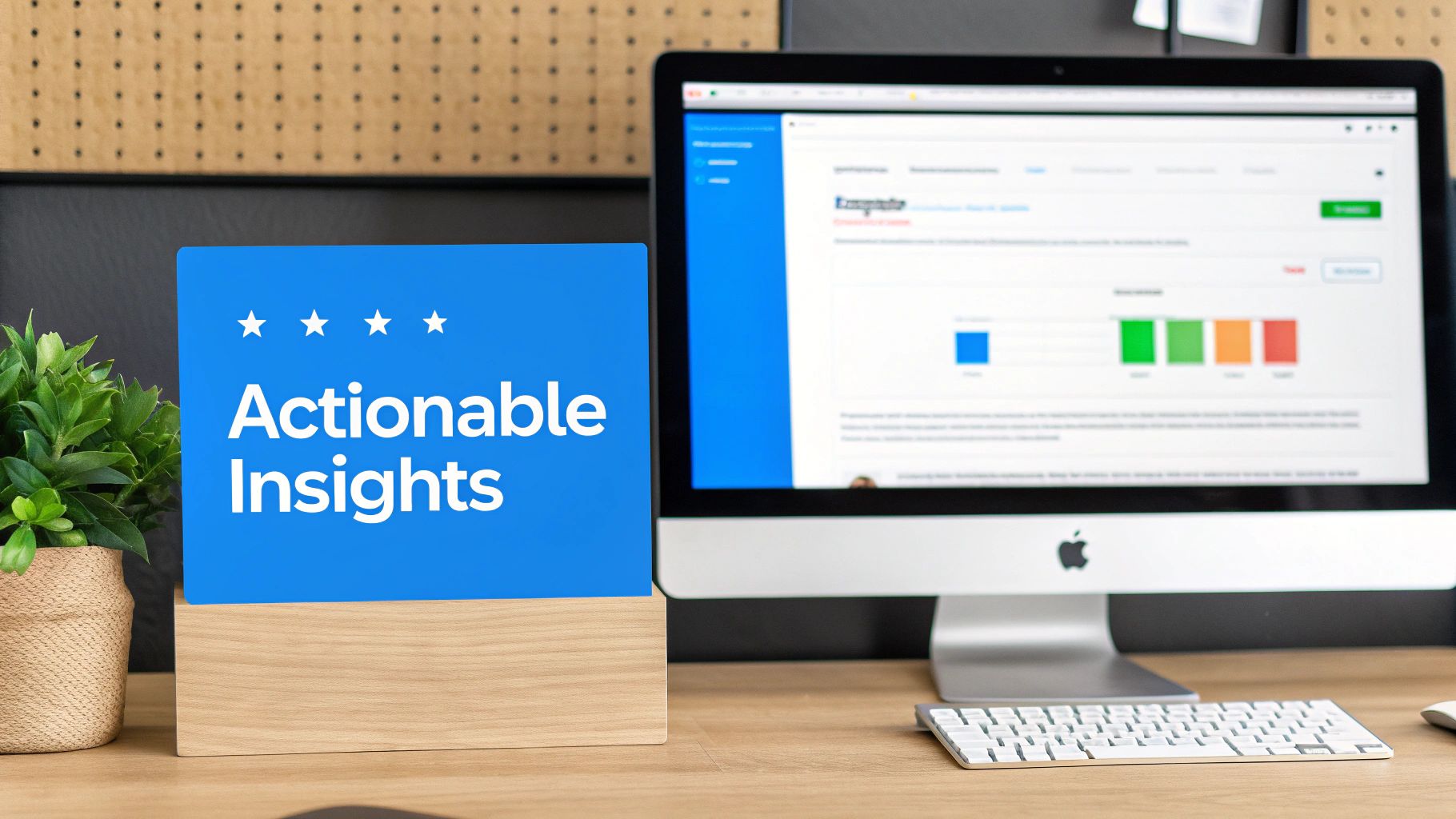
VoC analytics is all about digging deeper than surface-level comments to get to the root of what customers are feeling. It helps you understand not just what people are saying, but why they're saying it. This distinction is crucial; it’s the difference between patching up symptoms and actually solving the underlying problem.
Two core concepts drive this analysis:
- Sentiment Analysis: Think of this as an emotional thermometer. It can automatically determine the tone behind a piece of text—is a customer's comment positive, negative, or neutral? Modern tools can scan thousands of reviews or chat logs in seconds to give you an at-a-glance sentiment score.
- Root Cause Analysis: This is about playing detective. If customers are unhappy (negative sentiment), this analysis helps you figure out if it's because of a buggy product feature, a confusing checkout process, or maybe poor communication from your team.
For instance, a customer might write, "I can't believe I'm still waiting for my order." Sentiment analysis immediately flags this as negative. But root cause analysis connects this comment with dozens of others mentioning delivery delays, pinpointing a systemic issue with your logistics partner. Without that deeper look, you’d just see a bunch of individual complaints instead of a major, actionable trend.
Uncovering Trends in Unstructured Data
A huge chunk of your most valuable feedback is "unstructured," meaning it doesn't fit neatly into a spreadsheet. We're talking about the free-form text in your chatbot conversations, email inquiries, and social media comments. Luckily, modern tools like conversation intelligence platforms can automatically sift through these interactions to pull out rich, meaningful feedback.
VoC analytics is like being a detective. The clues are scattered across all your customer touchpoints. Your job is to piece them together to solve the mystery of what your customers truly need and want.
This kind of analysis is becoming more accessible than ever. Many businesses are investing in tools that can mine these valuable insights, which you can see in the rapid growth of the customer analytics market.
Actionable Takeaway: A Quick Checklist for Analysis
Ready to start digging in? Here’s a simple checklist to help you turn your data into action.
- Group Feedback by Theme: Start by categorizing comments into buckets like "product quality," "website usability," "customer service," or "shipping."
- Identify High-Frequency Issues: Which themes pop up most often? A high volume of comments about a single issue is a clear signal that it’s a priority.
- Analyze Sentiment Within Themes: Look at the emotional tone. Is the feedback about "customer service" generally positive, while comments on "shipping" are overwhelmingly negative?
- Connect Insights to Business Metrics: How does this feedback affect your bottom line? For example, does a spike in negative comments about your website correlate with a dip in conversion rates? You can explore how to use data analytics to boost the customer experience for more ideas.
- Assign Ownership: Who on your team is responsible for fixing this? Assigning ownership ensures that feedback actually leads to real change.
Building Your First Voice of Customer Program

Alright, you're ready to build a system that actually listens and reacts to your customers. Getting your first voice of customer program off the ground isn't as daunting as it sounds. If you break it down, you can create a powerful feedback loop that fuels real, continuous improvement.
We like to think of it as a four-stage cycle. This isn't just about collecting data; it's about making sure that feedback sparks meaningful change. You’ll collect what customers are saying, figure out what it means, do something about it, and then check your results to start the whole process over again.
Stage 1: Collect — Define Your Goals and Channels
Before you even think about asking for feedback, you have to know why you're asking. What are you actually trying to solve? Are you looking to figure out why customers are leaving, improve a specific product feature, or understand why people abandon their shopping carts?
Having a clear goal is everything. It stops you from collecting a mountain of data that just gathers digital dust. Once you know your "why," pick a couple of feedback channels to start. A great mix is one direct method (like a simple post-purchase survey) and one indirect method (like keeping an eye on social media mentions or digging into your chat logs).
Stage 2: Analyze — Find the Patterns
Now that feedback is coming in, your job is to find the story hidden in all that noise. This is where you connect the dots between what feel like random, one-off comments to spot the bigger themes. Are five different people all complaining about the same confusing checkout step? That’s not a coincidence; it's a pattern.
A simple way to start is by tagging feedback with keywords like "shipping," "usability," or "customer service." As you sort the comments, you'll quickly see which topics pop up the most and whether the general vibe is positive or negative. This is how you move from just hearing anecdotes to having real evidence to guide your priorities.
A VoC program is a promise to your customers. Collecting their feedback without acting on it is worse than not asking at all, as it can erode trust and make them feel ignored.
Stage 3: Act — Close the Loop
This is it. The most important step—and the one most companies skip. Acting on insights means turning your analysis into real-world changes. It could be something small, like tweaking an FAQ page because your chatbot keeps getting the same question, or it could be a major project, like redesigning a core product feature.
But "acting" isn't just about fixing things. It’s also about closing the loop. Let your customers know you listened! A quick email saying, "You asked, we listened! Our shipping policy is now clearer," shows people their feedback actually matters. That’s how you encourage them to keep sharing.
Stage 4: Monitor — Track Your Progress
Last but not least, you need to see if your changes actually worked. Did rewriting that product description reduce support tickets? Did making your shipping info clearer lead to better customer satisfaction scores? You have to track these outcomes.
Monitoring is what proves the ROI of your voice of customer program and helps you sharpen your strategy. Set up a basic dashboard to watch your key metrics and schedule a recurring check-in—even 30 minutes a month is enough—to review what you've learned and decide what to tackle next. This creates the rhythm of listening and improving that keeps your business in sync with what your customers need. For more inspiration, this comprehensive guide to the Voice of the Customer is a fantastic starting point.
Got Questions About VoC? We’ve Got Answers.
Jumping into a Voice of Customer program can feel like a big step, and it’s totally normal to have a few questions swirling around. Getting clear on the details is the first step to making it really work for your business.
We get these questions all the time from business owners just like you. Let's clear the air and get you ready to start listening.
How Can a Small Business Start VoC on a Budget?
Good news: you don’t need a massive budget to get started. Some of the most powerful VoC methods are low-cost or even free, especially if you tap into the channels you’re already using.
The trick is to start small and be smart about it. Forget launching a huge, expensive survey campaign for now. Instead, start by digging into the goldmine of data you already have. Your support chat logs, social media comments, and product reviews are overflowing with raw, honest feedback. In our other guide, we learn more about using AI chat logs to improve your product feedback loops.
The most valuable feedback often comes from the places your customers are already talking. The trick isn't spending more money; it's learning to listen more effectively in the right places.
What’s the Difference Between General Feedback and a VoC Program?
This is a fantastic question, and the distinction is critical. Collecting general feedback is usually passive and disorganized. You might get an occasional email, see a random review, and maybe you react to it, maybe you don't. It's inconsistent and lacks a real strategy.
A Voice of Customer program, on the other hand, is a deliberate, structured system. It’s all about proactively setting up listening posts, methodically analyzing what you hear to spot patterns, and—most importantly—creating a repeatable process to turn those insights into tangible business improvements. Think of it as the difference between occasionally overhearing a conversation and actively conducting an investigation.
How Often Should We Analyze VoC Data?
The perfect rhythm for analysis really depends on your business volume and how quickly you can act on what you learn. But for most small to medium-sized businesses, a formal review on a monthly basis is a great place to start.
This gives you enough time for meaningful trends to pop up without letting critical issues simmer for too long. For real-time channels like chatbot conversations, a quick weekly check-in can help you catch urgent problems much faster. The goal is to build a rhythm of review and action that your team can actually stick with. We know that many customers don't complain—they just leave. If you aren't listening everywhere, you're losing customers without ever knowing why, and you can dive deeper into these customer service findings to get the full picture.
Ready to turn customer conversations into your biggest competitive advantage? With FastBots.ai, you can build a custom AI chatbot in minutes, trained on your data, to capture the voice of your customer 24/7. Start listening, analyzing, and acting on feedback today. Visit https://fastbots.ai to begin.