A Guide to Marketing Automation for Agencies

Are you trying to juggle multiple clients, each with their own unique goals and a constant demand for faster results? For a growing agency, marketing automation stops being a "nice-to-have" and quickly becomes a core part of your operation. It’s how you build scalable systems that free up your team for the high-value, strategic work that truly matters.
This guide will walk you through why marketing automation for agencies is so critical, which workflows to tackle first, and how to implement a system that drives real growth—for you and your clients.
Why Automation Is a Game Changer for Modern Agencies

If you've ever felt the strain of managing ten clients with processes designed for two, you already understand the scaling problem firsthand. Manual tasks—like sending follow-up emails, posting to social media, or pulling weekly reports—are manageable at first. But they quickly become a massive bottleneck to growth.
This is where automation completely changes the game. We're not talking about replacing your talented team; we're talking about giving them superpowers. By automating the repetitive work, you unlock your team's creative and strategic potential.
Shifting Focus From Repetitive Tasks to Strategic Growth
Imagine your account managers spending less time buried in spreadsheets and more time actually building client relationships. Picture your creative team brainstorming big-picture campaigns instead of manually scheduling dozens of social media posts. This shift is the real magic of automation.
It allows you to create repeatable, scalable systems for everyday agency work:
- Client Onboarding: Automatically send welcome emails, schedule kickoff calls, and assign initial tasks to your team the moment a new client signs.
- Lead Nurturing: Build automated email sequences that warm up prospects for your clients without anyone needing to lift a finger.
- Reporting: Generate and email performance reports automatically, keeping clients in the loop and saving your team countless hours.
The Financial and Operational Impact
The growth of marketing automation isn't just a trend; it's a direct response to the value it delivers. The market is projected to grow significantly, with one report estimating it will reach $15.58 billion by 2030. Many decision-makers feel internal pressure to automate more, which tells you everything you need to know about its impact on efficiency and ROI.
Let us give you a real-world example. A digital marketing agency we know used to spend nearly a full day each week just compiling performance reports for five clients. After setting up an automated reporting tool, they got all those hours back. That time was reinvested into strategic planning sessions, which directly led to a 15% increase in client retainers the following quarter. This is a typical outcome for agencies that get automation right.
Essential Automation Workflows to Master First

Alright, let's get practical. Understanding why marketing automation for agencies matters is one thing, but seeing it in action day-to-day is where the magic really happens. We're moving past the theory and into the essential workflows that deliver the biggest impact for both your agency and your clients.
Think of these as your agency's foundational automation playbook. If you can nail these first, you’ll immediately free up time, deliver better results, and build a solid base for more advanced strategies down the road.
Automated Lead Nurturing Funnels
For many of your clients, the real struggle isn't just getting leads; it's the relentless follow-up required to turn them into customers. This is where automated lead nurturing becomes your secret weapon. You can build entire conversations that engage prospects over time, educating them and building trust without manual effort.
Imagine a client in the B2B software space gets a new lead from a whitepaper download. Instead of letting that lead go cold, your automated workflow springs into action:
- Day 1: An email instantly delivers the whitepaper.
- Day 4: A follow-up email highlights a key pain point the software solves.
- Day 8: They receive a short video testimonial.
- Day 12: If they've been clicking and opening, an automated invite to a demo is sent.
This simple sequence keeps your client top-of-mind and methodically guides prospects closer to a sale. For a deeper dive, our guide on the power of drip campaigns in marketing automation is a great next step.
The numbers are compelling. Businesses often see a strong return on investment from automation, with some data showing 80% of users see a jump in leads. Nurturing specifically can drive a significant increase in qualified leads. You can explore the full marketing automation statistics to see just how powerful this can be.
Streamlined Client Onboarding
The first few weeks with a new client are critical. A clunky, disorganized onboarding process can create a bad first impression that’s hard to shake. Automation is the key to ensuring every client gets the same professional, high-touch experience from day one.
Picture this: the moment a client signs your contract, a workflow triggers. It can automatically schedule the kickoff call, send a welcome packet, and dispatch an intake form to gather all the assets and account access you need. This frees up your account managers from administrative tasks so they can focus on strategy.
Automated Client Reporting
Pulling together weekly or monthly reports is a classic agency time-drain. It’s critical work, but it’s also repetitive. By putting it on autopilot, you can deliver consistent, data-rich reports to your clients without burning hours of your team's time.
You can set up dashboards that automatically pull data from sources like Google Analytics, social media platforms, and ad accounts into a single report. Schedule it to land in your client’s inbox at the same time every month. This not only saves you a headache but also constantly reinforces your agency's value by keeping results front and center.
Your Step-by-Step Implementation Roadmap
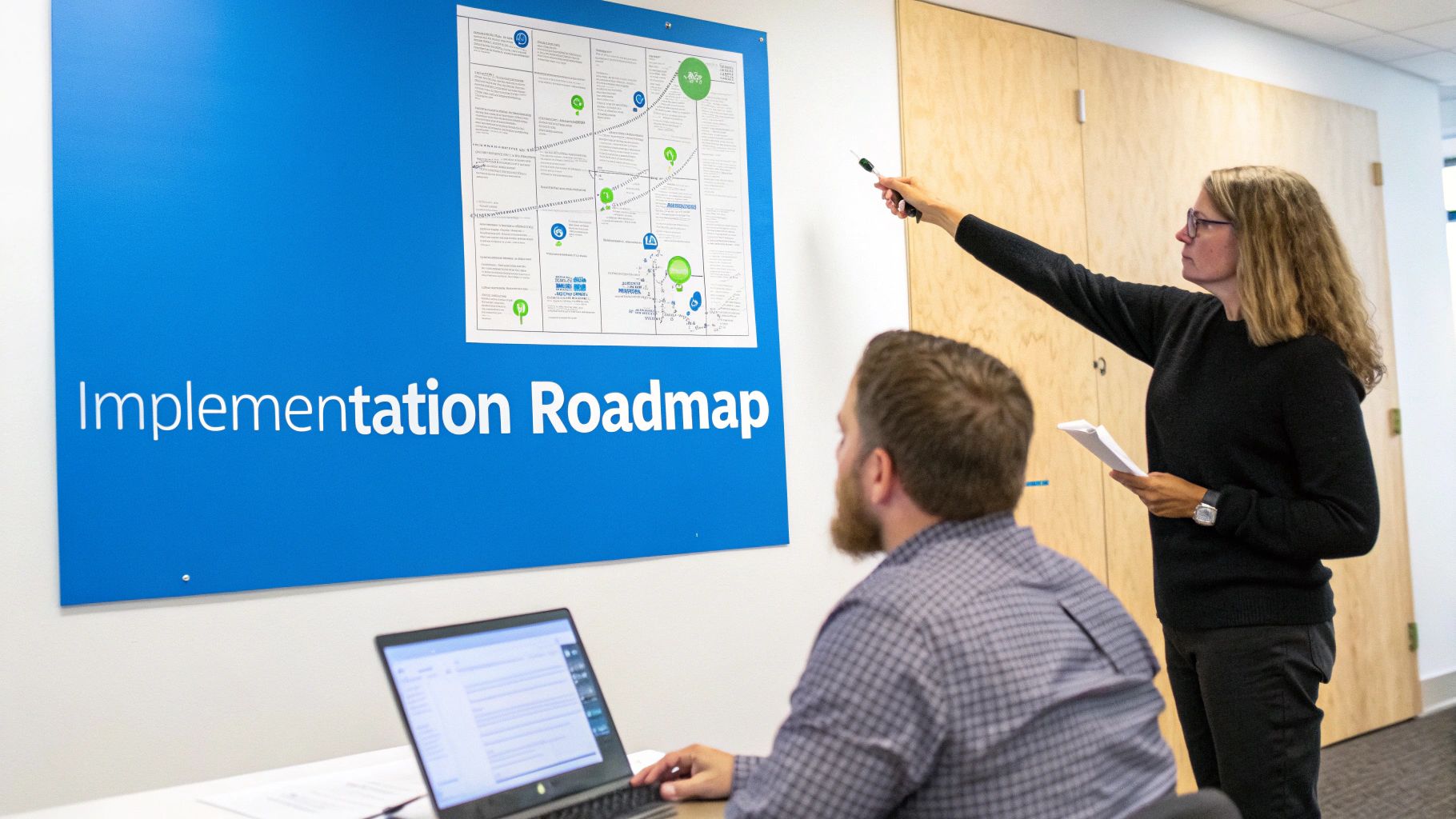
The thought of rolling out a new system can feel daunting, but it doesn't have to be. By breaking it down into smaller, manageable chunks, you can bring marketing automation for agencies into your workflow smoothly. A good plan is the foundation for an automation strategy that will pay dividends for years to come.
Phase 1: Planning and Goal Setting
Before you even look at a single platform, you need to define what winning looks like. Vague goals like "get more efficient" are hard to measure. Get specific instead. Are you aiming to slash client reporting time by 50%? Or maybe you want to boost qualified leads for a key client by 20% in the next quarter.
These clear, measurable goals will steer every decision you make, from picking the right software to designing your first workflow. It's also the time to get your team on board by showing them how this makes their jobs better, not redundant.
Phase 2: Preparing Your Data
Let’s be honest: your automation platform is only as smart as the data you feed it. Before migrating anything, you need to perform a data audit. This means scrubbing contact lists, removing duplicates, and ensuring your data formats are consistent.
It’s not the most glamorous part of the job, but it is absolutely critical. Messy data leads directly to broken workflows and botched personalization. Getting your CRM and contact lists clean before you start is one of the most important things you can do.
For example, a B2B agency we worked with spent a full week just consolidating leads from three different spreadsheets into one clean CRM before launching a new system. That one step ensured their automated emails were laser-focused and pulled in a 35% higher engagement rate than their old manual campaigns.
Phase 3: Building Templates and Integrations
With your goals set and your data clean, it's time to build. Start with high-priority workflows like your client onboarding sequence or a lead nurturing campaign. Create reusable templates for these common processes so you aren’t reinventing the wheel for every client.
This is also when you connect your marketing automation platform to your other core tools, especially your CRM. Using native integrations or tools like Zapier, you can make sure data flows between systems smoothly.
Actionable Takeaway: Your Implementation Checklist
Use this checklist to keep your project on track and make sure you don't miss any critical steps.
- Define SMART Goals: Write down 3-5 Specific, Measurable, Achievable, Relevant, and Time-bound goals for your automation push.
- Audit Your Data: Block out time to clean and standardize all client and agency contact data before you migrate anything.
- Map Your First Workflow: Grab a whiteboard and visually map out one key process (like new client onboarding) before you build it in the software.
- Identify Key Integrations: List the top 3-5 tools your automation platform must connect with (think CRM, email, project management).
- Assign an "Automation Champion": Pick one person on your team to lead the charge and become your go-to internal expert.
How to Choose the Right Automation Platform
Picking a marketing automation platform can feel overwhelming. The trick is to look past the shiny feature lists and zero in on the core functions that actually support the agency model. You’re investing in a central command center that will power the marketing for many clients.
Look For Agency-Specific Features
Many platforms are designed for a single business, which can be a problem for an agency juggling multiple clients. You need a tool that was either built for agencies or has powerful features for a multi-client setup.
Keep an eye out for these non-negotiables:
- Multi-Client Management: A single, centralized dashboard where you can effortlessly switch between client accounts is a must-have. This is a massive time-saver and reduces the risk of human error.
- White-Labeling Capabilities: Being able to add your own logo to the platform presents a slick, unified front to your clients and reinforces your value.
- Scalable, Agency-Friendly Pricing: Find a pricing model that grows with you. Plans based on the number of contacts or clients often align better with how an agency scales than per-seat pricing.
All-in-One vs. Best-of-Breed Solutions
Another decision is choosing between an all-in-one platform or a "best-of-breed" approach. An all-in-one system, like HubSpot, packs a wide range of tools under one roof. This simplifies your tech stack and ensures data flows smoothly.
The best-of-breed strategy involves hand-picking specialized tools—like Mailchimp for email—and connecting them. This can give you more powerful, niche features but often means more work on the integration front. Consulting a comprehensive marketing automation software comparison can help you weigh your options. For many growing agencies, starting with an all-in-one platform is often a practical path.
Limitations and What to Watch Out For
Look, adopting marketing automation is a huge step forward, but it’s not a magic wand. If you just switch it on without a solid game plan, you can end up with wasted money, a frustrated team, and underwhelmed clients. We want to give you an honest look at where agencies can stumble so you can get it right from the start.
The Danger of Over-Automation
It’s easy to get carried away and try to automate everything. This is a classic mistake that can lead to robotic, impersonal interactions. The whole point of marketing automation for agencies isn't to get rid of the human touch; it’s to free up your team to be more strategic and personal where it really counts.
For example, an agency might decide to automate every single client check-in email. While it’s efficient, it kills the opportunity for a personal note that might uncover a new opportunity. The secret is to automate the predictable, not the personal.
Focusing on Technology Over Strategy
Another common trap is getting mesmerized by a platform's bells and whistles instead of focusing on the actual strategy. A powerful tool with no clear purpose is just an expensive toy. Your "why" should always dictate the "what" and "how."
Before you build a workflow, you need solid answers to these questions:
- What specific client goal does this automation support?
- How will we measure whether it worked?
- Does this workflow make the customer's experience better or worse?
Thinking through these points first ensures your efforts are tied to real business outcomes. Don't let the platform drive the strategy.
Maintaining Clean Data Across Clients
Your automation engine runs on data. If that data is a mess, your results will be a mess, too. Keeping data clean and segmented is a challenge, especially when juggling multiple client accounts. Outdated contacts or wrong segments can lead to campaigns that are ineffective or even embarrassing.
Imagine an automated workflow that sends a "welcome back" offer to one of your client's most loyal customers. An error like that, born from bad data, can damage trust. Regular data hygiene isn’t just a nice-to-have; it's a non-negotiable part of the process. You can also explore tools like AI-powered chatbot marketing that help qualify and tag leads correctly from the source.
Measuring Success and Proving ROI to Clients

So, how do you know if your automation engine is working? More importantly, how do you prove its value to your clients in a way that ties directly to their bottom line? This is how you become an essential growth partner. It means ditching surface-level “vanity metrics” and focusing on the key performance indicators (KPIs) that show a real impact.
Moving Beyond Vanity Metrics
It's tempting to get excited about high email open rates, but they don't tell the whole story. A huge open rate means nothing if it doesn't drive a single conversion. Solid marketing automation for agencies demands a shift in focus to metrics that draw a straight line between your automated campaigns and actual business outcomes.
Key KPIs to Track and Report
When building client dashboards, zero in on the metrics that track a lead’s journey down the sales funnel. These KPIs paint a much more compelling picture of success.
- Lead-to-Customer Conversion Rate: This is the big one. It’s the percentage of leads from your automated campaigns that become paying customers.
- Sales Cycle Length: How long does it take for a new lead to sign? Good automation should shorten this timeline by delivering the right message at the right moment.
- Customer Lifetime Value (CLV): Great automation doesn't stop after the first sale. Automated onboarding, upsell, and re-engagement sequences can increase how much a customer is worth over time.
- Cost Per Acquisition (CPA): By improving efficiency, automation should help drive down the cost of acquiring a new customer. Showing a reduced CPA is a powerful way to demonstrate financial return.
For a deeper dive into the specifics, check out our guide on how to measure marketing ROI for business success.
Quick Checklist: A Sample Reporting Framework
Don't just email your clients a spreadsheet. You need to wrap the numbers in context and tell a story. Here’s a simple framework for your client check-ins.
- Start with the Executive Summary: Kick things off with a high-level snapshot. "This month, our automated lead nurturing campaign generated 25 sales-qualified leads, resulting in a 15% shorter sales cycle."
- Visualize the Key KPIs: Use simple charts to show trends for your most important metrics like conversion rate and CPA. Visuals make complex data easy to understand.
- Connect Actions to Outcomes: For each KPI, briefly explain what you did and how it moved the needle. "By launching a 3-part re-engagement email, we reactivated 12 contacts."
- Outline Next Steps: Always end by looking ahead. Based on this month's data, what's the plan for next month? This shows you’re proactive and strategic.
Your Top Automation Questions, Answered
Alright, we’ve walked through the strategy, the setup, and how to prove that automation is working. But you probably still have a few questions. Let's tackle them head-on.
Is Automation Too Expensive for a Growing Agency?
Let’s clear the air: marketing automation doesn’t have to break the bank. While enterprise platforms can carry a hefty price tag, the market is full of tools with affordable starter plans built for growing agencies.
The real question isn't about cost; it's about value. If a tool saves your team five hours a week on manual reporting, it often pays for itself quickly. Look for platforms that scale with your client roster, not ones that penalize you for adding a new team member.
How Technical Do I Need to Be?
This is another huge one. The word "automation" can conjure up images of complex code. The good news is, that's not the reality anymore. Most modern automation platforms are built for marketers, not engineers.
They typically feature drag-and-drop builders and pre-made templates for common agency tasks. If you can sketch out a process on a whiteboard, you have all the skill you need to build it in today's software.
What’s the Real-World ROI on This?
The return on investment shows up in two places: your time and your bottom line. A reduction in operational costs is a common benchmark, but the impact runs deeper. It's about keeping clients longer because your service is consistently excellent.
Most importantly, it’s about having the bandwidth to take on more clients without burning out your team. The ROI will be a direct reflection of the biggest agency headaches you choose to solve first.
Ready to see how a custom AI chatbot can automate lead capture and support for your agency and your clients? FastBots.ai helps you build and deploy intelligent bots trained on your own data in minutes. Explore our features and start your free trial today.