A Guide to KPIs for Websites That Drive Growth


Key Performance Indicators (KPIs) for a website are the handful of numbers that tell you if you’re actually hitting your business goals. Think of them as your site's vital signs, tracking everything from traffic and user engagement to sales conversions and technical health.
Understanding Your Website's Core Numbers

Imagine flying a plane without a dashboard. Sure, you know you're in the air, but you have no clue about your speed, altitude, or direction. A website without clear KPIs is flying just as blind—it's active, but its performance is a total mystery.
These indicators are way more than just industry jargon; they're the tangible metrics that bridge the gap between your website's activity and real business results.
This guide will cut through the noise and give you a simple framework for picking, tracking, and acting on the numbers that genuinely matter. We’ll keep coming back to one central idea: the "best" KPIs are always tied directly to your specific goals. That’s how you make sure your efforts lead to real growth.
The Four Pillars of Website Measurement
To make sense of all the data, we can group the most important KPIs for a website into four distinct categories. Each pillar helps answer a fundamental question about how your site is doing, giving you a complete picture of its health and impact. This structure helps you spot problems and find opportunities much faster.
Here’s a quick look at these foundational categories, which we'll call the Four Pillars.
The Four Pillars of Website KPIs
This table breaks down the main KPI categories and the critical business questions they help answer.
| KPI Category | What It Reveals | Core Business Question |
|---|---|---|
| Traffic Metrics | The volume and origins of your visitors. | Are we reaching our target audience? |
| Engagement Metrics | How users interact with your pages and content. | Is our content resonating with visitors? |
| Conversion Metrics | How effectively your site drives valuable actions. | Is our website generating leads or sales? |
| Technical Metrics | The operational health and performance of your site. | Does our site provide a good user experience? |
By organizing your analysis around these four pillars, you create a structured way to measure performance. For example, high traffic with low conversions points to a completely different problem than low traffic with high engagement. This segmented view is the first step toward making smart, data-driven decisions.
A metric tells you what happened; a KPI tells you if what happened actually mattered for your goals. The distinction is crucial—you track many metrics, but you focus on a few key indicators.
Whether you run an e-commerce store, a local business site, or a corporate blog, this framework applies. If you're running an online store, keeping an eye on these key ecommerce performance metrics to track is essential for spotting growth opportunities.
As we move forward, we'll dive deeper into picking the right metrics within each category to perfectly match your unique business objectives.
Tying Your Website KPIs to Business Goals
Tracking website data without a clear goal is like hoarding puzzle pieces without ever looking at the picture on the box. You end up with a ton of information, but you have no clue what you're actually trying to build. The most powerful website KPIs aren't just generic metrics everyone tracks; they're hand-picked to tell you if you're getting closer to your unique business objectives. This is the moment raw data becomes your strategic roadmap.
Instead of drowning in a sea of metrics, the best way forward is to start with your destination and work backward. What does success really look like for your business right now? Answering that question is the key to filtering out the noise and zeroing in on the handful of metrics that truly matter.
Let's break down how to connect specific KPIs to the most common business goals, using real-world examples to show you how it's done.
Goal 1: Boost Brand Awareness
When your main objective is just getting your name out there, your attention shifts to reach and visibility. You need to know if more people are discovering your brand and, just as importantly, where they're coming from.
Imagine a local bakery that just launched its first website. Their immediate goal isn't to sell a thousand croissants online; it's simply to let the community know they exist on the web. For a goal like this, your dashboard should be all about traffic.
Unique Visitors: This tracks the number of distinct individuals who land on your site. A steady climb here is a great sign that your brand's reach is growing.
Traffic Sources: This KPI shows you how people are finding you—is it through Google (organic search), Facebook (social media), or a link from another local blog (referrals)? This tells you which marketing channels are actually working.
Branded Search Volume: This is a big one. It measures how many people are specifically typing your company’s name into a search engine. When this number goes up, it’s a powerful signal that your brand recognition is on the rise.
Goal 2: Generate More Leads
For a lot of businesses, a website's primary job is to keep the sales pipeline full. If you're a B2B service provider or a real estate agency, your success is measured by the number and quality of inquiries you get. The focus here is all about action—turning anonymous visitors into potential customers.
Your KPIs need to measure how well your site convinces people to take that next step.
The most important mental shift here is from asking, "How many people visited?" to "How many of those visitors actually did something?" This is what connects your website directly to revenue.
Here are the must-track KPIs for a lead generation website:
Conversion Rate: This is the percentage of visitors who complete a specific action, like filling out a contact form or downloading an ebook. It’s the ultimate measure of how persuasive your website is.
Cost Per Lead (CPL): This calculates exactly how much you have to spend in marketing to get a single lead. Keeping your CPL low is the key to running a profitable and efficient acquisition strategy.
Goal 3: Increase Ecommerce Sales
For any online store, the goal is refreshingly simple: sell more stuff. The KPIs have to give you a crystal-clear picture of shopper behavior, from how they browse to what makes them buy—or what makes them leave. Every metric should help you answer the question, "How can we get more people to click 'buy now'?"
Let's go back to our local bakery, which now offers online ordering. Their goal is to maximize sales through their new ecommerce site. They'd be watching these numbers like a hawk:
Average Order Value (AOV): This KPI measures the average amount spent every time a customer places an order. Bumping up your AOV with things like upsells ("Would you like a coffee with that croissant?") or product bundles is one of the fastest ways to grow revenue.
Cart Abandonment Rate: This is the percentage of shoppers who add items to their cart but bail before finishing the purchase. A high rate often points to a problem, like surprise shipping costs, a clunky checkout process, or unexpected fees. According to studies, nearly 70% of online shopping carts are abandoned, which means there’s a massive opportunity for improvement right there.
Goal 4: Improve Customer Support
Finally, your website can be an incredibly powerful tool for customer service. A great help center or knowledge base can reduce support costs and make for happier customers by empowering them to find answers on their own, instantly.
The right KPIs here will measure how effectively your site is preventing support tickets from ever being created in the first place.
Help Desk Article Views: By tracking which of your support articles get the most traffic, you can quickly identify your customers' most common pain points. This tells you exactly where you should focus on improving your content or your product.
Ticket Deflection Rate: This metric estimates the number of support tickets you avoided because customers found what they needed on your site. It’s a direct measurement of the ROI of your self-service content.
Decoding User Behavior And Engagement

Once someone lands on your site, their clicks, scrolls, and hesitations tell a story. Getting past simple traffic counts and into engagement metrics is where you find out what people actually do. It answers the most important question of all: "Is what we're offering hitting the mark with our audience?"
Think of your website like a physical shop. Just because someone walks through the door doesn't mean they had a good time. Did they wander through multiple aisles? Did they ask for help? Or did they take one look, turn around, and walk straight out? This is exactly what engagement KPIs are designed to measure online.
Understanding this layer of data is how you start seeing your site through your users' eyes. It shows you what’s working, what's frustrating, and ultimately, what it takes to turn casual browsers into loyal customers.
Interpreting Core Engagement Metrics
Three classic metrics have been the go-to for engagement analysis for years: bounce rate, pages per session, and average session duration. But here's the thing—they aren't always what they seem. Context is everything.
A high bounce rate (when a user visits one page and leaves) often gets a bad rap. But what if that one page was a blog post where they found the exact answer they were looking for? Or a landing page with a phone number they immediately dialed?
A short visit isn't always a failed one. If a user finds exactly what they need in seconds—like your business hours or a phone number—then that's a successful interaction, even if it results in a high bounce rate.
Likewise, a low number of pages per session could mean visitors are getting lost and giving up. Or it could mean your navigation is so clear and efficient they found what they needed on the very first try. With over 1.13 billion websites competing for attention, the typical user now views only about two pages per session anyway. You have to analyze these numbers in relation to your website's purpose.
Moving Beyond Basic Engagement KPIs
While the classics have their place, modern analytics lets us go so much deeper. Advanced KPIs paint a much clearer picture of what a user wants, showing you exactly where their journey is smooth and where they’re hitting roadblocks.
These metrics offer insights that the old-school numbers just can't provide:
Scroll Depth: This tells you how far down a page people are actually scrolling. If 90% of visitors never get past the first paragraph of your most important article, you know your intro needs work. Simple as that.
User Flow Analysis: Think of this as a map of the paths visitors take through your site. You can spot the most common routes, identify where people are dropping off unexpectedly, and find places where they get stuck in loops, unable to find their next step.
Engagement Rate (GA4): This is Google's newer, smarter replacement for bounce rate. A session is counted as "engaged" if the user stays for more than 10 seconds, triggers a conversion event, or visits at least two pages. It’s a much more nuanced look at whether someone is truly interacting.
By pulling these different views together, you can start to really decode user behavior. For example, you might see that visitors from your email newsletter have a high scroll depth on product pages but a low conversion rate. That's a huge clue! It tells you the email got them interested, but something on the product page itself is stopping them from buying. This is a perfect example of how you can use data analytics to boost the customer experience by turning simple observations into real improvements.
Measuring Conversions And Business Impact

This is where the rubber meets the road. All the traffic and engagement in the world don't mean much if visitors aren't taking the actions that grow your business. Conversion metrics are the KPIs that directly link your website's performance to your bottom line.
Think of it like a physical store. Traffic and engagement are people walking in and browsing the aisles. Conversions? That’s the sound of the cash register ringing. These are the make-or-break actions that turn a casual browser into a valuable customer.
Without tracking conversions, you’re essentially flying blind. You're spending time and money getting people to your site with no idea if it's actually paying off. That's why getting a handle on conversion-focused KPIs for a website is absolutely non-negotiable for any business that wants to grow.
Defining Your Key Conversion Actions
First things first: not all conversions are created equal. To track what really matters, you have to separate the ultimate goals (macro-conversions) from the smaller, supporting steps that get people there (micro-conversions).
Macro-conversions are the big wins—the primary reason your website exists. These actions are almost always tied directly to revenue.
Completed Purchase: The holy grail for any e-commerce store.
Submitted Lead Form: A potential client raising their hand and saying, "I'm interested."
Free Trial Signup: The crucial first step in turning a user into a software subscriber.
Micro-conversions, on the other hand, are the smaller breadcrumbs that show someone is on the right path. They signal interest and tell you a visitor is warming up to the idea of becoming a customer.
Newsletter Subscription: Building an audience you can market to later.
PDF or Ebook Download: Trading valuable content for a lead's contact information.
Adding an Item to Cart: A huge indicator of purchase intent, even if they don't check out right away.
Tracking both gives you the full picture of your sales funnel. You'll see not just who's buying, but who's getting ready to buy.
Essential Conversion KPIs You Must Track
Once you know which actions you're aiming for, it’s time to measure how well you’re doing. These KPIs go beyond simple counts to give you a clear view of your website's efficiency and profitability.
A conversion is an action, but a Conversion Rate is a measure of your website's persuasiveness. It tells you what percentage of your visitors were convinced to do what you asked them to do.
Let's break down the most critical conversion KPIs to have on your dashboard:
Conversion Rate: This is the big one. It’s the percentage of your visitors who complete a desired goal. You calculate it with
(Total Conversions / Total Visitors) * 100, and it's the single best indicator of your site's overall effectiveness.Cost Per Acquisition (CPA): This KPI gets straight to the point: How much does it cost you, on average, to land one new paying customer? It’s absolutely essential for smart budgeting and figuring out if your campaigns are actually profitable.
Return on Ad Spend (ROAS): If you're running paid ads, ROAS is your North Star. It measures the gross revenue you earn for every single dollar you spend on advertising. A ROAS of 4:1, for instance, means you're making $4 for every $1 you invest.
Keeping a close eye on these numbers is what separates the pros from the amateurs. In fact, studies show that websites with truly optimized conversion paths can boost their rates by a staggering 200% to 300%.
Understanding how these numbers interact is fundamental to your business's financial health. To go even deeper, check out our guide on how to measure marketing ROI for business success. Ultimately, every conversion metric points toward the same goal: improving website conversion rates with practical CRO and systematically turning more of your visitors into loyal customers.
Getting Your Website's Technical Health in Order
Even the most creative marketing campaign or brilliant sales copy will completely miss the mark if your website is slow, buggy, or insecure. Technical health isn't just some backend issue for the IT crowd; it's the very foundation of a good user experience and a massive ranking factor for search engines.
Think of these technical KPIs as the engine under the hood. If they aren't running smoothly, your entire digital strategy is going to stall out.
Imagine your website is a real-world retail store. If the front door is stuck, the lights are flickering, and people have to wait in a crazy long line just to get inside, what happens? Most will just give up and go somewhere else. A slow-loading, clunky website creates that exact same frustrating experience online, scaring visitors away before they even get a chance to see what you're selling.
Page Load Time: Your Digital Welcome Mat
The single most important technical metric you can track is Page Load Time. It’s simple: this is how long it takes for your page’s content to fully appear and become usable for a visitor. In a world of instant everything, every millisecond genuinely counts.
The global average load time for a desktop website is about 2.5 seconds, but for mobile, it jumps to a sluggish 8.6 seconds. That's a problem, especially when Google recommends a mobile load time of three seconds or less to keep people from bouncing. With a staggering 78.39% of all global traffic now on mobile, you can't afford to ignore it. Improving load time isn't just a tweak; it's a core strategy for both SEO and keeping users around, as you can see from other key website metrics on Lucky Orange.
Getting to Grips with Google’s Core Web Vitals
To give site owners a clear way to measure user experience, Google rolled out a set of metrics called Core Web Vitals. Think of them as a standardized health checkup for your site's speed, responsiveness, and stability.
Largest Contentful Paint (LCP): This measures how fast your page loads. Specifically, it marks the point when the biggest, most important piece of content is visible, telling the user, "Hey, this page is useful now." You want your LCP to be 2.5 seconds or less.
First Input Delay (FID): This is all about interactivity. It tracks the delay between when a user does something (like clicking a button) and when the browser actually starts processing it. A good FID is snappy—100 milliseconds or less.
Cumulative Layout Shift (CLS): This one measures visual stability. We've all been there: you go to click a button, and suddenly an ad loads above it, pushing everything down the page. CLS quantifies that annoying shifting. A good CLS score is tiny: 0.1 or less.
You don't need to be a developer to check these. Free tools like Google's PageSpeed Insights make it incredibly easy to see how your site stacks up.
A website that passes Core Web Vitals is essentially telling search engines and users, "This site is fast, responsive, and won't frustrate you." This signal can directly impact your search rankings and user satisfaction.
The Non-Negotiables: Mobile and Security
Beyond raw speed, a couple of other technical KPIs are absolutely essential today. No excuses.
First up is Mobile Responsiveness. Your website has to look and work perfectly on every screen size, from a huge desktop monitor to the smallest smartphone. With most of your traffic likely coming from mobile, a clunky, hard-to-use mobile site is no longer just an inconvenience—it's a deal-breaker.
Second is HTTPS Security. That little "https://" at the start of your URL comes from an SSL certificate, and it encrypts the data flowing between your user's browser and your server. It builds trust, and Google has confirmed it's a ranking signal (albeit a small one). More importantly, without it, modern browsers will slap a "Not Secure" warning on your site, which is a massive red flag for any potential customer.
How To Build A Practical KPI Dashboard
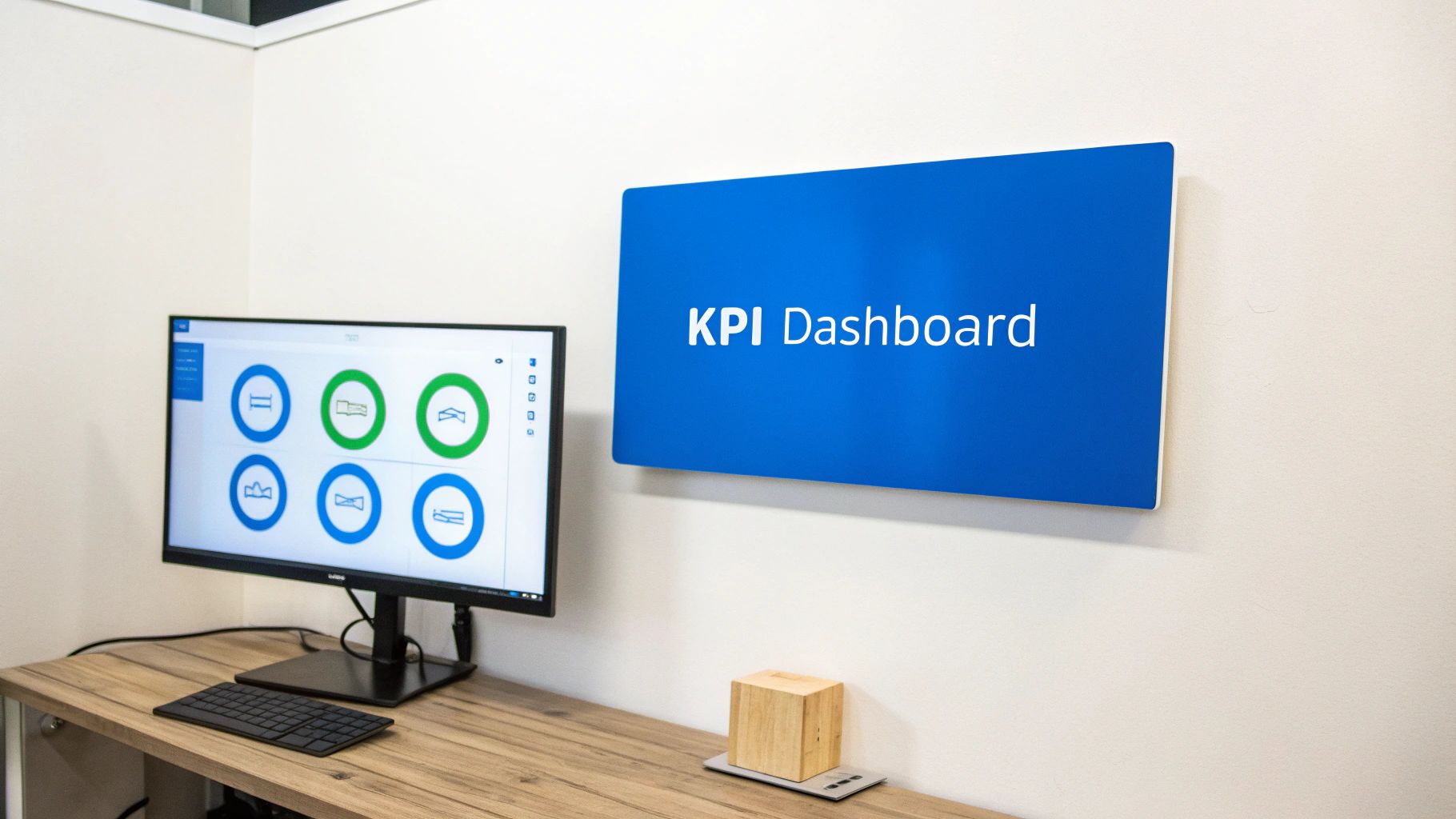
Tracking individual KPIs for a website is a solid start, but the real magic happens when you bring them all together. A good KPI dashboard does just that—it turns your scattered data points into a single, cohesive story you can understand in a glance. Think of it as the difference between having a pile of ingredients and seeing the finished meal.
A well-designed dashboard isn't just another report; it's a dynamic tool that helps you grow. It gets you out of the habit of reacting to isolated numbers and empowers you to spot trends, see how different metrics influence each other, and make smart, proactive decisions.
The best part? You don't need to spend a fortune on fancy software. Free tools like Google Looker Studio let anyone connect data from places like Google Analytics to build powerful, shareable dashboards. This unified view keeps your entire team on the same page, all pulling in the same direction. For a deeper dive, check out our guide on creating powerful marketing dashboards for visualising data for decision-making.
Choosing The Right Dashboard Template
Your dashboard should be a mirror of your business goals. A one-size-fits-all approach just doesn’t cut it, because every business has different priorities. The trick is to start with a template that’s actually designed for what you’re trying to achieve.
Here are three common models to get you started:
For Lead Generation (SMBs): This kind of dashboard is all about the sales funnel. Key visuals would track things like Unique Visitors, Traffic Sources, Form Conversion Rate, and your Cost Per Lead. It’s built to answer one question, fast: "Are we generating enough quality leads?"
For E-commerce: Here, the focus shifts squarely to sales performance. You’ll want your most prominent metrics to be Total Revenue, Average Order Value (AOV), Conversion Rate, and the dreaded Cart Abandonment Rate. This view helps you spot any hiccups in the customer's buying journey right away.
For Content & Engagement: If your main goal is building an audience, then your dashboard needs to reflect user interaction. You'll want to keep an eye on Pages Per Session, Average Session Duration, Scroll Depth, and the ratio of New vs. Returning Visitors.
Making The Dashboard Part Of Your Routine
A dashboard is useless if it just sits there collecting digital dust. The final, and arguably most important, step is to build a regular review process. This simple habit is what turns data from a static report into a living, breathing part of your strategy.
Your KPI dashboard shouldn't be a destination you visit once a month. It should be the compass you check regularly to ensure you're still heading in the right direction. A consistent review cadence is what turns insights into action.
Set aside time each week to go over the key trends with your team. Start asking the important questions: What changed from last week? Did that new blog post actually improve engagement? Is our paid ad campaign delivering a positive return? These consistent check-ins help you catch problems early, double down on what’s working, and continuously fine-tune your website’s performance based on real-world feedback.
Got Questions About Website KPIs? We've Got Answers
Even with the best strategy laid out, you're bound to have questions once you start digging into your website's performance. That's completely normal. Getting clear answers helps turn good intentions into solid, repeatable habits.
Think of this section as your quick-reference guide. We're tackling the most common questions that pop up when dealing with website KPIs. Let's clear up any confusion so you can feel confident about how you measure, interpret, and act on your data.
How Often Should I Check My Website KPIs?
The honest answer? It depends entirely on the KPI and the rhythm of your business. You definitely shouldn't be checking everything every single day. That’s a recipe for analysis paralysis.
Daily or Weekly: Fast-moving metrics need a close eye. Think conversion rates for an active ad campaign, traffic spikes from a newsletter, or checkout abandonment rates. You need to monitor these frequently to spot problems or jump on opportunities right away.
Monthly: This is the sweet spot for your big-picture metrics. Things like overall organic traffic, total unique visitors, and new leads are best reviewed monthly. Looking at them month-over-month smooths out the daily noise and shows you the trends that actually matter.
Quarterly: Technical KPIs like Core Web Vitals or overall page load speed don't need daily check-ins. While you should have tools monitoring them constantly, a deep-dive review each quarter (or after a major site update) is usually enough to make strategic decisions.
The goal is to find a consistent rhythm that helps you spot patterns without getting bogged down in tiny, meaningless day-to-day fluctuations.
What Is The Difference Between A Metric And A KPI?
This one trips a lot of people up, but the distinction is crucial. It's actually pretty simple when you break it down: all KPIs are metrics, but not all metrics are KPIs.
A metric is just a number—any quantifiable data point on your site. Total page views, bounce rate, and time on page are all metrics. A Key Performance Indicator (KPI), on the other hand, is a specific metric you’ve hand-picked because it directly measures how well you're progressing toward a critical business goal.
For example, "page views" is a metric. But the "conversion rate on your pricing page" is a KPI because it tells you if you're succeeding at your goal of generating new customers. You'll track plenty of metrics, but you should only have a handful of true KPIs that steer your most important decisions.
What Are The Best Free Tools For Tracking KPIs?
You absolutely do not need to drop a ton of money on expensive software to get started. In fact, a few powerful and completely free tools from Google can give you everything you need.
Google Analytics 4 (GA4): This is non-negotiable. GA4 is the central hub for tracking traffic sources, user engagement, conversions, and a massive range of other user behaviors. It's the foundation of your entire tracking setup.
Google Search Console: If you care at all about organic search traffic (and you should), this tool is essential. It tells you exactly how you're performing on Google, including keyword rankings, click-through rates, and any technical SEO issues holding you back.
Google PageSpeed Insights: Your site's technical health is a huge factor in user experience and SEO. This is the go-to tool for analyzing how fast your pages load and whether you're meeting Google's Core Web Vitals.
Honestly, with just these three tools working together, you've got a seriously robust setup for tracking the most important KPIs for any website.
Ready to turn website visitors into customers 24/7? FastBots.ai lets you build a custom AI chatbot trained on your own content in minutes. Capture leads, answer questions, and improve your conversion rates automatically. Build your first bot for free at FastBots.ai.