7 Knowledge Management Best Practices to Boost Team Efficiency

Your business runs on information. From a top performer's sales tactic to the steps for resolving a complex ticket, this knowledge is your most valuable asset. When you leave it unmanaged, it creates friction and costly mistakes.
New hires take longer to onboard, your support teams give inconsistent answers, and valuable insights walk out the door every time an employee leaves. This isn't just an inconvenience; it's a direct drain on your resources and a barrier to growth.
Effective knowledge management isn't about creating a dusty, digital encyclopedia. It’s about building a living ecosystem where you capture, refine, and make critical information easily accessible to the right person, at the right time. For many businesses, mastering this process is a competitive advantage.
This article provides a prioritized, actionable roundup of the top knowledge management best practices. We'll dive into concrete implementation steps, common pitfalls to avoid, and specific ways you can leverage tools like AI-powered chatbots to automate knowledge distribution. You will learn how to transform scattered documents into a streamlined system that boosts productivity and enhances customer satisfaction.
1. Create a Centralized Knowledge Repository
One of the most impactful knowledge management best practices you can implement is creating a centralized knowledge repository. This is a unified, digital system where all crucial organizational information is stored, organized, and made easily accessible.
Instead of having information scattered across Google Docs, Slack channels, and email threads, you create one authoritative hub. This approach dismantles information silos and is key to establishing a single source of truth for consistency. For customer-facing teams, this means everyone, including your AI chatbots, pulls answers from the exact same playbook.
Actionable Takeaway: How to Build Your Central Repository
Getting started doesn't have to be a monumental task. You can begin by auditing your existing documentation, identifying duplicates, and archiving outdated content. From there, consolidate the most important information into a single platform.
Here’s a quick checklist to guide you:
- Establish a Governance Policy: Define who can add, edit, and archive content. This prevents your repository from becoming cluttered.
- Consolidate Your Content: Use a tool to easily upload diverse content formats like PDFs, website content, or even YouTube video transcripts to build a comprehensive knowledge source.
- Organize for AI and Humans: Use clear categories and tags to structure your information. This helps your team and also enables AI chatbots to pinpoint the most relevant answers quickly.
- Automate Updates: Set up your chatbot to automatically retrain whenever new content is added. This ensures it always provides the most current information. You can learn how to implement knowledge base chatbots to connect your repository.
What to Watch Out For
A common pitfall is poor initial setup and a lack of ongoing maintenance. Without a clear owner or a defined update schedule, even the best-intentioned repository can quickly become a "content graveyard" filled with obsolete information.
To avoid this, assign a specific person or team to oversee its health and conduct quarterly content audits. Make sure your process for adding new knowledge is simple enough that team members will actually follow it.
2. Standardize Your Documentation
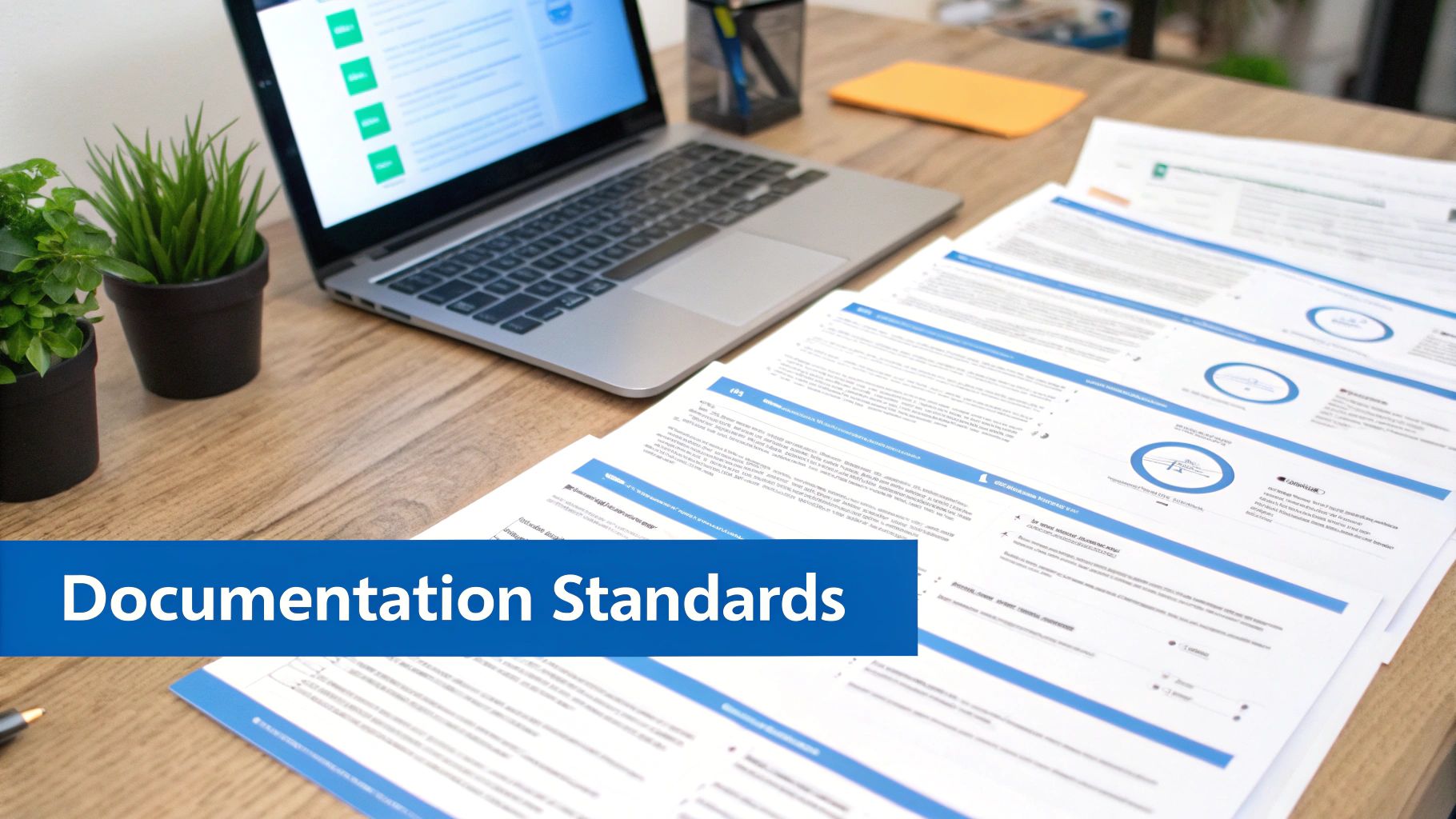
Simply having a repository isn't enough; the knowledge within it must be consistent, clear, and structured. This is where knowledge codification comes in. It's the process of transforming tacit knowledge—the expertise in your team's heads—into explicit, standardized documentation.
This practice is crucial for scaling your support operations. For example, a financial services company we worked with saw customer satisfaction scores jump by 15% after they standardized their FAQ templates. Before, agents and bots gave slightly different answers about fee structures, causing confusion. Standardized content eliminated that problem.
Actionable Takeaway: How to Standardize Your Documentation
Implementing documentation standards creates a predictable structure that speeds up content creation and retrieval. Start by defining what "good" documentation looks like for your organization and build repeatable processes around it.
Here’s a practical checklist to get you started:
- Create Universal Templates: Design standard templates for common document types like FAQs and how-to guides.
- Establish a Style Guide: Define your organization's tone of voice, terminology, and formatting rules.
- Structure for Readability and AI: Use clear headers, short paragraphs, and bullet points to make content scannable. A well-structured document is key to effective knowledge management best practices.
- Implement Metadata Tagging: Use tags to categorize content by topic, product, or urgency. This helps your AI chatbot quickly filter and surface the most relevant information.
What to Watch Out For
A common trade-off is creating standards that are too complex or rigid. If your documentation process is overly bureaucratic, your team will avoid it, and knowledge will remain undocumented. The goal is to make it easy to contribute, not to create barriers.
Start with a simple set of guidelines and refine them over time based on team feedback. Also, ensure there is a clear process for updating standards as your products or services evolve.
3. Build Feedback Loops for Continuous Improvement
A static knowledge base is a dying one. The best knowledge management practices involve creating a dynamic system that evolves through feedback. This means establishing a process for collecting and acting on input from customers, employees, and even your AI chatbots.
This approach ensures your knowledge base remains relevant and effective. Instead of guessing what customers need, you use direct evidence from their questions to guide content updates. You can monitor chatbot conversations to identify gaps in your knowledge base and update training data based on what customers are actually asking.

Actionable Takeaway: How to Build Your Feedback Loop
You can build a powerful improvement engine by leveraging the data your support channels already generate. Start by regularly reviewing AI chatbot interactions and customer support tickets to pinpoint recurring issues.
Here’s a quick checklist to guide you:
- Analyze Chat Logs: Use your chatbot's analytics to identify questions it couldn't answer or conversations that required human handover.
- Track Key Metrics: Monitor KPIs like customer satisfaction (CSAT) scores and first-contact resolution rates. A drop can signal outdated knowledge.
- Schedule Regular Reviews: Dedicate time each week to review problematic conversations. Create a straightforward process for your team to submit suggestions.
- Use AI for Insights: Your chatbot's conversations are a goldmine of customer intelligence. You can leverage the voice of the customer using AI chat logs to improve product feedback loops.
What to Watch Out For
A common mistake is collecting feedback without a clear process for acting on it. If insights sit in a spreadsheet and are never used to update your knowledge base, the loop is broken. This leads to team frustration and perpetuates the same customer service issues.
To avoid this, assign clear ownership for the review and update process. Ensure that the person responsible has the authority and time to make necessary changes promptly.
4. Distribute Knowledge Across Multiple Channels
Once your knowledge is centralized, the next step is to deliver it consistently wherever your customers are. This involves using your single knowledge base to provide unified support across your website, email, social media, and messaging apps.
This approach is essential for modern customer service. Instead of managing separate and often inconsistent information for your website FAQ, your chatbot, and your support team, you power them all from one central source. This not only improves customer trust but also significantly reduces the effort needed to keep information up-to-date.

Actionable Takeaway: How to Distribute Knowledge Across Channels
Deploying your knowledge base everywhere at once can be overwhelming. Instead, we recommend a phased rollout, starting with your most active customer channels and expanding from there.
Here’s a practical checklist to guide you:
- Prioritize Your Channels: Identify where most of your customer interactions happen. Is it live chat on your website or your Facebook page? Start there.
- Map Knowledge to Channel Context: A question asked via SMS might need a shorter, more direct answer. Tailor how information is presented for each platform.
- Deploy a Versatile Chatbot: Use a tool to build one central chatbot and deploy it across multiple channels. It can be integrated into your website, Slack, WhatsApp, and more, all drawing from the same knowledge base.
- Monitor Channel-Specific Performance: Track metrics like resolution rate for each channel. This helps you identify where your knowledge content might need adjustments.
What to Watch Out For
A common limitation is assuming a one-size-fits-all approach will work for every channel. Simply copying and pasting information without considering the context can lead to a poor user experience. An answer that works well in a detailed help center article will feel clunky in a fast-paced WhatsApp conversation.
To avoid this, review and adapt your bot's tone and response length for each specific platform. You can discover more by reading about the best practices for implementing multi-channel chatbots.
5. Tailor Knowledge Access and Personalization
Not every user needs or should see the same information. A powerful knowledge management best practice is tailoring knowledge access based on user roles, customer segments, or the context of their interaction.
This strategy means a sales prospect visiting your site might interact with a chatbot focused on benefits and pricing, while a logged-in customer gets help with account-specific issues. This contextual delivery of information makes your knowledge base a dynamic asset, not just a static library.
Actionable Takeaway: How to Implement Personalization
You can start segmenting your audience and tailoring information without a complex setup. The key is to map your user journeys and create distinct knowledge pathways for each important group.
Here’s a quick checklist to guide you:
- Map Your Customer Segments: Identify your key user groups, such as prospects, new customers, VIP clients, and internal support agents.
- Create Segmented Knowledge: Develop distinct training datasets or content collections tailored to each segment.
- Customize Your Chatbot's Persona: Use your chatbot's settings to adjust its persona and tone for different audiences.
- Integrate with Your CRM: Connect your chatbot to your CRM using tools like Zapier. This allows the bot to pull user context and deliver personalized responses.
What to Watch Out For
A common pitfall is over-personalization or incorrect segmentation. If your user data is inaccurate, you might show a loyal, long-term customer a welcome message intended for new prospects. This can create a confusing experience.
To avoid this, start with broad, clearly defined segments before creating more granular ones. Regularly audit your CRM data for accuracy and test the user experience for each segment.
6. Capture Both Implicit and Explicit Knowledge
Effective knowledge management goes beyond just documenting the obvious. A truly robust system captures both explicit knowledge (facts, procedures) and the more elusive implicit knowledge (instincts, expert insights).
This strategic approach involves preserving the unwritten rules held by your most experienced team members. Think of it as bottling the "magic" of a top-performing support agent. By capturing this, you ensure their expertise remains within the organization, even after they've moved on.
Actionable Takeaway: How to Capture and Codify Expertise
The key is to systematically convert implicit know-how into an explicit format that can be stored and shared. Start by identifying your top performers and documenting their unique processes.
Here’s a practical checklist to get started:
- Interview Your Experts: Sit down with top performers and ask them to walk you through how they handle complex situations. Record and transcribe these sessions.
- Document Edge Cases: Create documents dedicated to exceptions, workarounds, and "if-then" situations that only experienced staff know how to navigate.
- Create Decision Trees: Map out the judgment calls your experts make. A visual decision tree can turn a complex thought process into a clear, followable guide.
- Upload Captured Wisdom: Consolidate these interview transcripts and guides into formats like PDFs or Google Docs, then upload them to your knowledge base.
What to Watch Out For
A significant challenge is that experts often don't realize what they know or find it difficult to articulate their "gut feelings." They may dismiss their process as "just common sense."
To overcome this, use specific, scenario-based questions rather than broad ones like "How do you do your job?" For example, ask, "Walk me through the last time you dealt with a difficult customer and why you chose that specific solution."
7. Ensure Knowledge Quality and Validation
Implementing a formal process for knowledge quality assurance is one of the most critical knowledge management best practices, especially when AI is involved. This practice ensures that all information is accurate, relevant, and complete.
Think of it as a safety net for your knowledge base. For industries where accuracy is non-negotiable, like healthcare or finance, this process is standard. For example, many banks use a rigorous, multi-stage review process for all customer-facing financial information. This commitment to quality ensures the information is trustworthy.
Actionable Takeaway: How to Implement Quality Assurance
Building a validation process protects both your customers and your business from the risks of misinformation. It ensures your AI tools are trained on verified, high-quality data.
Here’s a practical checklist to guide you:
- Create a Review Checklist: For new content, establish a simple checklist covering accuracy, clarity, completeness, and tone of voice.
- Assign Subject Matter Experts (SMEs): Designate internal experts to validate domain-specific knowledge.
- Test AI Responses Before Deployment: Before your chatbot goes live with new information, test its responses against a list of sample questions.
- Monitor Performance Analytics: Regularly check your chatbot’s analytics for low-confidence answers or frequent escalations to human agents.
- Establish an Error Reporting Process: Make it easy for employees and customers to flag incorrect information.
What to Watch Out For
A common pitfall is making the review process so complex and bureaucratic that it discourages content creation. If getting a new article approved takes weeks, your team will stop contributing. The goal is to create a process that is rigorous but also efficient.
To avoid this bottleneck, empower your designated SMEs to give final approval without unnecessary oversight. Also, ensure the process is well-documented and transparent.
Conclusion: Putting Your Knowledge to Work
We've explored a set of knowledge management best practices, from creating a central repository to cultivating a culture of sharing. The journey from scattered information to strategic, accessible knowledge is not a one-time project; it's a continuous commitment to capturing and refining your organization's collective intelligence.
The core takeaway is that effective knowledge management is more than just a tool. It's a living ecosystem where information flows seamlessly between people and systems. When you build robust feedback loops and organize information with a thoughtful taxonomy, you transform your knowledge base from a passive archive into an active business driver.
Your Quick-Start Checklist
Embarking on this journey can feel daunting, so we recommend starting with a few high-impact initiatives. Use this checklist to prioritize your next steps.
- Conduct a Knowledge Audit: Identify where your critical knowledge currently resides. Is it in emails, scattered documents, or only in the minds of key team members?
- Define Your "Single Source of Truth": Choose a central location for your knowledge. The tool is secondary to the principle: everyone must know where to go for the right answer.
- Establish a "Good Enough" Standard: Don't let perfection be the enemy of progress. Define a minimum viable standard for documentation and get your team to start codifying their most frequently used knowledge.
- Appoint Knowledge Champions: Identify individuals on each team who are passionate about organizing information. Empower them to lead documentation efforts.
Mastering these knowledge management best practices allows your business to shift from reactive to proactive. Instead of searching for answers every time a customer asks a question, you can operate with confidence. This shift has a profound impact, reducing employee frustration and dramatically improving the consistency of your customer experience. To further deepen your understanding, you could explore additional knowledge management best practices.
Ready to turn your knowledge into a 24/7 competitive advantage? FastBots.ai helps you build a custom AI chatbot from your existing content in minutes, centralizing your knowledge and making it instantly accessible to your customers and team. Stop searching and start solving by visiting FastBots.ai to see how easy it is to put your knowledge to work today.