How to Train an AI Chatbot for Your Business
Training an AI chatbot is simpler than you might think. You feed it high-quality, relevant business data, give it a personality with some ground rules, and then you just keep testing and tweaking until it gets things right. This is how you turn a generic tool into a specialist that knows your business inside and out, capable of giving accurate and context-aware answers.
Why a Custom-Trained Chatbot Is a Real Business Asset

Before we get into the nuts and bolts, let's talk about why learning how to train an AI chatbot is such a critical skill. Sure, an off-the-shelf bot can handle basic FAQs, but a custom-trained AI becomes a genuine asset. It stops being a simple Q&A machine and turns into a powerful engine for both your support and sales teams.
When you train a chatbot on your own data—your website, product guides, and help articles—you’re essentially creating a digital expert. This expert is on call 24/7, ready to give instant, precise answers that are perfectly tailored to what your customers are asking.
From Simple Tool to Strategic Advantage
The real magic happens when the bot starts to understand the little details of what you offer. Imagine a potential customer asking about a specific software feature. A generic bot would probably just shrug and offer to connect them to a human. A trained one, however, can pull the answer straight from your latest PDF manual, delivering a perfect response that might just close the deal.
This shift can have a massive impact on how a business runs. We see companies slash the number of routine support tickets, which frees up their human agents to tackle the complex, high-value problems that need a personal touch.
The results typically speak for themselves:
- Better Efficiency: Automating repetitive questions saves thousands of hours a year.
- Happier Customers: Getting instant, accurate answers around the clock builds loyalty and trust.
- More Sales: A sharp bot can guide users through a sales funnel and qualify leads.
The ROI of a Well-Trained Bot
The return on the time you invest in training a chatbot can be significant. For example, one way to measure this is by looking at cost savings and new revenue. Some businesses have seen a return of over 5,000% by automating support and lead generation. You can dig into more numbers in this chatbot statistics report. This isn’t just for the big players; small and medium-sized businesses are seeing these kinds of results, too.
Building Your Chatbot's Knowledge Base
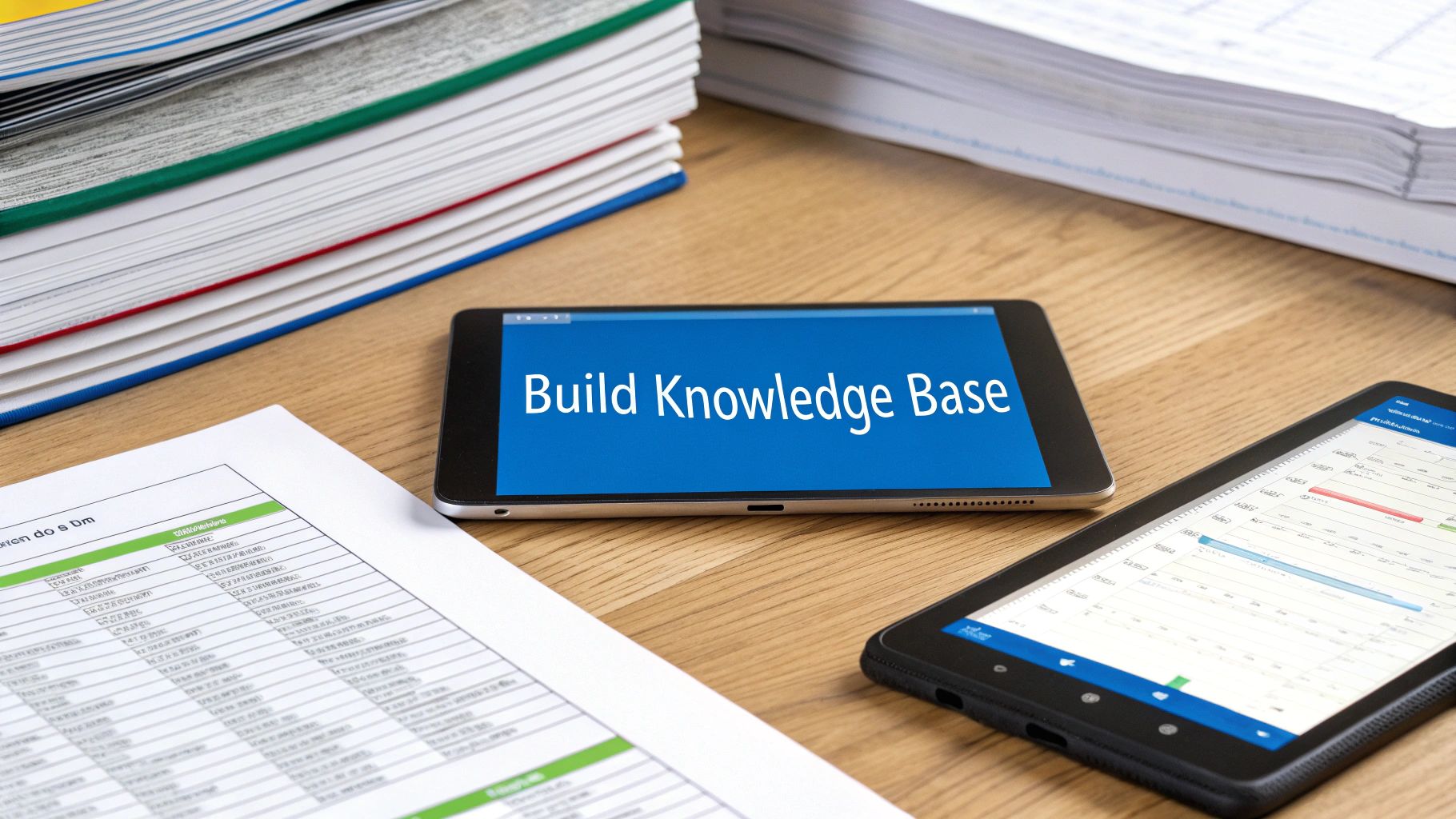
Let's get one thing straight: your chatbot is only as smart as the information you feed it. This isn't just a step in the process; it's the absolute foundation. Getting this right is the most critical part of learning how to train an AI chatbot that actually solves problems instead of creating them.
Think of it less like a file upload and more like curating a specialized library. The goal is to build a rock-solid knowledge base that truly represents your business. The best chatbots are trained on a rich mix of your most valuable content, which is how they learn to handle specific questions with confidence.
Identifying Your Core Knowledge Sources
So, where is all this great information hiding? It’s probably scattered all over your company. Your first job is to hunt down the official, verified content that acts as the single source of truth for your products, policies, and operations.
Here are the most effective places to start looking:
- Website Content: The obvious first stop. Crawl your entire site, pulling from product pages, service descriptions, FAQs, and blog articles.
- Documentation: This is where the real gold is. Think PDFs, DOCX files, and internal wikis like product manuals or detailed policy documents.
- Spreadsheets and Data: For structured data like pricing tables or feature comparison charts, nothing beats a clean CSV or XLS file.
- Transcripts: Don't forget multimedia. Transcripts from your YouTube tutorials or webinars are packed with expert insights.
To help you decide which content types are best suited for different training goals, here’s a quick rundown.
Choosing the Right Data Source for Your Chatbot
| Data Source Type | Best Used For | Preparation Tip |
|---|---|---|
| Website Pages | General company info, product overviews, marketing content | Ensure the site is up-to-date and remove any expired promotional pages before crawling. |
| PDFs & DOCX | In-depth guides, policy documents, user manuals, legal terms | Break down long documents into smaller sections with clear headings for better comprehension. |
| CSV & Spreadsheets | Pricing lists, feature comparisons, product catalogs, location data | Keep it simple. Use clear column headers and ensure data is consistent and error-free. |
| YouTube Transcripts | How-to guides, tutorials, expert interviews, webinar content | Clean up the auto-generated transcript to fix any errors in terminology or names. |
The real power comes from combining these sources to create a complete picture of your business.
Structuring Data for Accurate Answers
Just dumping a folder of documents into the system and hoping for the best is a recipe for messy answers. The structure of your data has a massive impact on your chatbot’s performance. A neatly formatted document leads to sharp, accurate answers, while a messy one causes confusion.
Imagine a bank training a chatbot on mortgage rates. If an old PDF with last year's rates gets mixed in, it could give a customer dangerously wrong information, instantly breaking trust. The old saying Garbage In, Garbage Out (GIGO) has never been more true.
To sidestep this, get your documents in order first. Break down long reports into smaller, focused sections with clear headings. If you want to dive deeper, we have more tips for building a great knowledge base chatbot.
Actionable Takeaway: Your Data Audit Checklist
Before you upload a single file, run through this quick content audit. It's a simple sanity check to make sure you’re building your chatbot on solid ground.
- Is it current? Get rid of old documents, expired price lists, and outdated promotional materials.
- Is it accurate? Double-check your information. Does the return policy on your website match the one in your internal training PDF?
- Is it structured? Use clear headings, bullet points, and short paragraphs. AI models process well-organized content much more effectively.
- Is it relevant? Only include information a customer or employee would actually ask about.
By thoughtfully preparing your data, you aren't just uploading files—you're teaching your chatbot how to be a valuable, accurate, and trustworthy extension of your brand.
Defining Your Chatbot’s Persona and Rules

Alright, your data is clean and your knowledge base is ready. Now for the fun part: giving your chatbot a personality and a rulebook. This is one of the most important steps in learning how to train an AI chatbot because it’s where you teach it how to behave.
This boils down to what we call prompt engineering. You’re essentially writing a master set of instructions—a "base prompt"—that acts as your chatbot's core programming. This single prompt tells the AI who it is, what it sounds like, and what it's allowed to do.
Crafting the Core Identity
Think of your bot's persona as a direct extension of your brand. Is your company a playful startup or a formal financial institution? The way your chatbot communicates should feel instantly familiar to your customers.
The difference is night and day. A customer support bot for an e-commerce brand might be designed to be friendly and empathetic. In contrast, a lead generation bot on a B2B software site needs to be professional, efficient, and direct.
Setting Clear Operational Rules
A great personality isn't enough; your prompt also has to lay down the law. These operational guardrails keep your bot on track, preventing it from giving unhelpful or made-up answers. You need to be crystal clear about what it should do and what it shouldn't.
A solid base prompt should cover these rules:
- Knowledge Source Boundaries: Should the bot stick only to the documents you provided? Nailing this down prevents it from inventing facts.
- Human Escalation Triggers: When does the bot pass the conversation to a human? You can set rules for it to escalate when a user gets frustrated or asks for a manager. A seamless human handover process is key for a good user experience.
- Handling Off-Topic Questions: Instruct the bot to politely sidestep irrelevant questions and guide the conversation back to business.
- Clarification Protocol: Teach the bot to ask for more information when a user's question is vague. A simple, "Could you tell me a bit more?" is better than a wild guess.
Actionable Takeaway: Your Base Prompt Checklist
As you write your base prompt, run through this checklist. If you can answer "yes" to all of these, your chatbot has the personality and rules it needs to be genuinely useful.
- Is the persona clearly defined? (e.g., "You are a friendly and helpful support assistant named 'Botly.'")
- Is the tone of voice specified? (e.g., "Use a professional yet approachable tone. Avoid slang.")
- Are the knowledge limits set? (e.g., "Only answer questions based on the provided documents. If the answer is not in the documents, say you don't know.")
- Are the escalation rules clear? (e.g., "If the user asks to speak to a person, immediately offer to connect them to our live support team.")
- Does it know how to decline gracefully? (e.g., "If asked a question outside of your expertise, politely state that you can only help with our products and services.")
Testing and Refining Your Chatbot

You've built a solid knowledge base and given your chatbot a personality. That’s a great start, but it’s just the beginning. The real magic happens when you see how it handles real-world questions.
This testing and refinement phase is where a good bot transforms into an indispensable tool. Think of it less as a one-and-done task and more as an ongoing cycle of listening and improving.
Getting Your Chatbot Live to Start Gathering Data
Before you can fix anything, your bot needs to be live. Modern chatbot platforms make this part easy, letting you deploy your AI assistant right where your customers already are.
You can add it to your website with a quick copy-paste of a code snippet or integrate with platforms like WhatsApp, Slack, or Facebook Messenger. By meeting customers on their turf, you start collecting real-world interaction data from day one.
A Framework for Rigorous Internal Testing
Your team is your first line of defense. Before a single customer interacts with your bot, you need to do everything you can to break it. This internal stress-testing helps you catch the most glaring errors in a safe space.
Get your team involved and tell them to throw complex, multi-part questions at it. Encourage them to try and trick the bot with weird edge cases. This process is perfect for checking accuracy, tone, and whether your prompt works. For a deeper dive, check out our guide on how to do chatbot testing.
During this stage, hone in on these key areas:
- Accuracy Check: Ask questions where you already know the answer. Is the bot pulling the right info?
- Tone of Voice: Does the bot stick to the persona you designed?
- Edge Case Handling: What happens when you ask something random? Does it politely say it can't help?
Analyzing Chat Logs for Invaluable Insights
Once your chatbot is live, the chat logs become your single most important resource. By reading through these conversations, you’ll see exactly what your customers are asking, in their own words.
This is where the real breakthroughs happen. You’ll quickly spot patterns and uncover needs you never would have predicted. For example, a retail store might find that 20% of users are asking about a product feature that isn't clearly explained on the website. That kind of feedback is gold.
This direct line to your users allows you to make data-driven improvements. You can pinpoint which questions the bot fumbles and identify gaps in your knowledge base.
Actionable Takeaway: Your Quick Refinement Checklist
Use this simple checklist to guide your refinement process after your initial tests. It will help you systematically improve your chatbot's performance.
- Identify Top Unanswered Questions: Dive into the chat logs. What are the most common questions your bot couldn't handle?
- Update Your Knowledge Base: Create or revise documents to provide crystal-clear answers to those questions.
- Refine Your Base Prompt: If the bot’s tone is off or it’s mishandling certain situations, adjust its core instructions.
- Test the Changes: After making updates, run through your internal tests again to make sure your fixes worked.
- Repeat the Cycle: This isn't a one-time project. Set aside time to review your chat logs regularly to keep making your bot better.
What to Watch Out For: Limitations and Considerations
Building a powerful AI chatbot is exciting, but you have to be realistic—it's not a magic wand. Getting honest about its limits is the first step to building an assistant that’s genuinely trustworthy. A huge part of knowing how to train an AI chatbot is learning how to manage its blind spots.
One of the biggest issues you can run into is outdated information. Your pricing, product features, and policies are always evolving, and your bot needs to keep up.
The Danger of Stale Information
An AI chatbot can only know what you've told it. If it was trained on last year's service agreement or an old pricing sheet, it will confidently—and incorrectly—give outdated info to your customers. This isn't just a bad look; it can create serious compliance headaches and shatter trust.
Picture a bot for a financial firm quoting an old, lower interest rate. The fallout can be massive. This is exactly why keeping your knowledge base fresh isn't just a "nice-to-have"—it's non-negotiable.
Knowing When to Call in a Human
Even the sharpest AI hits a wall. It can get tangled up in complex questions or fumble an emotionally charged conversation. Forcing a frustrated customer to keep poking at a bot that can't help them is a surefire way to lose them for good.
This is where a seamless human handover becomes your most critical feature. You need to set up clear triggers that automatically pass the conversation to a live agent. These triggers are usually based on common sense signals:
- Keywords: Simple phrases like "speak to a person" or obvious signs of frustration.
- Going in Circles: If a user asks the same question three times, it's a clear signal the bot is failing.
- Sensitive Topics: Conversations about personal complaints or security worries should always get a human involved.
Security and Data Privacy Can't Be an Afterthought
When customers chat with your bot, they're handing over their data. It could be a simple name and email, or it could be much more sensitive information. Protecting that data isn't just good business; it's a legal requirement.
Your chatbot platform has to be built on a rock-solid security foundation. That means you need to work with providers who are transparent about how they protect you.
Actionable Takeaway: Your Quick Security Checklist
When you're looking at different platforms, these are the non-negotiable questions you need to ask.
- Is it SOC 2 compliant? This is a rigorous, third-party audit that proves a company takes security and confidentiality seriously.
- Does it comply with GDPR? If you have any customers in Europe, this is an absolute must.
- Is the data encrypted? All chat data—both when it's being sent and when it's stored—should be locked down.
- Do you own your data? You must have the power to access and delete user data whenever you need to. You can see how we tick these boxes on our features page.
Automating Retraining and Measuring Success
A great chatbot isn’t a "set it and forget it" tool. The moment you stop refining it is the moment it starts becoming obsolete. Your business is always evolving—products get updated, marketing campaigns launch, and policies change. Your chatbot’s knowledge has to keep pace.
Learning how to train an AI chatbot that actually works long-term means mastering automated retraining and keeping a close eye on performance.
Keeping Your Chatbot's Knowledge Fresh Automatically
Manually updating your chatbot every time a detail changes is inefficient and won't last. The smarter approach is to use automated retraining features that periodically re-scan your data sources. You can set your bot to automatically crawl your website or sync with a document every day or week.
This simple setup ensures any new information—a new blog post or an updated FAQ—is automatically absorbed into the bot's knowledge base. For a retail business, this means a bot can instantly learn about a new product line. For a software company, it can answer questions about a feature that was just released.
Measuring What Matters Most
You can't improve what you don't measure. Tracking the right metrics is the only way to truly understand how your chatbot is performing and prove its return on investment. The data will show you exactly where the bot is excelling and where it needs more training.
Here's a look at the essential metrics you should be tracking.
Key Chatbot Performance Metrics
| Metric | What It Measures | Why It Matters |
|---|---|---|
| Resolution Rate | The percentage of conversations solved without human help. | This is a direct measure of efficiency and shows how effectively the bot is reducing your support team's workload. |
| User Satisfaction (CSAT) | Feedback from users, often via a quick post-chat survey. | This tells you if customers are actually happy with the answers they receive, providing direct insight into the user experience. |
| Conversion Rate | The percentage of users who take a desired action (e.g., book a demo). | For sales bots, this is the ultimate ROI metric, linking the chatbot directly to revenue generation. |
| Human Handover Rate | The percentage of chats escalated to a live agent. | A high rate may indicate gaps in the knowledge base or issues with the bot's ability to understand user intent. |
By regularly reviewing these numbers, you can make data-driven decisions. For a deeper dive, check out our guide on the most important chatbot analytics to monitor.
Common Questions About Training an AI Chatbot
As you start digging into the process, a few questions always seem to pop up. Let's tackle some of the most common things people ask about how to train an AI chatbot for their business.
How Long Does It Take to Train a Chatbot?
With modern platforms, the initial setup is surprisingly fast—often just a few minutes. You point it to your data sources, like your website URL, and the system builds its first brain.
But the real work is in the ongoing refinement. While you can have a working bot in less time than it takes to make coffee, you'll want to spend time analyzing its first conversations to sharpen its performance.
Do I Need Coding Skills to Train a Chatbot?
Absolutely not. Today's no-code chatbot builders are made for business users, not developers. The whole process is handled through a simple, visual interface.
The focus has completely shifted from technical know-how to the quality of your content. If you can write a clear FAQ page, you have all the skills you need. You can see more about this on our features page.
How Often Should I Retrain My Chatbot?
This depends on how often your business information changes. If your product docs get an update every week, you should aim for a weekly retraining schedule.
Many platforms, ours included, offer automated retraining that can sync with your website daily or weekly. This is a game-changer because it ensures your chatbot’s knowledge is always current without you having to lift a finger.
Ready to build an AI expert for your business? At FastBots.ai, you can create a custom-trained chatbot that delivers instant, accurate answers 24/7. Start your free trial today and see how easy it is to get started.