How to Make an AI Assistant: A Practical Guide
So, you want to learn how to make an AI assistant. You've come to the right place. The core idea involves defining what you need it to do, choosing a platform, feeding it your business data, and then deploying it on your website or other channels.
It sounds simple, but the real art is in designing smart, helpful conversations and connecting the assistant to your other tools so it can actually get work done for you.
Why Your Business Needs a Custom AI Assistant
Before we get into the nuts and bolts, let's talk about why this is worth your time. Building an AI assistant isn't just a cool tech project anymore; it's a fundamental part of a modern business strategy.
Companies are using custom AI to handle customer support, streamline internal processes, and provide personalized experiences that are simply impossible to deliver at scale otherwise.

Think about it: what if you could free up your team from answering the same five questions over and over again? They could finally focus on the strategic, high-value work that truly needs a human touch. This isn't just about efficiency—it’s about carving out a real competitive edge.
The Growing Demand for AI Automation
The market for AI assistants is growing rapidly, which tells you a lot about where the industry is headed. According to recent data, the market is expected to expand significantly, showing just how quickly businesses are adopting this technology.
This growth is driven by tangible results. A well-built AI assistant can handle thousands of customer chats simultaneously, offer 24/7 support without needing a coffee break, and capture leads long after your team has gone home for the day. For example, many e-commerce stores are seeing success by using AI to automatically engage customers who abandon their shopping carts.
Understanding the broader benefits of harnessing AI automation for businesses helps clarify why this is such a smart move. An effective AI assistant acts like a new member of your team, handling routine tasks so your people can focus on complex problems and build stronger customer relationships.
Learning how to build an AI assistant now puts you ahead of the curve. You'll be better equipped to meet customer expectations for instant, helpful service while making your own operations smoother.
Defining Your AI Assistant's Purpose and Persona
Before you touch a single line of code or sign up for a platform, we need to talk strategy. It’s tempting to jump straight into the technology, but rushing into development without a clear plan is a common way to build an AI that sounds robotic and doesn't actually help anyone.
The very first step in learning how to make an AI assistant is to ask a simple question: what specific job do we want this assistant to do?
Your assistant’s core purpose is the north star for every decision you’ll make. For instance, are you building an external-facing bot for your e-commerce store to handle order status questions? Or is this an internal assistant for your HR team to answer questions about company benefits? The goals for these two bots are worlds apart.
Starting With a Clear Use Case
Nailing down one primary goal focuses your efforts and makes it much easier to measure success. A retail brand, for instance, might be buried in support tickets about shipping. Their AI assistant's primary goal would be to answer "Where is my order?" questions accurately, with a clear target to reduce ticket volume.
A B2B software company might want an assistant to qualify leads on its website. Here, the goal isn't reducing tickets; it's about engaging visitors, asking the right questions, and booking demos for the sales team. Pinpointing this function is non-negotiable, and our guide on why every business needs a custom chatbot digs deeper into this.
Actionable Takeaway: Quick Checklist
Grab a whiteboard (or a doc) and answer these questions with your team:
- What is the single most repetitive, time-consuming task we handle daily?
- Who is the main person this assistant is for (e.g., new customers, existing employees, potential leads)?
Your answers form the foundation of your assistant's purpose.
Choosing Your AI Assistant's Primary Goal
A comparison of common business goals for AI assistants to help you define your project's scope and expected outcomes.
| Business Goal | Example Use Case | Key Metric (KPI) | Best For |
|---|---|---|---|
| Reduce Support Tickets | Answering "Where's my order?" or password reset questions. | Ticket Containment Rate | E-commerce, SaaS, High-volume support teams |
| Generate & Qualify Leads | Engaging website visitors, asking qualifying questions, booking demos. | Qualified Leads Generated, Meetings Booked | B2B Companies, Agencies, High-ticket services |
| Boost Sales & Conversions | Proactively offering product recommendations or discount codes. | Conversion Rate, Average Order Value (AOV) | E-commerce, Direct-to-consumer (DTC) brands |
| Improve Internal Efficiency | Answering HR policy questions or IT troubleshooting steps. | Employee Satisfaction, Time Saved Per Task | HR departments, IT support, Operations teams |
| Onboard New Users | Guiding a new customer through product setup steps. | User Activation Rate, Time-to-Value | SaaS platforms, Subscription services |
Don't try to boil the ocean. Pick one primary goal to start. You can always expand later, but a focused assistant is typically a successful one.
Crafting a Memorable Persona
Now that you know what your assistant will do, it's time to decide who it will be. An assistant's persona is its personality—the tone and style it uses. This isn't just fluff; it's a huge part of the user experience that builds trust and ensures the bot feels like a natural extension of your brand.
Think about your brand voice. Are you formal and professional, or friendly and casual? A bank's AI assistant, for example, should probably sound reassuring and professional. In contrast, an online boutique's bot might use emojis and a witty, laid-back tone. Whatever you choose, it needs to align with how you already communicate with your customers.
This is where modern tools shine—building custom AI agents trained on your own content allows you to bake this personality in from the very beginning.
Choosing the Right Tools and Preparing Your Data
With your strategy locked in, it's time to roll up your sleeves and move from planning to building. This part is about two things: picking your technology and preparing the knowledge for your new AI assistant.
Getting these two pieces right is the foundation for an assistant that's powerful, reliable, and genuinely helpful.
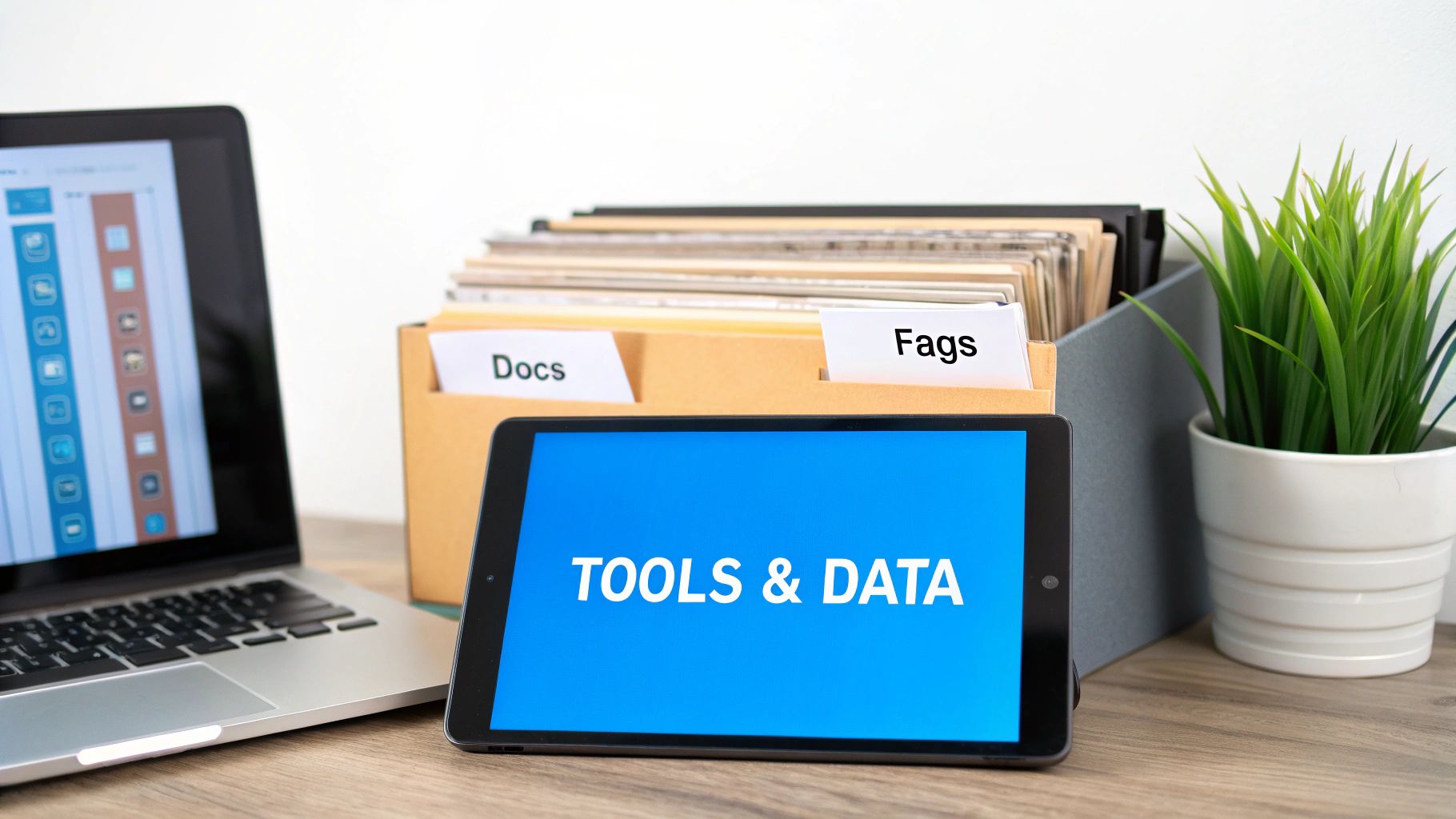
The world of AI tools can feel complex, but your options really boil down to a few key categories. Your final choice will likely depend on your team's technical skills, your budget, and how quickly you need to launch.
No-Code vs. Low-Code vs. Custom Frameworks
The first big decision you’ll make is what kind of platform to use. Each has trade-offs regarding flexibility, cost, and the skills needed to get started.
No-Code Platforms: These are excellent if you're on a non-technical team. Tools like FastBots.ai let you build a powerful AI assistant by uploading documents you already have. You can have a working bot running in under an hour, making it a great fit for teams that need to move quickly without a developer.
Low-Code Platforms: This is a good middle ground. These platforms offer more customization than no-code options but still provide a visual builder to speed up development. You might go this route if you have some tech-savvy team members and want to create more complex conversation flows.
Custom Frameworks: For those who need complete control, frameworks like Rasa or Microsoft Bot Framework offer a "build it from scratch" path. This approach requires a dedicated development team with AI expertise and is usually reserved for large companies with very specific, complex needs.
For most businesses, a no-code platform strikes a great balance of power and simplicity. We've put together a guide exploring various tools to develop AI chatbots if you'd like to dive deeper.
Your AI Is Only as Good as Your Data
The platform is just the engine; your data is the fuel. Let's be direct: an AI assistant's ability to give good answers comes directly from the quality of the information you provide. Garbage in, garbage out.
Start by gathering all the "sources of truth" across your company. This is the knowledge base your assistant will use to answer every question. Once you have your documents, the real work starts: cleaning and structuring. This means removing outdated info, fixing errors, and ensuring everything is written in clear language.
Structuring Data for Accurate AI Responses
How you organize your data can significantly impact your assistant's performance. Instead of uploading one giant 100-page PDF, it's often better to break it into smaller, logically organized chunks.
For instance, you could create separate files for "Shipping Policy," "Return Process," and "Warranty Information." This approach helps the AI quickly find the exact information a user is asking for, leading to faster, more accurate answers. It also makes updates much easier down the road.
Taking the time now to pick the right platform and prepare your data is what sets a successful project apart from a frustrating one. It’s how you build an assistant that helps people and delivers a clear return on investment.
Training and Integrating Your Assistant
You've got your strategy and your data is prepped. Now for the exciting part—this is where your AI assistant starts becoming a real, working tool. We're going to bring it to life by training it with your unique knowledge and then supercharge it by plugging it into your core systems.

Think of this phase as teaching a new hire. You’re showing your AI how to think, talk, and act like a valuable member of your team.
From Raw Data to a Trained Model
The first step is to upload all that clean, organized data you prepared. Modern no-code platforms have made this process incredibly simple. You'll likely just be dragging and dropping files or pasting website links into an interface, and the system handles the rest.
Once your data is in, the actual training process begins. The AI model reads through everything—every FAQ, policy document, and product spec—to learn the ins and outs of your business. This is the crucial step that turns a generic AI into an expert on your company. Our guide on how to train a chatbot on your own data offers a deeper look at this process.
Now, it’s your turn to test it. Start by asking simple questions, then ramp up the difficulty. This back-and-forth helps you immediately spot any knowledge gaps or areas where its answers need more polish.
The Power of Integration
An AI assistant that just answers questions is helpful. An integrated assistant, however, is a game-changer. The real value emerges when your AI can do things by connecting to the other software you use daily.
These connections are often managed with tools like Zapier or Make, which act as the glue between your AI and thousands of other apps. This allows you to set up simple workflows that trigger actions based on conversations. For instance, an integrated assistant could look up an order status in Shopify, create a new lead in Salesforce, or log a ticket in Zendesk.
These integrations elevate your assistant from a simple Q&A bot to a true extension of your team, automating tasks that used to consume valuable time. You can explore other useful automations in our list of proven B2B marketing AI tools.
Deploying Across Multiple Channels
Your customers aren't just on your website; they're on WhatsApp, Facebook Messenger, and Slack. A key part of building a successful AI assistant is meeting your audience where they already are.
Most modern platforms are built for multi-channel deployment. This means you build your assistant once, then deploy it across different channels with a few clicks. The core knowledge base remains the same, ensuring a consistent experience no matter where a customer interacts with you.
What to Watch Out For: Limitations and Considerations
Building your first AI assistant is exciting, but it's wise to be aware of common hurdles. Understanding these challenges will help you create a tool that people actually trust and use. This isn't about being negative; it's about being strategic.
One of the biggest pitfalls is feeding your AI low-quality or outdated data. If your knowledge base has conflicting information, your bot will provide incorrect answers with complete confidence. This damages your brand's credibility and can lead to very frustrated customers.
Even the most advanced AI has its limits. It will eventually encounter a question that's too complex or emotionally charged for an automated system. Without a plan for these moments, you risk leaving users stuck in a frustrating loop.
Plan for a Flawless Human Handover
This is precisely why a seamless human handover is essential. You need a graceful way for the assistant to say, "I'm not sure, but I can connect you with someone who can help." Modern platforms like FastBots.ai often have this built-in with live chat features that make the transition painless.
The goal is to avoid a conversational dead end. Make sure the entire chat history is passed to the human agent so the customer doesn't have to repeat their problem.
Don't Overlook Data Privacy and Security
Another important consideration is data privacy, especially if your assistant handles sensitive details. Users need to feel confident that their data is secure. Failing to protect data can harm your reputation and lead to legal issues.
Before you commit to a platform, ensure it is transparent about its security measures. Look for features like data encryption and compliance with regulations like GDPR. Your AI assistant is an extension of your business, so it must meet the same high standards for data protection. The market for intelligent virtual assistants is growing quickly, and as more businesses adopt this tech, user expectations around privacy and performance will only increase, as noted by research from firms like Precedence Research.
Ultimately, success when you make an AI assistant comes from understanding and respecting its limitations. By planning for data quality, human handovers, and robust security from the start, you build a tool that not only works but also earns your users' trust.
Launching, Monitoring, and Continuously Improving
Going live isn't the finish line; it’s the starting line. Now that you know how to make an AI assistant, the real learning begins. Your assistant's first few weeks in the wild will provide a wealth of data about how real people interact with it.
Monitoring its performance right away is critical. This isn't just about watching for technical glitches; it's about listening to what your users are asking and identifying where conversations break down. This early feedback is what separates a decent bot from a truly valuable one.
Analyzing Performance and Gathering Feedback
Your first job post-launch is to review the conversation logs. These transcripts are your best source of truth, showing you the most common questions and the moments where your assistant gets confused.
For example, an e-commerce store might notice dozens of users asking, "Can I change my delivery address after ordering?" If the bot doesn't have a clear answer, that's an immediate signal to update its knowledge base. Reviewing these logs regularly helps you catch these gaps early.
Implementing a Cycle of Continuous Improvement
Once you’ve identified knowledge gaps, the next step is to act on them. This creates a powerful cycle where your assistant gets smarter with every interaction. Many modern platforms have features that make this process straightforward.
For instance, a tool like FastBots.ai can automatically retrain your assistant whenever you update your website, ensuring its knowledge is never out of date. This automated approach is key to maintaining accuracy over the long haul.
You can also gather feedback directly. A simple "Was this helpful? 👍/👎" prompt at the end of a conversation provides invaluable input. Combining this feedback with insights from your logs gives you a complete picture of your assistant's performance.
This ongoing process of monitoring, analyzing, and refining ensures your AI assistant becomes an asset that delivers increasing value to your business and your customers over time.
Still Have Questions About Building an AI Assistant?
You have the blueprint, but a few questions might still be on your mind. Here are straightforward answers to some of the most common questions we hear from businesses.
How Much Technical Skill Do I Really Need?
A few years ago, you would have needed a team of developers. Not anymore. Today, you can build a powerful, custom AI assistant with zero coding knowledge.
Thanks to no-code platforms, the barrier to entry has lowered significantly. If you can upload a PDF or copy a website link, you have the skills you need. These tools are designed for business users, not programmers, allowing you to focus on the quality of your data and the user experience.
What's a Realistic Budget for an AI Assistant?
The cost can vary, but it's often more affordable than people assume. Your spending will depend on a few key factors:
- Platform Subscription: Most no-code tools operate on a monthly subscription, with costs ranging from free tiers to a few hundred dollars per month for advanced features.
- Developer Time (If Applicable): If you choose a low-code or custom build, this will be your biggest expense, potentially ranging from a few thousand to tens of thousands of dollars.
- Ongoing Maintenance: Remember to factor in the time your team will spend monitoring logs and updating the knowledge base.
For most small to medium-sized businesses, a no-code platform offers the best value by keeping costs predictable and overhead low.
How Long Does It Take to Build?
This depends on the path you choose. With a no-code tool, you can go from an idea to a working AI assistant in under an hour. The main time investment is often in organizing your data beforehand.
A custom project, on the other hand, is a longer journey. A simple custom bot might take a few weeks, while a more sophisticated, integrated assistant could take three to six months to develop and launch.
Ready to stop answering the same questions over and over? FastBots.ai lets you build a custom AI assistant trained on your own content in minutes—no coding required. Start your free trial today and see how easy it is to build your first AI assistant.