Discover how to increase website conversion rate: A practical guide

If you want to increase your website's conversion rate, you first need to appreciate its power. This isn't about chasing more traffic; it's about getting more value from the traffic you already have. You'd be surprised how small tweaks can deliver a bigger punch to your bottom line than a splashy new ad campaign.
Why Your Conversion Rate Is a Powerful Growth Lever
Imagine doubling your revenue without a single new visitor. It sounds too good to be true, but that’s the reality of focusing on your website's conversion rate. It's often an overlooked growth strategy, but it’s one of the most cost-effective ways to turn casual browsers into paying customers.
Many businesses get stuck on a hamster wheel, pouring cash into ads to pull in more visitors and just hoping some of them stick. That approach gets expensive, fast. Conversion rate optimization (CRO), on the other hand, is all about making the marketing dollars you're already spending work much harder for you.
The Real Impact of Small Improvements
The math here is simple but incredibly powerful. Let's say your business gets 1,000 visitors a month and has a 2% conversion rate. That's 20 sales. If you can bump that rate up to just 4%, you suddenly have 40 sales from the exact same traffic. You’ve just doubled your revenue without touching your ad budget.
This is why figuring out how to increase your website conversion rate is a core business skill, not just a marketing buzzword. You’re building a more efficient engine for growth. To really drive this point home, look at the numbers in a typical scenario.
How a Small Lift in Conversions Doubles Revenue
| Monthly Visitors | Initial Conversion Rate (2.5%) | Projected Revenue | Improved Conversion Rate (5%) | New Projected Revenue |
|---|---|---|---|---|
| 10,000 | 250 sales | $25,000 | 500 sales | $50,000 |
| 20,000 | 500 sales | $50,000 | 1,000 sales | $100,000 |
| 50,000 | 1,250 sales | $125,000 | 2,500 sales | $250,000 |
Assuming an average order value of $100.
As you can see, doubling your conversion rate literally doubles your revenue from the same pool of visitors. This is the kind of leverage that can change the game for a business. Benchmark studies show that average eCommerce conversion rates hover between 1.9% and 2.6% globally. The top performers aren't just getting lucky; they're systematically testing and refining their sites.
What to Watch Out For: Limitations and Considerations
While the upside of CRO is massive, you have to approach it with the right mindset. If you get too obsessed with just the conversion metric, it's easy to fall into short-term thinking that hurts you later.
For example, slapping aggressive pop-ups all over your site might temporarily boost sign-ups, but it can erode brand trust and kill long-term customer loyalty. Nobody likes feeling cornered or pressured.
The real goal isn't just to trick people into clicking "buy." It's about genuinely improving the user experience so that converting feels like the natural and right next step. If you want to dig deeper into this philosophy, check out this great piece on the importance of Conversion Rate Optimisation in Marketing.
How to Implement: Finding Your Leaks with an Audit
Before you can boost your conversion rate, you have to play detective. Any changes you make without knowing what’s actually broken are just shots in the dark. A practical website audit is your first step to uncovering where your visitors are getting stuck or frustrated enough to leave.

Think of your website as a bucket with a few leaks. Your job is to find them—not by guessing, but by following the data trails your visitors leave behind. This isn't about becoming a data scientist overnight; it's about using simple tools to spot the friction points that are costing you money.
Starting with the "What": Quantitative Analysis
Your first stop is your website analytics platform, like Google Analytics. This is where you get the hard numbers—the "what." You're looking for pages that are underperforming compared to the rest of your site.
Specifically, you should identify pages with unusually high exit rates. If a product page has a 90% exit rate, it means nine out of every ten people who land there leave your site entirely from that one page. That's a massive leak.
Similarly, dig into your conversion funnel. Where are the biggest drop-offs? Is it between adding an item to the cart and starting the checkout? The numbers will tell you exactly where the bleeding is worst.
Understanding the "Why": Qualitative Analysis
Once you know where the leaks are, it's time to figure out why they're happening. This is where qualitative tools come in, helping you see the website through your customers' eyes.
Tools that provide heatmaps and session recordings are gold for this. Heatmaps give you a visual summary of where users click, move their mouse, and how far they scroll. You might discover that everyone is clicking on an image that isn't a link, or that no one sees your main call-to-action button.
Session recordings take this a step further, letting you watch anonymized videos of real user sessions. This kind of context is something raw numbers can never give you and is a key step in optimizing your lead generation landing pages.
Actionable Takeaway: Your Quick Audit Checklist
Here’s how you can apply this in your business. You don't need a massive budget, just a methodical approach.
- Find Your Top 5 "Leakiest" Pages: Dive into your analytics and pull the five pages with the highest exit rates or funnel drop-offs.
- Analyze Heatmaps for Those Pages: What are people clicking on? What are they ignoring? Is the most important info visible?
- Watch 10 Session Recordings: Pick five recordings of users who converted and five who didn't. Note what successful users did differently.
- Just Ask: Use a simple on-page survey on your problem pages. Ask one question: "Was there anything stopping you from completing your purchase today?"
Core Capability: Designing a User Experience That Converts
Great user experience isn’t about flashy design. It's about making it dead simple for your visitors to say "yes." This means zeroing in on the core elements that make a website feel intuitive, fast, and trustworthy.
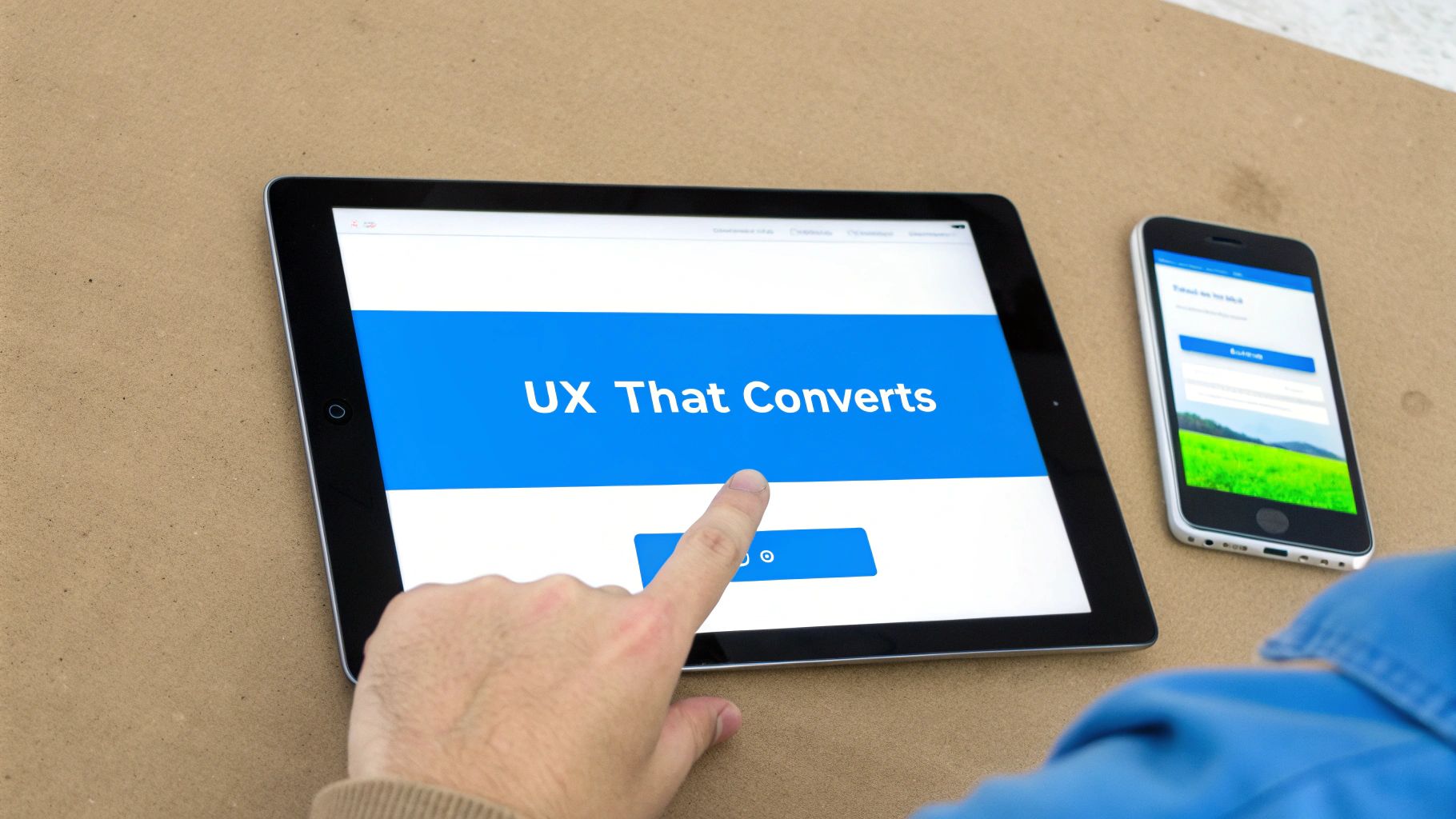
It all boils down to a simple question: are you making things easy or hard for your visitors? Every extra click, confusing label, or slow-loading page adds a tiny bit of friction that quietly encourages people to leave.
Every Second Counts: The Importance of Page Speed
If there’s one foundational element of a high-converting user experience, it’s speed. In a world of instant gratification, a slow website is an absolute conversion killer. It creates a poor first impression and communicates a lack of care.
Studies have hammered this point home. A large portion of mobile users will ditch a site if it takes longer than three seconds to load. For instance, Walmart famously reported that for every one-second improvement in page load time, they saw conversions jump by about 2%. This is why a fast, responsive experience is non-negotiable.
Creating a Clear Path to Conversion
Beyond speed, your site's structure is everything. A visitor should be able to understand what you offer and how to get around within seconds. This is all about clear navigation and a strong visual hierarchy.
Think of visual hierarchy as a way of telling your visitors what's most important without using words. Larger headlines, brighter buttons, and prominent placement for key info guide the user's eye naturally toward the action you want them to take.
For example, a typical e-commerce site might use a clean layout where the product image is the biggest element, followed by a clear headline and a brightly colored "Add to Cart" button. This kind of intentional design guides the user’s focus.
What to Watch Out For: Trade-offs in UX Design
Improving user experience is a powerful way to boost your conversion rate, but it isn’t without its trade-offs. The biggest challenge is often balancing simplicity with providing enough information for someone to make a decision.
Sometimes, in an effort to create a "clean" design, businesses strip out crucial details that customers need. For instance, removing shipping details from a product page might look less cluttered, but that missing information can become a major conversion blocker for a nervous buyer. The goal isn't minimalism for its own sake; it's clarity.
Core Capability: Crafting Copy and CTAs That Drive Action
Your website's design lays out the red carpet, but it's your words that convince people to walk down it. Think of great copy and clear calls-to-action (CTAs) as your most direct tools of persuasion. This is where you connect with a visitor's real needs and earn their trust.
Conversion copywriting isn’t about being clever. It's the art of using language to prompt a specific action. You need headlines that stop the scroll and a value proposition that instantly answers their biggest question: "What's in it for me?"
From Features to Benefits
One of the most common copywriting mistakes is talking endlessly about yourself. Businesses list features and technical specs but forget to connect them to the customer’s problem. To see your conversion rate climb, you have to speak their language—the language of benefits.
A "feature" is what something is. For example, "Our drill has a lithium-ion battery." A "benefit" is what it does for the customer: "Drill for three hours straight on a single charge." The benefit is the real reason someone buys.
Anatomy of a High-Converting CTA
Your Call-to-Action is the moment of truth. A weak CTA can tank all the great work you did getting them there. Generic phrases like "Submit," "Click Here," or "Learn More" are missed opportunities because they have zero urgency and little value.
A powerful CTA is action-oriented and screams value. For instance, instead of "Subscribe," try "Get Weekly Growth Tips." This simple shift reframes the action from something the user is giving (their email) to something they are gaining (valuable content).
Building Trust with Social Proof
People are often more persuaded by what other people think and do. This is where social proof becomes your secret weapon. Strategically placing testimonials, reviews, or case studies near your CTAs can reduce friction and build instant confidence.
Seeing that others had a great experience with your product removes a huge amount of perceived risk. Think about integrating these trust signals at key decision points, like a checkout page or next to a chatbot landing page form. The right testimonial at the right moment is often the final piece of the puzzle.
Core Capability: Using AI to Remove Friction and Guide Buyers
Imagine having a perfect sales assistant on your site 24/7—someone who can answer any question, guide users to the right product, and capture leads without missing a beat. This is exactly what modern AI chatbots are built to do.
A well-trained AI agent can be a personal shopper, a support rep, and a sales assistant all rolled into one. The goal is to provide immediate, intelligent help that turns hesitant visitors into confident buyers.
Proactively Solving Doubts Before They Become Dealbreakers
Think about the last time you were about to buy something online and stopped. Maybe you couldn't find the return policy or shipping costs. These little moments of hesitation are massive conversion blockers.
An AI chatbot, trained on your business data, erases these doubts in real time. This kind of proactive support is a game-changer for anyone trying to figure out how to increase website conversion rate. It meets customers right where they are, answering questions the second they pop into their heads.
It's a tough statistic, but e-commerce cart abandonment rates often hover above 70%, typically because of unexpected costs. An AI bot that provides instant clarity on these costs can single-handedly rescue a huge chunk of those sales. You can dig into more global conversion and cart abandonment rates to see just how big this problem is.
This conversational approach is especially powerful for complex products or services. For a SaaS company, an AI bot can help a visitor figure out which pricing tier fits their needs. We cover this in-depth in our guide on how an AI sales chatbot can boost conversion rates.
How AI Chatbots Solve Common Conversion Blockers
| The Conversion Blocker | How It Hurts Your Conversions | The AI Chatbot Solution |
|---|---|---|
| "I can't find the answer." | Users get frustrated hunting for information and eventually just leave. | Provides instant, 24/7 answers drawn directly from your knowledge base. |
| "I'm not sure which product is right for me." | Analysis paralysis sets in. The visitor feels overwhelmed and leaves. | Acts as a personal shopper, asking questions to guide the user to the best-fit solution. |
| "What are the real costs?" | Sticker shock at checkout is the #1 cause of abandoned carts. | Proactively clarifies total costs, shipping policies, and return info before the user gets to the cart. |
| "I want to talk to someone, but it's after hours." | You lose a high-intent lead because your team is offline. | Captures lead information and can even book a demo or schedule a callback. |
A chatbot is a strategic tool designed to plug the leaks in your conversion funnel by providing immediate, accurate, and helpful guidance when it matters most.
Actionable Takeaway: Your Quick Implementation Checklist
Here’s how you can apply this to your business and see a real impact on your conversions.
- Identify Your Top 3 Questions: Dive into your support tickets and sales call logs. What are the three most common questions your team answers? This is your bot's first mission.
- Train on Key Documents: Upload your full FAQ page, return policy, and shipping info directly to the AI. This ensures its answers are accurate from day one.
- Define a Clear Human Handover: Decide on the trigger for escalating a chat to a live person. A smooth handover is non-negotiable for a good user experience.
Conclusion: Your Step-by-Step Plan to Increase Website Conversion Rate
Theory is great, but results are better. Let's turn all this talk into a practical checklist you can use to increase your website's conversion rate. You don't have to tackle everything at once; just use this to guide your efforts.
Phase 1: The Initial Audit and Discovery
First, you need to know what you're working with. Before you can celebrate any wins, you have to establish a clear baseline.
- Pinpoint Your Top 5 "Leaky" Pages: Find the pages where you're losing people by looking for high exit rates or funnel drop-offs.
- Become a User Behavior Detective: Get your hands on heatmaps and watch at least 10 session recordings for those problem pages to find patterns of frustration.
- Gather Direct Feedback: Pop a simple on-page survey on your leaky pages asking what stopped visitors from converting.
Phase 2: UX and Design Sanity Checks
Now that you know where the problems are, it's time to look at the user experience.
- Test Your Page Speed: Use a tool like Google's PageSpeed Insights to see how your site stacks up, especially on mobile. A delay of even a second or two can impact conversions.
- Run a 5-Second Test: Grab someone who has never seen your site. Show them a key landing page for five seconds, then hide it. If they can't tell you your core value proposition, your messaging is failing.
- Check Mobile Usability: Pull out your phone and actually try to navigate your site. Are the buttons big enough to tap? Is filling out a form difficult?
Phase 3: A Hard Look at Your Copy and CTAs
Your words are what ultimately guide people to take action.
- Scan Your Headlines for Benefits: Are you talking about what the customer gets (the benefit), or just what your product does (the feature)?
- Audit Your Calls-to-Action: Are your CTAs specific and packed with value, like “Get My Free Guide”? Or are they generic, like “Submit”?
- Verify Your Social Proof: Check that you have testimonials or reviews placed near your most important decision points, like the pricing page.
Common Questions About Conversion Rate Optimization
If you're new to CRO, you probably have a few questions. Let's clear up some of the most common ones.
What Is a Good Website Conversion Rate, Anyway?
This is the million-dollar question, and the honest answer is: it depends. A "good" conversion rate changes based on your industry, traffic source, and what you’re selling.
That said, a general benchmark for e-commerce is somewhere in the 2% to 3% range. A solid goal to shoot for is anything over 5%. The best way to think about it is to focus on improving your own baseline, month after month.
How Long Does It Take to See CRO Results?
The timeline for seeing results from CRO efforts boils down to two things: how big of a change you made and how much traffic your website gets. A small tweak on a high-traffic page could show a statistically significant result in a couple of weeks.
Bigger projects, like a complete redesign of your checkout flow, might need a month or two of data before you can confidently say whether it worked. CRO is a marathon, not a sprint. The goal is continuous, incremental improvement.
Should I Focus on More Traffic or a Higher Conversion Rate?
For most businesses that already have some traffic, the answer is almost always: focus on improving your conversion rate first. Driving more traffic to a site that doesn’t convert well is like pouring water into a leaky bucket.
You’re spending money to bring people in, only for them to fall right out through cracks like a clunky user experience or confusing messaging. Fix the leaks first. Then you can confidently turn on the firehose of traffic and know it will be profitable.
Ready to provide instant answers and guide more visitors to convert? With FastBots.ai, you can build a custom AI chatbot trained on your business data in minutes and deploy it 24/7 to remove friction from your customer journey. Start your free trial today.