How to Create a Chatbot for Website: A Quick Guide

Adding a chatbot to your website is more than just a tech upgrade; it's about giving your business an automated assistant that provides 24/7 support, captures leads, and guides users—all without you lifting a finger. With modern platforms, you can train a bot on your own data, like FAQs and product docs, and get it live in under an hour without writing a single line of code.
Why Your Website Needs a Chatbot, Yesterday
Before we jump into the "how-to," let's talk about the "why." A chatbot is no longer a novelty; it’s a core part of a smart business strategy. We live in a world where customers demand instant answers and round-the-clock service. A chatbot is your tireless front-line employee, ready to help every single visitor, any time of day.
Think of it this way: a chatbot transforms your website from a static brochure into a dynamic, interactive conversation. Instead of making people hunt for information, the bot proactively engages them, answers their questions on the spot, and points them exactly where they need to go. That immediate help is crucial for keeping potential customers from bouncing and heading straight to a competitor.
Meeting Customers Where They Are
Let’s be honest, nobody has the patience for slow response times anymore. A chatbot cuts out the waiting game entirely by offering instant solutions to common problems. This has a massive impact on customer satisfaction and, just as importantly, frees up your human support team to tackle the more complex, high-value conversations.
Instead of answering the same five questions over and over, your team can focus on the nuanced issues that actually require a human touch.
But a well-designed bot does so much more than just support:
It captures leads around the clock: It can qualify visitors, grab their contact info, and even schedule demos while you're asleep.
It makes navigation a breeze: By figuring out what a user wants, it can send them to the right page, product, or resource, drastically improving their experience.
It boosts engagement: A conversational interface keeps people interacting with your site longer, which helps build a much stronger connection to your brand.
For a deeper look at these perks, check out our guide on the benefits of adding a chatbot to your website.
A chatbot isn't just about deflecting support tickets. It’s a proactive tool that enhances the entire customer journey, from their first visit to the final purchase. It meets users right where they are, offering personalized help that builds trust and drives conversions.
The market's explosive growth tells the same story. The global chatbot industry, valued at just $2.47 billion in 2021, is projected to skyrocket to $46.64 billion by 2029. This isn't a fluke; it highlights just how vital automated, conversational tools have become. You can find more insights on this trend over at explodingtopics.com. Adopting this technology isn't just about keeping up anymore—it's about getting ahead of the curve.
Defining Your Chatbot Strategy and Goals
Before you even think about chatbot platforms or conversation designs, let’s hit pause. The single most important thing you can do is figure out your bot's purpose. A chatbot without a clear mission is just a flashy website gadget. But a chatbot with a defined goal? That’s a powerhouse for your business.
So, the first question isn't "how do I build a chatbot?" It's "why am I building one?"
Your strategy should start by zeroing in on a specific problem or opportunity. Are your support agents drowning in the same five questions over and over? Is your sales team struggling to sift through a flood of website leads to find the good ones? Maybe visitors are just bouncing because they can't find what they need. These are the exact pain points a well-designed chatbot can solve.
Identify Your Primary Mission
Every great chatbot I've ever seen has one main job it does exceptionally well. Sure, a bot can do multiple things, but trying to make it a jack-of-all-trades from day one is a recipe for frustration. Focus on a single, high-impact goal to start.
Think about which of these core functions would make the biggest difference for you right now:
Slash Support Tickets: Your bot can be the first line of defense, instantly handling common questions about shipping, returns, or account issues. This frees up your human agents to tackle the really tough problems.
Qualify Sales Leads: It can greet visitors, ask a few smart questions about their needs or budget, and even book demos for the most promising prospects. It turns passive website traffic into a real sales pipeline.
Guide and Onboard Users: A chatbot is a fantastic tour guide for new visitors. It can point them to key features, helpful tutorials, or the right product pages, drastically improving that critical first impression.
The infographic below really brings these roles to life, showing how a bot provides that constant, always-on support that drives your business forward.
This flow really hammers home the point: a chatbot’s value is in being an ever-present resource for support, lead gen, and user guidance.
Set Measurable and Realistic Goals
Okay, you’ve picked a mission. Now, you need to attach some real numbers to it. A vague goal like "improve customer service" is impossible to measure. You need specific, quantifiable Key Performance Indicators (KPIs) that scream "success!"
This is how you turn your chatbot from a "nice-to-have" into a provable, ROI-driven asset. Make your goals concrete.
A chatbot's success isn't measured by its existence, but by its impact. Setting clear KPIs like "reduce ticket volume by 30%" or "increase qualified leads by 15%" provides a clear benchmark for performance and justifies the investment.
Here are a few examples of what strong, measurable goals look like in the real world:
| Primary Mission | Example KPI | How to Measure It |
|---|---|---|
| Customer Support | Reduce average response time by 60% | Track the time-to-first-response in your helpdesk software. |
| Lead Generation | Increase lead capture from the pricing page by 20% | Monitor form submissions or leads captured directly by the bot. |
| User Guidance | Decrease bounce rate on the homepage by 10% | Dig into your website analytics and watch user engagement metrics. |
When you map your bot's job to a specific KPI, you can actually prove its value. This data-driven approach doesn't just show you how it's performing today—it gives you the insights you need to make it even better tomorrow. Starting with a clear strategy and tangible goals is the bedrock for building a chatbot that truly serves both your business and your customers.
Choosing the Right Platform to Build Your Chatbot
The platform you pick is the absolute foundation for your chatbot. Think of it as the engine that powers its conversations, the brain that processes every question, and the toolkit you'll use to make it smarter over time. With so many options out there—from hardcore coding frameworks to slick, user-friendly builders—it’s easy to get stuck.
The whole decision really comes down to a classic "build vs. buy" scenario. Do you have the time, budget, and in-house expertise to code a bot from the ground up, or does a ready-made platform make more sense for you? Let's get practical and break down the real-world differences.
Coding a Chatbot From Scratch
Building a chatbot from scratch with a programming language like Python gives you total, granular control. You dictate every single feature, from the guts of the natural language processing (NLP) model to the tiniest detail of its conversational logic. This path is really only for large companies with highly specific, complex needs and a dedicated team of developers on payroll.
But let's be honest, this approach comes with some serious baggage:
Hefty Price Tag: Development, ongoing maintenance, and hosting costs can quickly spiral into tens of thousands of dollars.
Glacial Timelines: A custom build isn’t a weekend project. It can easily take several months just to get from an idea to a live bot.
Niche Expertise: You can't just wing it. You need a team with deep knowledge in AI, machine learning, and backend development.
For the overwhelming majority of businesses, especially small and medium-sized ones, the time and money required for custom coding just don't add up. The goal is to get a helpful chatbot on your website fast, not to launch a massive, internal software development project.
Using a No-Code AI Chatbot Platform
This is where no-code chatbot builders completely change the game. Platforms like FastBots.ai are designed to tear down the technical walls, making it possible for anyone to create a surprisingly powerful AI chatbot in minutes, not months. These tools handle all the complicated stuff behind the scenes—the AI models, the servers, the security—so you can focus entirely on what your chatbot says and how it helps your customers.
The benefits are immediate. Instead of wrestling with code, you just upload your existing content, like website pages, FAQs, or product manuals. The platform’s AI does the heavy lifting, instantly learning your data to serve up accurate answers.
The real magic of a no-code platform is speed to value. You can go from signing up to having a fully trained, AI-powered chatbot embedded on your site in under an hour. That kind of rapid deployment means you start seeing a return on your investment almost immediately.
This approach makes advanced AI accessible to everyone, allowing businesses of any size to offer a level of support that was once reserved for the big players. For a deeper look at this, check out our guide on the differences between no-code and low-code chatbot development.
Key Factors for Your Decision
As you weigh your options, run through these critical factors. Your answers will quickly point you in the right direction.
| Factor | No-Code Platform (e.g., FastBots.ai) | Custom Coding |
|---|---|---|
| Setup Time | Minutes to hours | Weeks to months |
| Budget | Low monthly subscription | $10,000+ upfront, plus ongoing costs |
| Technical Skill | None required | Expert development team needed |
| Maintenance | Handled by the platform | Requires ongoing developer resources |
| Scalability | Built-in and ready to handle growth | Needs to be custom-built and managed |
For most businesses that want a chatbot for their website, a no-code platform is the clear winner. It hits that sweet spot of power, flexibility, and simplicity. You get access to sophisticated AI technology without the crippling costs and headaches, letting you launch a genuinely helpful assistant that improves the customer experience from day one.
Preparing and Structuring Your Training Data
An AI chatbot is only as smart as the information it’s trained on. This is where the real work begins—turning your raw business knowledge into a structured "brain" your bot can use to give instant, accurate answers. Think of it like prepping study materials for a student; the better the notes, the better they'll do on the test.
The process kicks off by gathering all the information a customer might ever need. The good news? You don't have to create this content from scratch. It's all about strategically collecting the valuable knowledge you already have scattered across your business.
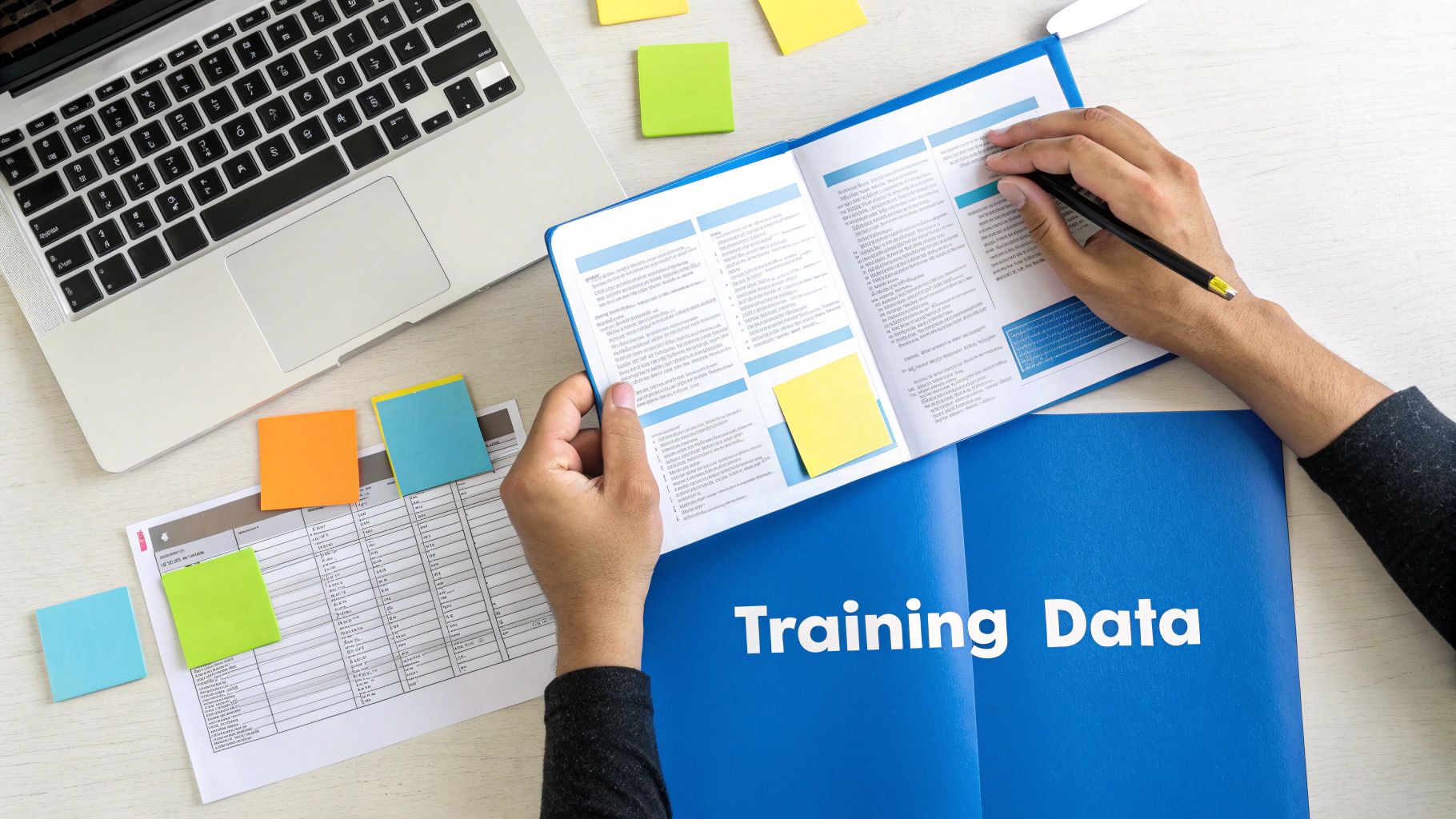
Where to Find Your Training Data
Your business is a goldmine of information. You just need to know where to look. Start by pulling together a list of your most valuable, customer-facing content.
Here are the best places to source high-quality training data:
Your Website Pages: Scrape your "About Us," "Services," "Pricing," and product pages. These are often the first places people look for foundational info.
Frequently Asked Questions (FAQ) Page: This is the lowest-hanging fruit. Your FAQ page is literally a list of questions your customers are already asking, along with the answers.
Support Documentation and Knowledge Base: Dive into your help articles, tutorials, and how-to guides. This content is specifically designed to solve problems, making it perfect for a support-focused chatbot.
Marketing Materials: Don't overlook your brochures, white papers, and case studies. They often contain detailed info about your value proposition and what you offer.
Once you have these sources, you can easily upload them into a no-code platform. This screenshot from FastBots.ai shows just how simple it is to add various data sources, from website links to document files.
As you can see, the interface lets you mix and match content types to build a really comprehensive knowledge base for your bot.
Formatting Data for Maximum Accuracy
How you structure your data is just as important as the data itself. A well-organized knowledge base helps the AI understand context and deliver precise answers. Just dumping a 100-page manual into the system is a recipe for vague or flat-out wrong responses.
Break down your content into logical, digestible chunks. Instead of one massive document, create smaller files focused on specific topics. For instance, have separate docs for your "Return Policy," "Shipping Information," and "Product Specifications."
Your chatbot thinks in terms of questions and answers. So, structure your data to mimic this. Use clear headings as questions and the paragraphs that follow as the answers. This one simple formatting trick dramatically improves the bot's ability to find the right information quickly.
Follow these best practices when you're formatting:
Use Simple Language: Ditch the internal jargon, complex acronyms, and overly technical terms. Write like you're explaining it to a brand-new customer.
One Topic Per Document: Keep each document or text entry focused on a single subject. This stops the bot from getting confused by overlapping information.
Create Clear Q&A Pairs: For common queries, a simple text file with one question per line followed by its answer is one of the most effective ways to train a bot on specific facts.
Getting the data prep right is becoming standard practice. About 46% of SaaS companies are expected to use chatbots by 2025. With these bots handling 74% of routine queries, the quality of their training data directly impacts the 80% of customers who report positive experiences.
Common Data Preparation Mistakes to Avoid
Even with the best intentions, it’s easy to slip up in ways that can hamstring your chatbot’s performance. Knowing the common pitfalls from the get-go will save you a ton of troubleshooting time later on.
The goal is a clean, unambiguous knowledge base.
Here are some frequent errors I see and how to fix them:
| Mistake | Why It's a Problem | How to Fix It |
|---|---|---|
| Outdated Information | The bot gives incorrect answers, which erodes user trust. | Regularly audit your training data. Remove or update old documents. |
| Conflicting Details | Two documents give different answers to the same question. | Designate a single source of truth for key info like pricing or policies. |
| Complex Formatting | Tables, charts, or multi-column layouts can confuse the AI. | Convert complex documents into simple text or Q&A formats before uploading. |
By thoughtfully gathering and structuring your knowledge, you lay the groundwork for a truly effective chatbot. For a more detailed walkthrough, check out our comprehensive guide on how to train a chatbot on your own data. Trust me, this preparation phase is the most critical step in creating a chatbot for your website that users will actually find helpful.
Giving Your Bot a Personality and Mapping Out Conversations
Once you've fed your chatbot the right information, it's time for the fun part: deciding how it should talk. A truly great chatbot does more than just spit out correct answers. It delivers them with a personality that feels like a natural extension of your brand, turning a simple tool into a memorable brand ambassador.
So, what's your bot's vibe? This is your first creative hurdle. Are you a buttoned-up, professional brand, or are you more quirky and fun? The bot's voice should mirror your company's overall tone. A chatbot for a financial advisory firm, for instance, should probably be formal and direct. But one for an online comic book store? It can afford to be a lot more playful and use slang.
This isn't just about being clever; it’s about building trust. A consistent and appropriate tone makes the whole experience feel less like you're talking to a cold, robotic script and more like a genuine conversation.
Nailing the Welcome Message and Setting Expectations
Those first few seconds of a chatbot interaction are everything. Your welcome message is your bot's digital handshake, and it has to do two things instantly: build a connection and set clear expectations. A vague "How can I help you?" just leaves people staring at the screen, unsure of what to ask.
A much better approach is to be specific and offer a little guidance.
For example, a weak welcome message might just say:
- "Hello. Ask me anything."
A strong welcome message, on the other hand, gets right to the point:
- "Hi there! I’m Sparky, your AI assistant. I can help you with pricing, technical specs, or your order status. What can I find for you today?"
See the difference? The better version introduces the bot, gives it a name (which immediately makes it feel more human), and clearly states what it can do. This simple act of setting boundaries stops users from getting frustrated by telling them upfront what the bot is good at. This is a game-changer when you create a chatbot for your website.
The best chatbot interactions start by managing expectations. A well-crafted welcome message that clearly defines the bot's purpose guides the user toward productive questions and keeps them from asking for things it can't deliver.
Planning Out Common Conversation Flows
Even though modern AI chatbots can handle all sorts of random, free-form questions, you should still put some thought into the most common user journeys. A conversation flow is really just a simple map of a typical interaction, guiding users from their first question to a successful answer.
Think about the top reasons people contact you. Are they constantly asking about your return policy? Or maybe they're trying to book a demo? For these frequent-flyer questions, you can design guided paths that get them what they need, fast.
For instance, if a user asks about "returns," the bot could respond with something like: "I can definitely help with that! Are you looking to start a new return or check the status of an existing one?" This little trick uses simple button prompts to steer the user toward a specific answer quickly, making the whole conversation feel incredibly efficient and user-friendly.
Designing a Smooth Handoff to a Human
Look, no matter how smart your chatbot is, there will always be times when a human touch is needed. A really complex problem, a sensitive issue, or a high-value sales inquiry is often best handled by a person. Planning for a seamless handoff to a live agent isn't just a nice-to-have; it's non-negotiable.
The process needs to be smooth and aware of the context. When the bot figures out a human is needed, it shouldn't just throw up its hands and say, "I can't help."
Instead, it should pass the baton gracefully:
- "It looks like this question requires a specialist's touch. I can connect you with a member of our support team right now. Would you like me to transfer you?"
Platforms like FastBots.ai have built-in live chat features that make this transition completely painless. The bot can grab the user's name and email, summarize the conversation so far, and pass it all directly to a human agent. The best part? The customer doesn't have to repeat themselves. It’s this kind of thoughtful design that ensures the customer experience stays positive, even when the bot reaches its limits.
Launching and Improving Your Website Chatbot

You’ve loaded up your chatbot’s knowledge base and given it a personality. Now it’s time for the final push before going live. This last phase is all about testing, a clean deployment, and setting up a system for making your bot better over time.
Remember, launching isn't the finish line. It's the starting gun.
Before you let your new bot loose on your website visitors, you need a solid pre-launch check to catch any awkward phrases or broken conversation flows. This is more than just spell-checking; you’re simulating real user interactions to make sure the experience is actually helpful, not frustrating.
Your Pre-Launch Quality Checklist
Run through a few scenarios yourself, but the real magic happens when you get a fresh pair of eyes on it. Grab a couple of colleagues who haven't been involved in the building process. They'll quickly spot confusing paths or unanswered questions you’ve become blind to.
Accuracy Check: Ask your most common customer questions. Does the bot spit out the correct, up-to-date info every single time?
Persona Consistency: Read the bot's responses out loud. Does the tone feel right for your brand, from the first "hello" to the final answer?
Human Handoff Test: Try to stump it. Ask a question you know it can’t answer. Does it escalate to a live agent smoothly, or does it just give up and leave the user hanging?
Embedding the Chatbot on Your Website
Once you're confident in its performance, getting the chatbot onto your live website is surprisingly simple, especially with platforms like FastBots.ai. The whole process usually just involves copying a small piece of code—often a single line of JavaScript—and pasting it into your website's HTML, typically right before the closing </body> tag.
That one snippet is all it takes to make the chat widget appear. No need to call in a team of developers.
A successful chatbot is a living tool, not a static one. Your goal after launch is to listen to what your users are actually asking and use those insights to make the bot smarter and more helpful every single week.
This cycle of ongoing improvement is where you’ll see the biggest return. After all, customer expectations are being reshaped by AI in real-time. We're in the middle of a huge shift, with an estimated 500 to 600 million people globally now using AI tools daily, many of them through website chatbots.
This trend makes it clear: people want instant, conversational support that gets better over time. You can learn more about these AI adoption statistics and what they mean for businesses.
Regularly diving into your chat logs is your roadmap for improvement. Platforms like FastBots.ai make this easy. Look for patterns in unanswered questions or topics where users seem to get stuck. Each one is a golden opportunity to add new information to your bot's knowledge base, sharpening its ability to meet customer needs. This is how a good chatbot evolves into a great one.
Frequently Asked Questions About Website Chatbots
Thinking about adding a chatbot to your website? You probably have a few questions. Let's tackle some of the most common ones we hear from businesses just starting out.
How Much Does It Cost to Create a Website Chatbot?
The price tag for a website chatbot can swing wildly depending on how you build it.
If you decide to hire a development team for a completely custom-built bot, you could be looking at an investment of $10,000 to $50,000 or even more. This route gives you ultimate control, but it comes with a hefty price and a long wait time.
A much more practical approach for most businesses is using a no-code AI platform like FastBots.ai. These platforms work on a simple subscription model, often with plans starting at a very low monthly cost. This opens the door for any size business to launch a smart AI assistant without the huge upfront investment, giving you the best of both worlds: powerful features and an affordable price.
How Long Does It Take to Build a Chatbot?
This all comes down to the method you choose. A custom-coded project isn't a quick job—it can easily take several weeks, if not months, to get from the initial idea to a live, working chatbot.
On the other hand, with a modern no-code platform, you can move at lightning speed. If you have your training materials ready—like your website's URL, a list of FAQs, or some support documents—you can build and launch a fully functional chatbot in less than an hour. It really is that simple: sign up, upload your data, tweak the design, and paste one line of code onto your website.
The speed of no-code platforms is a total game-changer. You can start generating leads, answering customer questions, and seeing a real return on your investment almost instantly, instead of waiting months for a development cycle to wrap up.
Can a Chatbot Connect with Other Business Tools?
Absolutely, and this is where chatbots really start to shine. Modern chatbot platforms are built to play nicely with the other software you already rely on to run your business.
Some of the most valuable integrations include:
Customer Relationship Management (CRMs): Imagine new leads captured by your bot automatically popping up in your sales pipeline. No more manual entry.
Email Marketing Services: New subscribers can be added directly to your email lists, ready for your next newsletter.
Support Helpdesks: When a user runs into a tricky problem that needs a human touch, the bot can automatically create a support ticket.
Before you commit to a platform, always double-check its integration capabilities to make sure it connects with your existing tech stack. This kind of automation is what transforms your chatbot from a simple Q&A tool into an indispensable part of your business operations.
Ready to build an AI assistant that works for you 24/7? With FastBots.ai, you can create a custom chatbot trained on your own data in minutes, not months. Start your free trial and launch your chatbot today!