How to Build a Chatbot A Practical Guide

Before you write a single line of code or click a button in a bot-builder, you need a plan. The entire process starts with a simple question: what business goal are we trying to achieve? From there, you can choose the right tech—whether it's a no-code platform or a custom build—and map out exactly how users will interact with it. Getting this blueprint right from the start is what separates a genuinely useful bot from a failed science project.
Your Blueprint for a High-Performing Chatbot
Treating your chatbot project like a strategic business initiative is non-negotiable. The global chatbot market is expected to hit a staggering $46.64 billion by 2029, and that growth isn’t just about cool tech. It’s fueled by companies that figured out how to solve real, measurable problems. Your first job is to define what winning looks like for you.
Are you aiming to slash customer support tickets by 40%? Maybe the goal is to qualify leads around the clock, feeding your sales team even while they sleep. Pinpointing a clear, quantifiable goal is the bedrock of the entire project.
A chatbot without a well-defined purpose is like a ship without a rudder. It might be impressive, but it won't get you anywhere meaningful. The goal dictates every subsequent decision, from the technology you choose to the conversations you design.
Defining Your Core Use Case
First things first: identify a high-impact area where a bit of automation will deliver the biggest bang for your buck. Resist the temptation to build a bot that does everything. Start small, stay focused, and solve one specific problem brilliantly.
Some common, high-value starting points include:
Customer Support Automation: Fielding all those repetitive questions about order status, return policies, or basic product features.
Lead Generation and Qualification: Engaging website visitors, asking the right qualifying questions, and booking demos straight into your sales team’s calendar.
Internal Support: Acting as a go-to resource for employees with questions about HR policies, IT troubleshooting, or where to find company documents.
Imagine an e-commerce store that builds a bot just to handle "Where is my order?" inquiries. That single-purpose bot is far easier to build, train, and measure. It delivers immediate value and frees up human agents to tackle the tricky stuff. If you're curious about the technical nuts and bolts, you might find our guide on key principles for chatbot architecture design useful.
Selecting the Right Technology Path
With your goal locked in, you’ve reached a fork in the road: do you use a no-code platform or go for a full custom development project? The right answer depends entirely on your team's technical chops, your budget, and how complex your use case is.
To make this decision clearer, let's break down the two main paths.
Chatbot Platform Comparison: No-Code vs. Custom Development
| Factor | No-Code Platforms | Custom Development |
|---|---|---|
| Speed to Launch | Very Fast (Hours or Days) | Slow (Weeks or Months) |
| Technical Skills | None required; drag-and-drop interface | Expert developers and data scientists needed |
| Cost | Low monthly subscription fees | High upfront investment (often $5,000 to $500,000+) |
| Flexibility | Good, but within the platform's limits | Unlimited; build anything you can imagine |
| Maintenance | Handled by the platform provider | Requires an ongoing internal or external team |
| Ideal For | SMBs, marketing teams, support departments | Enterprises with unique, complex requirements |
For most businesses, the choice is pretty straightforward. No-code platforms, like FastBots.ai, are designed for speed and simplicity. You can build and deploy a powerful chatbot in minutes using a visual interface, training it on your own documents and website content without touching a line of code. It's the perfect path for teams that need results, fast.
On the other hand, custom development offers complete freedom but comes with a hefty price tag in both time and money. This route makes sense for large enterprises with highly specific integration needs or those looking to build a proprietary AI solution from the ground up. While the cost—anywhere from $5,000 to over $500,000—is significant, it can be justified by massive efficiency gains. According to Exploding Topics, businesses stand to save up to $11 billion annually by using chatbots.
Ultimately, this planning phase ensures that your investment, whether it's a modest monthly subscription or a six-figure development project, is set up to deliver a real, tangible return.
Gathering and Structuring Your Chatbot's Knowledge
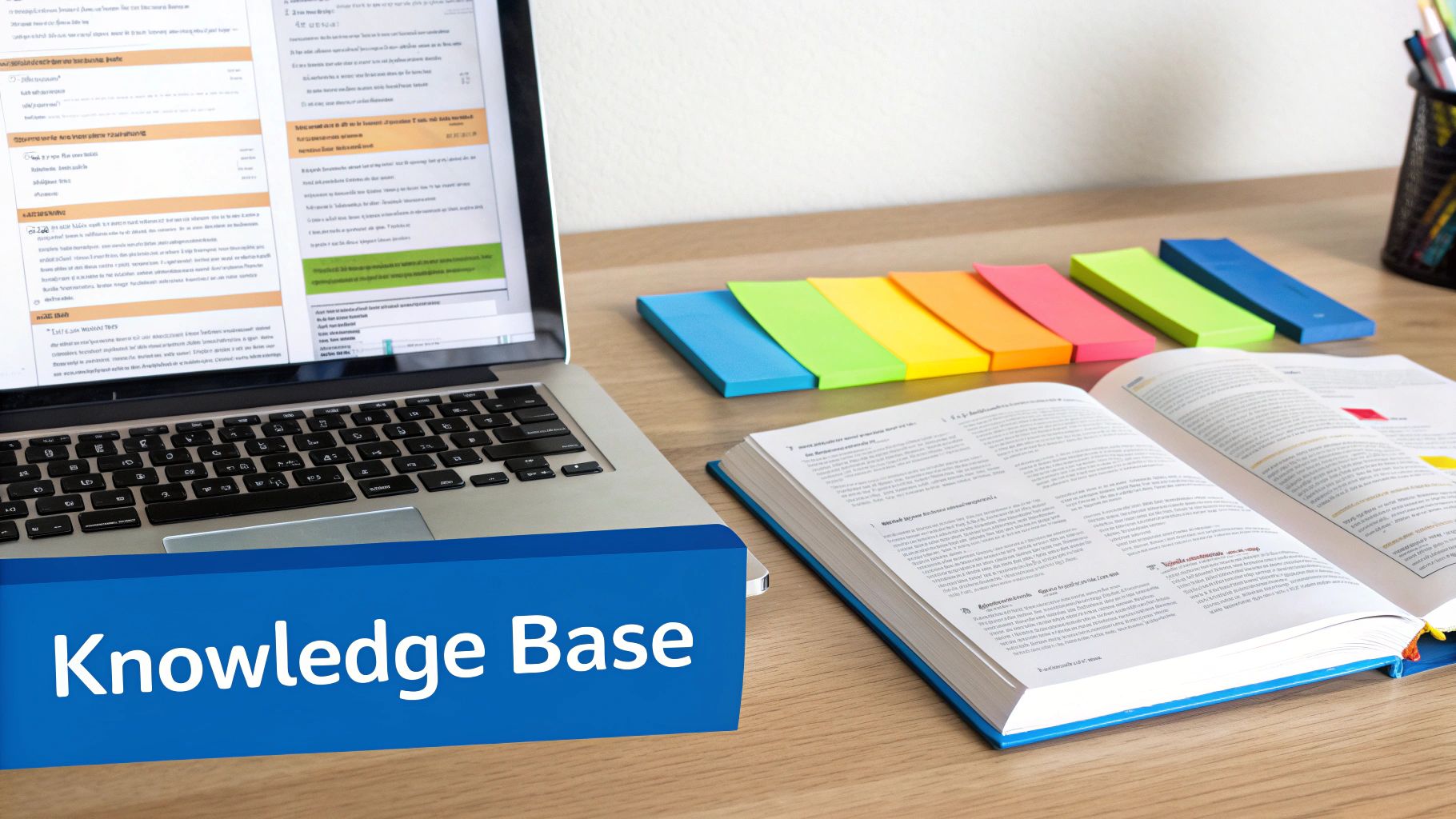
A chatbot is only as smart as the information you give it. This isn't just a cliché; it's the absolute truth. Think of this phase as creating the curriculum for your bot's education—its entire ability to be helpful hinges on the quality and organization of its "study materials."
To build a genuinely effective chatbot, you have to become a librarian for your own company's knowledge. This means sourcing information from every corner of your business where valuable customer-facing or internal data lives. The goal isn't to just dump a bunch of files into a folder, but to carefully curate a clean, relevant, and accessible knowledge base the AI can reliably draw upon.

Here's the good news: your existing resources are gold mines. Instead of writing everything from scratch, you can save a massive amount of time by gathering what you already have. This approach also ensures the chatbot’s voice and information are perfectly aligned with your established company knowledge from day one.
Sourcing Your Core Knowledge
First things first, you need to conduct an audit of your existing content. You're on the hunt for any document or system that currently answers the kinds of questions your target users are likely to ask. This is all about collecting the raw materials that will eventually form your chatbot’s brain.
Some of the most common sources for high-quality data include:
Existing FAQ Pages: This is the lowest-hanging fruit. These pages are already structured in a question-and-answer format, making them incredibly easy for an AI to process.
Customer Support Transcripts: Dig into your chat logs and support tickets. This is where you'll find the most common questions customers actually ask, in their own words. It’s an invaluable source for real-world phrasing and uncovering issues you might not have even known were issues.
Product Manuals and Guides: If you're building a technical or product-specific bot, these documents are non-negotiable. They contain detailed specifications, troubleshooting steps, and critical how-to instructions.
Internal Wikis and Knowledge Bases: Don't overlook your internal documentation, especially for HR or IT bots. Things like company policies, process guides, and internal FAQs are perfect training material.
The key is to gather a diverse set of documents that cover the full spectrum of potential user queries. A broader knowledge base almost always leads to a more competent and useful chatbot.
Cleaning and Formatting Data for the AI
Let's be honest—raw data is often messy. Before you can feed it to your chatbot, you have to clean it, structure it, and get it into a format the AI can actually understand. This is arguably the most critical step in determining your bot's accuracy.
Imagine feeding an AI a 50-page PDF filled with inconsistent formatting, random headers, and weird footers. It's going to struggle to find the right answers. Your goal is to create clear, concise snippets of information instead. For a deeper dive on this, our article has some excellent tips for building a great knowledge base chatbot.
The single biggest point of failure for new chatbots is poor data quality. Spending extra time here to clean, format, and organize your information will pay dividends in user satisfaction and bot performance. Don't rush this part.
Start by converting all your source material into a consistent format. Simple text files or structured documents like CSVs usually work best. Then, break down long documents into smaller, topically-focused chunks. A single chunk should ideally answer one specific question or cover one distinct topic.
Defining Intents and Entities
With your data all cleaned up, the next step is to teach the chatbot what users are trying to achieve. In the world of AI, this is done by defining intents and entities.
Intents represent the user's goal. Think of them as verbs. For example,
check_order_status,request_refund, orask_about_shipping_policyare all intents. They capture the underlying purpose of a user's message.Entities are the key pieces of information within an intent that the bot needs to fulfill the request. They're the nouns. In a
check_order_statusintent, the key entity would be theorder_number.
Let's look at a quick example. A user might ask, "Where's my stuff from order #12345?" Another might say, "Can I get a status update on 12345?"
The Intent: In both cases, the user's goal is the same:
check_order_status.The Entity: The crucial piece of data the bot needs to pull out is the
order_number, which is "12345".
By defining these, you're training the model to recognize the various ways a user might phrase a request while also extracting the specific details it needs to provide a precise answer. This structure is what transforms your raw knowledge into an intelligent system capable of understanding and acting on what people actually need.
Choosing Your Tools and Training the AI Model
Alright, you've got your knowledge base polished and ready to go. Now for the fun part: picking your tools and actually teaching your chatbot how to think. This is where the magic happens—where your bot develops its "brain," learning how to understand questions and pull the right answers from the data you've so carefully prepared.
The world of chatbot development is massive, with options ranging from super-accessible no-code builders to powerful AI APIs for the more technically adventurous.
The right choice really boils down to your team's tech skills, your budget, and the goals you set back in the planning stage. Platforms like FastBots.ai are built for speed and simplicity, letting you upload documents and launch a working bot in just a few minutes. On the other end, you can go direct, using APIs from providers like OpenAI, which gives you more granular control but definitely requires some coding chops.
Navigating the Platform Landscape
The platform you choose is going to shape your entire development journey, so it's worth taking a moment to pick one that fits your resources and long-term plans.
No-Code Builders: This is the best bet for most businesses. These tools have intuitive, visual dashboards where you can upload your knowledge sources (PDFs, website URLs, you name it), tweak the bot's personality, and get it live without touching a single line of code. They do all the heavy lifting on the backend, so you can focus on your content and the user experience.
Low-Code Platforms: Think of these as the middle ground. Tools like Google's Dialogflow or Microsoft Bot Framework give you pre-built components and some visual tools, but they also let you inject custom code for deeper integrations. They're a great fit for teams with some developers who need a bit more flexibility than a pure no-code option.
API-Based Development: This is the full-on, hands-on approach. You're building a completely custom solution from the ground up using foundational models like OpenAI's GPT series. It offers total control but demands serious expertise in programming, data science, and managing infrastructure.
If you want a deeper dive into the pros and cons, check out our guide on the best tools to develop AI chatbots efficiently. It breaks down the options to help you land on the perfect choice.
Kicking Off the Training Process
Once your platform is picked out, the training begins. For most modern AI chatbots, especially those using a method called Retrieval-Augmented Generation (RAG), "training" isn't about building a new AI model from scratch. It's really about making your knowledge base digestible and searchable for the existing AI.
Here’s what that typically looks like in practice:
Upload Your Knowledge Base: First, you’ll upload all those clean, formatted documents you prepared. The platform will ingest and process this content.
Create Embeddings: The system then converts your text into numerical representations, known as vectors or embeddings. This is the secret sauce that allows the AI to grasp the semantic meaning of your content, not just keywords.
Index for Retrieval: Finally, these vectors are stored in a special kind of database (a vector database) built for incredibly fast similarity searches. When a user asks a question, the system instantly finds the most relevant snippets from your knowledge base to give the AI the context it needs to form a smart answer.
This approach is incredibly powerful. The generative AI market has exploded, with ChatGPT alone capturing a staggering 81.37% of the worldwide market share. By building a chatbot today, you're tapping into the power of these massive, pre-trained models and simply grounding them with your specific, expert data.
Testing and Refining the First Draft
Let's be real: your bot's first answers won't be perfect. And that's okay. The initial training just gives you a starting point. Your next job is to test it like crazy, find the weak spots, and start making it better.
Start with the obvious stuff—the most common questions you expect your users to ask. Once you've covered those, try to break it. Ask vague questions, use slang, or give it incomplete information to see how it handles the curveballs.
Think of this initial testing phase as a conversation with a new employee. You need to see where their knowledge is strong, where they get confused, and what topics require more detailed training materials. Every "I don't know" is a valuable piece of feedback.
Make a note of every wrong or weird answer. These little failures are your roadmap for improvement. If the bot keeps fumbling questions about a particular product, that’s a flashing sign that you need to beef up the information about it in your knowledge base. By zeroing in on these gaps, you can systematically add new content, tweak existing documents, and retrain the model until its accuracy is where you need it to be.
Getting Your Chatbot in Front of Customers
A brilliant chatbot is useless if nobody can find it. Now comes the exciting part: moving your bot out of the lab and putting it right where your customers are. This isn't just about flipping a switch; it's about meeting people on the channels they already use every day.
The goal is to create a seamless experience, whether someone is browsing your website, sending a message on WhatsApp, or asking a quick question in Facebook Messenger. Each channel has its own quirks, but the principle is the same: be there and be helpful.
Deploying a Chatbot on Your Website
Your website is the most natural starting point. It's your digital storefront, and dropping a chatbot there gives you a 24/7 assistant to engage visitors, answer questions, and capture leads while you sleep. Modern platforms like FastBots.ai make this incredibly simple. Often, all it takes is pasting a single line of code into your site's HTML.
That little snippet of code is what adds the chat widget—that familiar bubble in the corner of the screen. When you're setting this up, keep a few things in mind:
Be visible, not annoying. The chat icon should be easy to spot but shouldn't block important content on the page. The bottom-right corner is standard for a reason.
Match your brand. Tweak the widget’s colors, add your logo, and write a welcome message that sounds like you. A cohesive look builds trust.
Use proactive triggers. Don't just wait for people to click. Have the bot pop up with a helpful message on key pages, like your pricing or checkout page, to offer assistance right when it's needed most.
Expanding to Messaging Apps
While your website is home base, a massive amount of customer interaction now happens on messaging apps. Integrating your chatbot with platforms like WhatsApp, Facebook Messenger, and Slack opens up entirely new ways to connect with people.
This is a bit more involved than just embedding code on a website. Each platform has its own API (Application Programming Interface) that your chatbot needs to talk to. For instance, the WhatsApp Business API has strict rules about initiating conversations, while Facebook Messenger offers cool UI elements like carousels and quick-reply buttons.
Tapping into these channels isn't just about being available; it's about using the native features users already know and love. A well-designed Messenger bot that uses interactive buttons feels far more natural than one that just spits out blocks of text.
Here’s a quick breakdown of what to focus on for each channel:
| Channel | Key Consideration | Best Use Case |
|---|---|---|
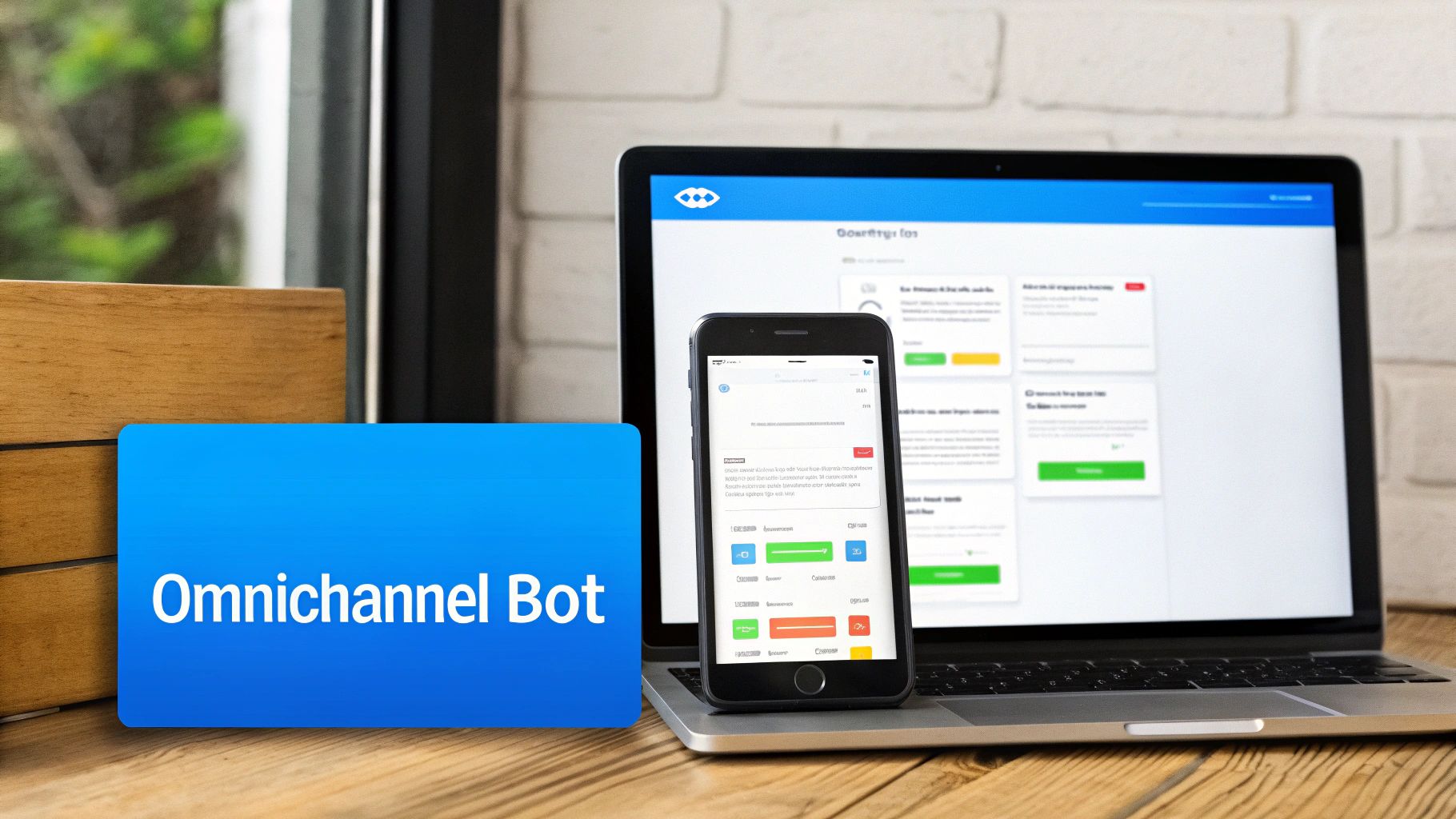
| API access and message templates | Customer support, order updates, and appointment reminders. | |
| Facebook Messenger | Rich UI elements (buttons, carousels) | Lead generation, product discovery, and marketing campaigns. |
| Slack | Internal workflows and app integrations | Internal IT support, HR questions, and team notifications. |
Choosing a Deployment Model
Finally, you have to decide where your chatbot will physically "live." The two main paths are cloud-based and on-premise, and the right choice really boils down to your needs for scale and data control.
A cloud-based model means the chatbot platform hosts and manages everything for you. This has become the go-to approach because it offers huge flexibility and you don't have to worry about managing servers. In fact, cloud deployment is now the choice for 78.4% of organizations thanks to its easy scalability and built-in security. If you're curious about market trends, Mordor Intelligence offers some great insights into the global chatbot market.
The alternative is an on-premise deployment, where you host the chatbot on your own servers. This gives you absolute control over your data, which is non-negotiable for industries with heavy compliance rules, like finance or healthcare. But it also means your team is on the hook for all the infrastructure, maintenance, and security. For most businesses, the scalability and sheer convenience of a cloud solution make it the most practical way to go.
How to Test, Secure, and Improve Your Chatbot
Getting your chatbot live is a huge step, but don't pop the champagne just yet. The launch is the starting line, not the finish. The real work is just beginning—a continuous cycle of testing, securing, and improving your bot’s performance. This ongoing process is what turns a good chatbot into a great one that actually helps your customers and protects their data.
Going live without a solid testing plan is like setting sail in a leaky boat. You need a structured way to make sure every piece of the experience works exactly as you planned. This isn't just about squashing bugs; it's about making sure the bot delivers on the goals you set from day one.
This final phase isn't a one-and-done task. Think of it as a commitment to building a tool that gets smarter and more valuable over time.
Creating a Practical Testing Framework
Before you tell the world about your new chatbot, you have to put it through its paces. A strong testing framework should cover everything from specific conversation flows to how it handles the weird, unexpected things real people type. It's all about building confidence that your bot is ready for the wild.
Start with unit testing for individual conversational paths. Basically, you create a script of common questions and scenarios and walk through them one by one.
Happy Path Testing: Does the bot handle the most common questions flawlessly? Think "What are your hours?" or "Where's my order?"
Edge Case Testing: What happens when someone types in slang, misspells a word, or just mashes the keyboard and types "help!!"? A well-built bot should handle the chaos gracefully, maybe by offering suggestions or escalating to a human agent.
Integration Checks: If your bot is connected to other systems, like your CRM or a scheduling tool, test those connections like crazy. Does it actually create a new lead? Does that meeting really show up on the calendar?
The final step is User Acceptance Testing (UAT). Grab a small group of real people who haven't been involved in the project—colleagues from another department or even a few loyal customers. Let them try to break it. Their unfiltered feedback is gold for spotting confusing flows or moments where the bot's personality just feels... off.
Safeguarding User Data and Ensuring Compliance
Trust is the currency of any conversation. When someone chats with your bot, they're trusting you with their information, whether it's a simple email address or a detailed support ticket. Protecting that data isn't just a nice-to-have; it's a legal and ethical must.
Security can't be an afterthought. From the very beginning, you should be thinking about how to protect user data. This means choosing a platform that offers features like encryption for data both in transit and at rest.
A single data breach can destroy years of customer trust. When you build a chatbot, you're also building a promise to your users that their privacy will be respected and their data kept safe.
Compliance with regulations like GDPR isn't optional. Your chatbot's entire operation needs to align with the data privacy laws that apply to your audience.
Data Handling: Have strict rules for how personally identifiable information (PII) is collected, stored, and accessed.
Transparency: Your privacy policy should clearly state what data the chatbot collects and why. No surprises.
User Consent: Always get clear, explicit consent before you collect any personal information.
Platforms like FastBots.ai are built with security in mind, offering features that help you meet standards like SOC 2 and GDPR. This lets you focus on creating an amazing user experience without cutting corners on security.
Establishing a Continuous Improvement Loop
A great chatbot is never really "done." It evolves. The secret to long-term success is creating a feedback loop where you constantly analyze performance, spot weaknesses, and use those insights to make the bot smarter.
Your chat logs are a treasure trove of data. Dig into them regularly. Find out where users are getting stuck, what questions your bot failed to answer, and which topics come up the most. This analysis tells you exactly what to work on next.
Analyze Chat Logs: Look for failed conversations or repeated "I don't know" responses. These are the most obvious gaps in your bot's knowledge.
Gather User Feedback: A simple thumbs-up/thumbs-down survey after a chat can give you a quick pulse on user satisfaction. It's easy to implement and incredibly valuable.
Refine and Retrain: Use what you've learned to update your knowledge base. Add new documents, rephrase existing answers for clarity, and retrain the model.
Track Key Metrics: Keep a close eye on your numbers. Metrics like resolution rate (how many chats were solved without a human), escalation rate, and user satisfaction scores give you concrete proof of your bot's ROI and show you where to focus your efforts.
This iterative process is what turns your chatbot from a static Q&A tool into a dynamic, learning system that delivers better results for your business and a more helpful experience for your customers.
Common Questions About Building a Chatbot
Even with the best plan in hand, you're going to have questions when you decide to build a chatbot. That’s perfectly normal. Getting straight answers early on demystifies the whole process and keeps the project from getting bogged down.
Let's walk through some of the most common questions we hear from teams just like yours.
How Much Does It Really Cost to Build a Chatbot?
This is usually the first question out of the gate, and the honest answer is: it completely depends on the path you take. The cost spectrum is huge, ranging from a couple of lattes a month to a six-figure investment.
No-Code Platforms: For most small and medium-sized businesses, this is the smartest, most cost-effective route. You're typically looking at a monthly fee that often starts with a free tier and scales with your usage. This model makes powerful AI accessible without a scary upfront investment.
Custom Development: Building a bot from scratch is a serious financial commitment. Costs can easily run from $5,000 to over $500,000 once you factor in developer salaries, server costs, and all the ongoing maintenance. This path really only makes sense for massive enterprises with incredibly specific, niche requirements.
The big takeaway here is that you don't need a huge budget to get a fantastic, capable chatbot anymore. Modern platforms have completely changed the game, making this tech available to everyone.
How Long Does the Building Process Take?
Just like cost, the timeline can vary wildly. A custom-built chatbot can take months—sometimes even a year—of development, testing, and back-and-forth before it’s ready to talk to a single customer. It’s a major project that requires a dedicated team and a rigid schedule.
On the flip side, using a no-code builder shortens that cycle from months to minutes. Seriously. You can go from signing up to having a working chatbot on your website in under an hour. Most of your time will be spent on the important stuff—like gathering your knowledge and organizing your data—not wrestling with code.
The speed of no-code platforms is a game-changer. It lets you test ideas, get real user feedback, and prove the value to your organization in days, not quarters.
This rapid deployment means you start seeing a return on your investment almost immediately, freeing up your team and improving your customer experience from day one.
What Technical Skills Do I Need?
This is where a lot of people get nervous, but the barrier to entry has never been lower.
If you’re going the custom-build route, then yes, you'll need a team with deep expertise in programming languages (like Python), AI frameworks, and API integrations. It's a heavy lift.
But for a no-code solution like FastBots.ai, the skill set you need is one you already have. If you can create a Google Doc or browse a website, you have more than enough technical ability to build a world-class chatbot. The whole process is designed to be visual and intuitive:
Upload Your Content: Just drag and drop files like PDFs, paste in links to your website, or connect a Google Sheet.
Customize the Look: Use a simple point-and-click editor to match the bot’s colors and style to your brand.
Deploy with a Click: You just copy a single line of code and paste it into your website’s backend. Done.
You don’t need to know a thing about vector databases or large language models to get an amazing result. The platform handles all that complex, nerdy stuff for you.
Can a Chatbot Understand Multiple Languages?
Absolutely, and this is one of the most powerful features of modern AI. The AI models that power today's chatbots have incredible multilingual skills built right in.
Many platforms can automatically detect the user's language and respond in the same one, making them perfect for any business with a global audience. A platform that supports 95+ languages means you can offer consistent, instant support to customers whether they're in Tokyo, Berlin, or São Paulo.
This isn't just a neat feature; it breaks down real communication barriers and expands your potential market without needing to hire a massive, multilingual support team.
Ready to build a chatbot that actually helps your business grow? With FastBots.ai, you can create a custom AI assistant trained on your own data in just minutes. Answer customer questions 24/7, capture more leads, and free up your team for high-value work. Start your free trial today and see how easy it is to build a smarter customer experience. Get started with FastBots.ai.