Your Guide to Help Desk Automation


Here's the simple truth: Help desk automation is all about using technology to handle the routine, repetitive tasks that clog up your support queue. Think of it as giving your support team a crew of tireless digital assistants who work 24/7, freeing up your human experts to solve the really tough problems.
What Is Help Desk Automation and Why Does It Matter?
Imagine a traditional help desk as a busy kitchen with a single chef. They're taking every order, cooking every dish, and running every plate out to the tables. It's pure chaos, and nothing gets done well.
Help desk automation is like upgrading that kitchen to a modern restaurant system. Orders are instantly zapped to the right station, simple drinks are poured automatically, and the chef can finally focus on what they do best: crafting amazing meals.
This isn't just about plugging in new software; it's a strategic shift in how you run your entire support operation. By letting technology handle the high-volume, low-complexity stuff, you empower your skilled agents to apply their expertise where it truly counts—solving unique customer issues that demand creative thinking and a human touch.
The Core Idea Behind Automation
At its heart, help desk automation is a focused application of a bigger business concept. If you want to see the 10,000-foot view, it helps to understand what business process automation is and its benefits and how it drives efficiency across an entire company.
In the world of customer support, this means identifying predictable, repeatable workflows and letting the machines manage them.
A few classic examples include:
- Ticket Routing: Automatically assigning an incoming ticket to the right person or department based on keywords, the type of issue, or the customer's history. No more manual triage.
- Canned Responses: Instantly answering the same questions you get a hundred times a day, like "How do I reset my password?" or "What are your business hours?"
- Status Updates: Proactively sending customers updates on their ticket's progress so they don't have to keep asking, "Is it done yet?"

When you automate these early stages, you dramatically speed up resolution times and, just as importantly, make your users a whole lot happier.
Why This Shift Is Happening Now
The massive push toward help desk automation is being fueled by two things: soaring customer expectations and explosive market growth. Customers today expect answers now, and businesses are pouring money into technology to keep up.
The global helpdesk automation market hit USD 10.7 billion in 2024 and is on track to reach an incredible USD 91.9 billion by 2033. That's a compound annual growth rate of 27%, which tells you everything you need to know about where the industry is heading.
By offloading repetitive tasks, automation directly combats agent burnout, slashes operational costs, and builds a support model that can actually grow with your business instead of holding it back.
This whole movement is powered by huge leaps in customer service software, which now comes packed with sophisticated AI and machine learning. These aren't just dumb rule-following tools anymore; they actively learn from every interaction to get smarter and more helpful over time.
To get a better sense of the technology behind this, check out our guide on the essential tools for enhanced support. In the end, automation has stopped being a luxury—it's now a competitive necessity.
The True ROI of Automating Your Support
Moving to help desk automation is more than just a technology upgrade; it’s a strategic investment with a clear and compelling return. While "efficiency" sounds nice, the real value is in the concrete, measurable outcomes that directly impact your budget, your team's morale, and your customers' loyalty. The return on investment (ROI) isn't just about saving money—it's about building a smarter, more resilient support operation.

Sure, there’s an initial cost for software and setup. But that upfront expense is quickly dwarfed by the massive long-term gains. When you automate repetitive tasks, you fundamentally change the cost structure of your support department. You stop scaling with headcount and start scaling with technology.
Slashing Operational Costs
One of the first things you'll notice is a sharp drop in operational overhead. Every single manual ticket has a cost attached to it—the time an agent spends reading, categorizing, responding, and closing it. When a huge chunk of those tickets are handled instantly by an automation, the cost per resolution plummets.
In fact, a recent report highlighted that 77% of customers believe the best service a company can offer is a fast response. Automation nails this by delivering instant resolutions for common problems.
Automation turns your support desk from a cost center into a highly efficient engine for customer retention. It minimizes the financial drain of repetitive work and frees up capital for growth-focused initiatives.
This newfound efficiency creates a ripple effect. You no longer need to hire more agents just to keep up with a growing ticket volume. Instead, you can invest in higher-skilled specialists. On top of that, by cutting down on human errors in tasks like data entry or ticket routing, automation prevents costly mistakes that can sour customer relationships.
Boosting Agent Productivity and Retention
Don't forget to factor your human agents into the ROI equation. An overwhelmed, burnt-out support team is expensive. It leads to high turnover, steep recruitment costs, and the loss of valuable institutional knowledge. Help desk automation tackles this problem head-on.
By filtering out the noise of simple, repetitive queries, you let your agents focus on what you hired them for: solving complex problems and having meaningful conversations with customers. This doesn't just make them more productive; it makes them happier in their roles.
- Higher Ticket Throughput: Agents can handle a greater number of complex issues because their queue isn't clogged with password resets.
- Reduced Training Time: New hires get up to speed much faster when the system guides them through processes and handles the basic stuff.
- Lower Turnover: Agents who feel their skills are being used effectively are far more likely to stick around, slashing costly employee churn.
To really get a grip on the impact, you have to track the right metrics. For a detailed breakdown of what to measure, check out our guide on how to measure the ROI of your chatbot for business growth.
A Data-Driven Look at the Transformation
Visualizing the "before and after" makes the business case for help desk automation crystal clear. The table below shows the typical performance improvements organizations see after bringing in automated workflows and AI-powered support tools.
Quantifying the Impact of Help Desk Automation
This table summarizes the key performance indicators (KPIs) that are directly improved by automation, showing a clear before-and-after picture.
| Metric | Typical Manual Help Desk Performance | Performance With Help Desk Automation | Business Impact |
|---|---|---|---|
| First Response Time | 2-4 hours | Under 1 minute (for automated responses) | Drastically improves customer satisfaction and reduces user anxiety. |
| Ticket Resolution Time | 24-48 hours | 8-12 hours (average) | Frees up customers to continue their work, enhancing their perception of your brand. |
| Agent Active Time on Tier 1 Tickets | 60% of workday | 15% of workday | Agents are reallocated to high-value, complex problems that require human expertise. |
| Cost Per Ticket | $15 - $25 | $1 - $5 (for automated resolutions) | Directly reduces operational expenses and improves the bottom line. |
As you can see, the numbers speak for themselves. The shift from a purely manual system to an automated one isn't just an incremental improvement—it’s a complete operational overhaul that pays dividends across the board.
Essential Automated Workflows You Can Build Today
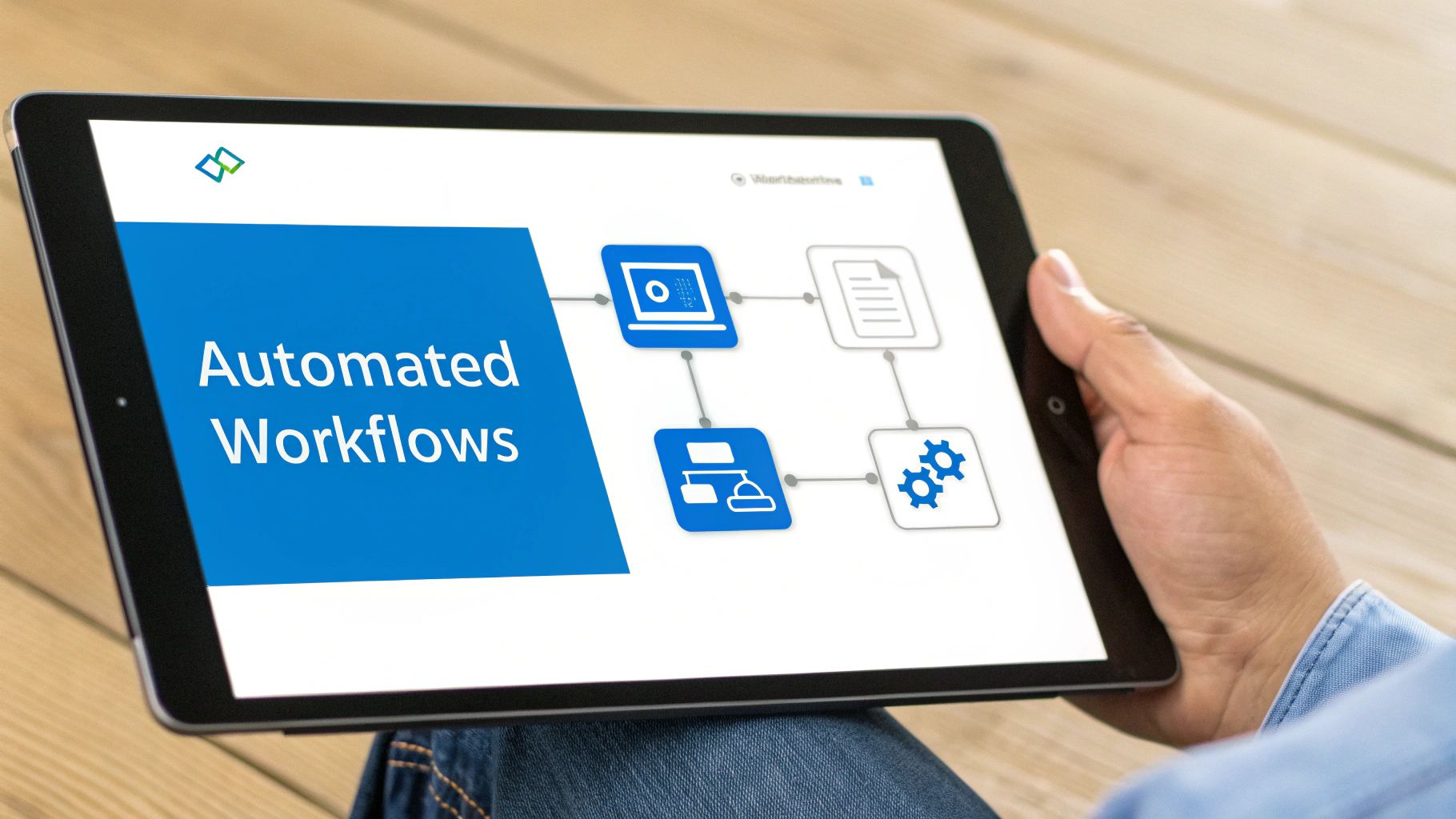
Knowing that help desk automation is powerful is one thing, but seeing it in action is where the real "aha!" moment happens. The magic isn't in the concept; it's in building specific, high-impact workflows that chip away at the daily grind.
These automated sequences become the engine of your support system, working quietly in the background to deliver faster, more consistent resolutions.
Think of each workflow as a highly-trained digital employee with a single specialty. One is a master of password resets, another handles software access requests, and a third is an expert at sorting complex bug reports. When you combine these specialists, you get a support ecosystem that’s miles ahead of any manual process.
Intelligent Ticket Routing and Triage
The first and most fundamental workflow to build is automated ticket routing. Trying to assign tickets by hand is like being the mail sorter for an entire skyscraper—it’s painfully slow, full of errors, and a colossal waste of a skilled person's time. Automation is the smart sorting system that gets every ticket to the right person, instantly.
The process uses simple, predefined rules to look at incoming requests. It can scan for keywords, check the customer's department, or look at the ticket category.
- A ticket with "invoice" or "billing question" gets zipped straight to the finance team.
- An urgent request flagged as "system outage" is immediately escalated to a Tier 2 support manager.
- A query about "GSuite access" lands with the IT admin who lives and breathes Google Workspace.
This simple setup ensures problems get to the person most qualified to fix them on the very first try. It kills the frustrating game of "ticket tennis," where a request gets bounced between departments for days.
By automating triage, you guarantee every issue starts its journey toward resolution the second it arrives. This one change eliminates the single biggest bottleneck in most support desks: the initial assignment delay.
Proactive Self-Service and Knowledge Deflection
The best help desk strategy solves problems before they even become tickets. This is where your knowledge base comes in. When a user starts typing out a problem, AI-powered tools can figure out what they need and suggest relevant articles, guides, or FAQs right away.
For instance, if someone types, "My Wi-Fi keeps disconnecting," the system can pop up a link to a troubleshooting guide titled "Fixing Common Wi-Fi Connectivity Issues." This is called ticket deflection, and it's all about empowering users to find their own answers.
Suddenly, dozens of common issues are resolved without ever needing an agent. This frees up your team to focus on the tricky stuff. Technologies like Robotic Process Automation (RPA) are often the backbone of these systems, handling the routine tasks that make powerful workflows possible.
Handling High-Volume, Repetitive Requests
Some support requests pop up over and over. Password resets, access requests, order updates... you know the ones. These are perfect candidates for full, end-to-end automation where the entire process is handled without a single human touch.
This is where you'll see the biggest and most immediate return on your investment.
A few classic examples include:
- Password Resets: The system verifies the user’s identity through a secure channel (like a code sent to their phone) and walks them through the reset process automatically. No agent needed.
- Software Access Requests: A user fills out a form asking for access to an app. The workflow checks their role, gets an automated thumbs-up from their manager, and provisions the access. Done.
- Order Status Inquiries: An e-commerce chatbot asks for an order number, looks it up in the system, and gives a real-time shipping update. It's simple, fast, and exactly what the customer wants.
The demand for these capabilities is exploding. The helpdesk automation market was valued at USD 5.7 billion in 2024 and is projected to hit USD 21.5 billion by 2030. This growth is all about one thing: the need to manage more tickets, more efficiently. Building these foundational workflows isn't just a nice-to-have anymore—it’s a core strategy for staying in the game.
A Practical Roadmap to Implementing Automation

Successfully launching help desk automation isn't about flipping some magic switch; it’s a journey. A good plan takes the guesswork out of the process, ensuring each step builds logically on the last.
This roadmap breaks it down into four clear phases. Think of it like building a house: you pour the foundation, put up the frame, and then you worry about the paint and windows. This approach keeps things manageable and helps you build momentum as you see real results at each stage.
Phase 1: Assess and Identify Opportunities
Before you can automate a single thing, you need to know where to start. The absolute best targets are the tasks that are high in volume but low in complexity. This is your low-hanging fruit—the stuff that will give you the fastest and most satisfying returns.
Start by digging into your ticket data from the last few months. What patterns jump out at you? What questions are your agents answering over and over again until they're blue in the face? Which processes are just a predictable, repetitive series of clicks?
Your goal here is to create a shortlist of "automation candidates." Don't try to boil the ocean. Just focus on the top 3-5 tasks that eat up the most agent time but don't require complex human judgment.
Common culprits to look for include:
- Password reset requests
- "Where's my order?" inquiries
- Requests for access to software or systems
- Basic troubleshooting for common glitches
By zeroing in on these areas, you make sure your first automation efforts hit where they'll make the biggest difference.
Phase 2: Choose Your Tools
With your hit list ready, it's time to pick your weapon. The market is flooded with automation platforms, but the best tool is the one that fits your specific needs, plays nice with your current systems, and can grow with you.
Create a simple checklist of your must-have criteria. This keeps you from getting distracted by flashy features you’ll never actually use and helps you focus on what really matters.
A solid evaluation checklist should include:
- Integration Capabilities: Does it connect seamlessly with your help desk software, CRM, and other essential apps? No one wants another silo.
- Ease of Use: Can your non-technical team members actually build and manage workflows with it, maybe with a simple drag-and-drop interface?
- Scalability: Will it choke when your ticket volume doubles, or can it handle more complex workflows as you expand?
- Analytics and Reporting: Can you easily see what's working? Clear data is non-negotiable for measuring success and spotting areas for improvement.
This isn't just about buying software; it's about empowering your team, not giving them another technical headache.
Phase 3: Design and Deploy
Alright, it's time to bring your first automated workflow to life. Start small. Pick the simplest, highest-impact task from your list—a password reset bot is a classic for a reason. The goal is to get a quick win, prove the concept, and build from there.
First, map out the workflow. A simple flowchart on a whiteboard will do. What are the steps? What info does the user need to provide? What does the system do next? This blueprint will be your guide. Then, jump into your chosen platform and build it out, training your chatbot with the relevant knowledge base articles and FAQs.
Before you unleash it on the world, run a pilot program. Let a small group of internal users or a friendly segment of customers kick the tires. This is your chance to gather feedback, squash bugs, and make tweaks in a low-risk setting.
Phase 4: Monitor and Refine
Here’s the thing about automation: it’s not "set it and forget it." The final, and arguably most important, phase is a continuous cycle of monitoring, analyzing, and refining your workflows. The system is live, but the optimization work is just beginning.
Keep a close eye on your platform’s analytics dashboard. Are resolution times actually going down? Is the chatbot successfully deflecting tickets? Where are users getting stuck or giving up? This data tells the real story of what's working and what isn't.
Make a habit of regularly reviewing user interaction logs and customer feedback. This is gold. It will show you exactly where to improve your chatbot’s answers, clarify confusing steps in a workflow, or even identify the next big task that’s ripe for automation. This iterative process is what turns a good automation system into a great one.
How Winning Companies Use Help Desk Automation
Theory and stats are great, but seeing help desk automation in the wild is what really makes it click. Smart companies aren't just plugging in new software; they're rethinking their entire support operation around it. They start by targeting the high-volume, low-effort tasks—the repetitive stuff—freeing up their human experts for the problems that actually need a human touch.
Let's look at a few real-world situations where automation is making a huge difference, from cutting down ticket queues to making customers happier. Each example is a simple story: problem, solution, and the result.
E-commerce Tackling the Holiday Rush
The Problem: An online retail brand had the same nightmare every single holiday season. Their support team was completely buried under an avalanche of questions about order status, shipping times, and return policies. Agents were spending their days just copying and pasting tracking numbers, leading to serious burnout and long waits for customers with trickier issues.
The Solution: The company brought in an AI-powered chatbot, much like the one from FastBots.ai, and plugged it right into their website, shipping software, and order management system. They fed it their return policy documents and FAQ pages, turning it into an instant expert on the questions they got asked a thousand times a day.
Here’s a peek at how simple it is to get an AI ready for action.
This screenshot shows the intuitive backend of a platform like FastBots.ai, where users can effortlessly train their AI on various content types, from websites to documents.
The Result: The change was immediate. The chatbot handled over 40% of all support chats during the busiest shopping season, answering "Where is my order?" and "How do I make a return?" in seconds. This didn't just cut the first-response time from hours down to zero; it also gave their customer satisfaction (CSAT) score a major boost and let the human team focus on real problems like damaged goods or wrong orders.
By automating the predictable, the brand turned its seasonal chaos into a smooth operation that kept both customers and agents happy.
SaaS Streamlining New User Onboarding
The Problem: A growing SaaS company noticed a worrying trend: a lot of new users were quitting within the first 30 days. A quick look at their support tickets showed why. New customers were getting stuck on basic setup tasks and felt totally lost. The support team was constantly repeating the same initial steps for each new user, a process that just couldn't scale.
The Solution: Instead of throwing more people at the problem, they built an automated onboarding workflow. The second a new user signed up, this sequence kicked in.
- Day 1: An automated welcome email landed in their inbox with a link to a "Getting Started" video.
- Day 3: The system checked if the user had done a key setup task (like creating their first project). If not, a chatbot popped up inside the app to offer a hand.
- Day 7: Another automated email went out, this time highlighting a cool but often-missed feature, complete with a link to a knowledge base guide.
This proactive, automated series of nudges guided users through their first week, giving them help right when and where they needed it.
The Result: The company saw a 25% drop in new user churn within the first quarter. Support tickets from new customers fell by 30% because the automated tips answered their questions before they even had a chance to ask.
IT Departments Automating Internal Support
The Problem: An internal IT department at a mid-sized company was drowning in employee requests. Their skilled technicians, who were supposed to be working on critical infrastructure projects, were burning nearly half their time on two incredibly simple tasks: resetting passwords and giving people access to common software. It created a massive bottleneck that slowed everyone down.
The Solution: The IT director rolled out a help desk automation platform that connected with their internal chat tool. They focused on two core workflows:
- Automated Password Resets: Employees could now just type "reset password" into a specific channel. A bot would verify their identity with a quick two-factor authentication prompt on their phone and then walk them through the reset. No human needed.
- Software Access Requests: They created a simple form for software requests. When an employee filled it out, the workflow automatically checked their role, pinged their manager for approval, and granted access the moment it was approved.
The Result: These two workflows automated over 60% of the IT team's daily ticket load. The time it took to resolve these requests plummeted from several hours to under two minutes. This freed up hundreds of technician hours every month, letting the team finally focus on the strategic projects that really mattered.
Choosing and Integrating The Right Chatbot Platform
Think of your chatbot as the digital frontline for your customer service—it’s often the very first "face" of your help desk automation. Getting this right isn't just a tech decision; it's a brand decision. The last thing you want is a clunky, frustrating robot making a bad first impression. The goal is to find a platform that feels like a natural extension of your team.
You have to cut through the marketing fluff and focus on what actually matters. The best platforms, like FastBots.ai, are built for both simplicity and power, letting you spin up a custom AI agent without needing a squad of developers. Your evaluation should be hands-on, not just a theoretical exercise on a spreadsheet.
Key Questions for Evaluating Chatbot Platforms
Before you sign on the dotted line, ask these questions. The answers will tell you everything you need to know about how well a chatbot will actually fit into your day-to-day operations.
How Seamless is the Integration? A chatbot can't be a silo. It needs to talk to your other tools—your help desk software, your CRM, you name it. A deep integration means the bot can create tickets, update customer records, and hand off a conversation to a human with the full context. No more asking the customer to repeat themselves.
How Easy is the Training Process? An AI is only as smart as the information you give it. Look for platforms that let you train your bot by simply uploading what you already have: your knowledge base, FAQs, and product manuals. If it takes weeks to get your bot up to speed, you've picked the wrong tool. It should be intuitive.
Can You Customize Its Persona and Tone? Your brand has a voice. Maybe it's formal and professional, or maybe it's witty and casual. A great platform will let you define your bot's personality to match, ensuring your customer experience feels consistent, whether they're talking to a human or an AI.
The right chatbot platform doesn't just answer questions; it embodies your brand's commitment to helpful, efficient, and accessible support. It should make your human agents' lives easier, not create more work.
From Selection to Go-Live
Once you’ve made your choice, getting it up and running should be quick. Modern chatbot solutions are designed for speed. The process usually boils down to adding a snippet of code to your website and connecting the platform to your other software using pre-built integrations or APIs.
For a detailed walkthrough, you can learn more about integrating FastBots.ai with your existing help desk in under an hour. That kind of speed is exactly what you need to start seeing a return on your investment right away.
One last thing: don't forget analytics. The platform absolutely must give you clear data on what questions people are asking, which answers are working, and where the bot gets stuck. These insights are pure gold for refining your automation and making the customer experience better and better over time.
Frequently Asked Questions
It's natural to have a few questions when you're looking at bringing automation into your help desk. Let's clear up some of the common ones so you can move forward with confidence.
Will Automation Replace Our Human Agents?
Not a chance. Think of help desk automation as a power-up for your human agents, not a replacement. Its real strength is in handling the repetitive, high-volume stuff—like password resets or "where's my order?" tickets—that grinds your team down.
By taking that off their plate, you free them up to tackle the tricky, high-value customer problems that actually need a human touch. In the end, automation makes their jobs more interesting and way more impactful.
Is This Only For Large Enterprises?
That's a common myth, but it's completely outdated. Modern automation tools and chatbot platforms are built to be affordable and scalable, which makes them a fantastic fit for small and medium-sized businesses (SMBs).
The technical barrier is lower than ever. Modern automation platforms feature no-code builders with intuitive drag-and-drop interfaces, making them accessible to non-technical users.
Many of these tools have flexible pricing, so you can start small with a couple of key workflows and expand as you grow. It really levels the playing field, giving smaller companies the same tools for boosting efficiency that the big players have.
How Much Technical Skill Do I Need?
You definitely don’t need to be a developer. Most of the top automation platforms today are built with simplicity in mind. They often have no-code or low-code builders with intuitive drag-and-drop interfaces that anyone can learn.
For something like an AI chatbot, the "training" can be as simple as uploading your FAQ page or pointing it to your website. Sure, a super-complex integration might need some help from IT, but building the core automated workflows that deliver the biggest wins is well within reach for just about anyone on your team.
Ready to see how easily you can implement powerful help desk automation? FastBots.ai allows you to build a custom AI chatbot trained on your own data in minutes. Start for free and provide instant, 24/7 support to your customers today at https://fastbots.ai.