10 Good Help Desk Practices to Implement in 2026

Your help desk is often the first place customers turn, making it much more than a simple problem-solving queue. When you get it right, it becomes an engine for customer retention, a source of invaluable product feedback, and a powerful tool for building loyalty. An effective help desk can transform from a cost center into a strategic asset. However, we see many teams struggle to move beyond a reactive, ticket-by-ticket mindset, leaving significant opportunities on the table.
This article provides an actionable list of good help desk practices designed for modern support teams. We'll skip the generic advice and dive straight into concrete strategies you can implement. You will learn how to build a 24/7 support system, create a self-sufficient knowledge base, and establish clear escalation pathways that blend AI efficiency with essential human expertise.
Each practice we cover includes the "why" behind the strategy and step-by-step guidance. We'll also explore how you can use AI tools like FastBots.ai to automate repetitive tasks, analyze interactions, and free up your team to focus on high-value work. Consider this your blueprint for elevating your help desk into a proactive, data-driven, and customer-centric operation.
Why Good Help Desk Practices Matter
Before we dive into the "how," let's quickly touch on the "why." A well-run help desk directly impacts your bottom line. According to industry data, companies that prioritize customer experience typically see higher customer retention rates and increased lifetime value.
For example, a mid-sized e-commerce business we worked with reduced their response time by 80% using an AI-first approach. This not only cut support costs but also led to a measurable lift in repeat purchases because customers felt heard and valued, even at 2 AM. This is the tangible impact of investing in your support systems.
1. Implement 24/7 Availability with AI-First Support
One of the most impactful good help desk practices you can adopt is providing immediate, round-the-clock support. In today's global market, your customers expect answers on their schedule, not just during your business hours. An AI-first support strategy meets this demand by deploying intelligent chatbots to handle inquiries 24/7, ensuring no customer is left waiting.
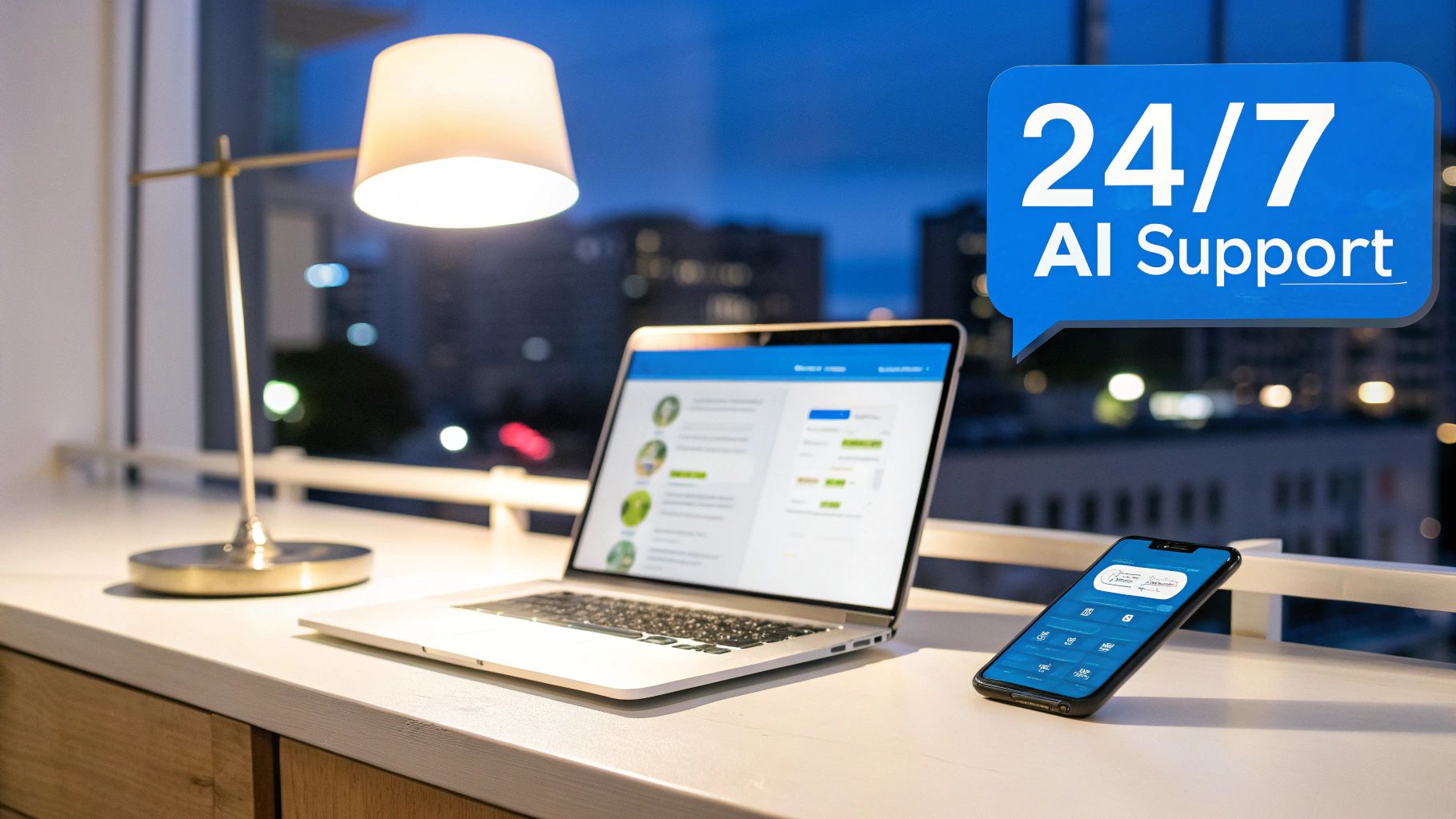
This approach significantly reduces the load on your human team, freeing them to focus on complex, high-value interactions. For instance, a small SaaS company can use an AI agent to instantly answer common questions about features, while an e-commerce store can automate order tracking and return requests. The core benefit is consistent, instant service that boosts customer satisfaction and operational efficiency.
Actionable Takeaway: Quick Checklist to Get Started
Implementing an AI chatbot is more accessible than you might think. Here’s a quick checklist to guide your setup:
- Start with High-Volume Questions: Identify the top 10-15 most frequent questions your support team receives. Train your AI on these first for the biggest immediate impact.
- Define Escalation Paths: Clearly program when the bot should hand off a conversation to a human agent. This ensures complex or sensitive issues receive the right attention.
- Monitor and Refine: Regularly review chat logs to find questions the AI couldn't answer. Use these insights to update its knowledge base and improve its performance over time.
2. Create a Comprehensive Knowledge Base Trained on Your Content
A powerful help desk practice is building a single source of truth that both your human agents and AI can rely on. A comprehensive knowledge base centralizes all your important information, from product specifications and troubleshooting guides to company policies.

By training an AI on your own content like websites, PDFs, and internal documents, you create a consistent and accurate support experience across all channels. This ensures that whether a customer interacts with a chatbot or an agent, they receive the same correct answer every time. For example, you can upload your entire feature documentation, enabling your AI to instantly guide users through complex workflows.
Actionable Takeaway: How You Can Apply This
Building an effective knowledge base is a strategic process. This checklist will help you create a robust foundation for your support operations:
- Audit and Consolidate: Gather all existing documentation—FAQs, manuals, spreadsheets, and policy documents. Review them for accuracy and identify any gaps in information.
- Organize Logically: Structure your content with clear categories and tags. This helps both humans and AI find information quickly.
- Upload and Train: Use a tool like FastBots.ai to easily upload your documents. The system will automatically learn from your content, turning it into a conversational AI ready to answer customer questions.
3. Establish Clear Escalation Pathways and Human Handoff Protocols
While AI can handle a vast majority of inquiries, one of the most crucial good help desk practices is knowing when to bring in a human. Establishing clear escalation protocols ensures that customers with complex issues or high-priority complaints are smoothly transitioned to a live agent. This prevents frustration and shows customers that you value their time.

This hybrid model is essential across industries. You might escalate a user reporting a critical bug directly to a Tier 2 technician, while a nonprofit could route a complex donation inquiry to its finance team. The key is that the handoff preserves the entire conversation history, so your agent has full context and can provide an empathetic, informed response without making the customer repeat themselves.
Actionable Takeaway: Building Your Escalation Strategy
Setting up intelligent handoffs is a foundational step for effective help desk management. Here’s a quick checklist to guide you:
- Define Clear Triggers: Identify 5-7 specific conditions for escalation, such as negative sentiment (detecting anger or frustration), requests for refunds, or specific technical error keywords.
- Ensure Context is Kept: Your system must pass the full chat transcript to the human agent. The agent should see exactly what the AI and customer discussed.
- Set Escalation SLAs: Establish a service level agreement for human responses, like a two-minute maximum wait time during business hours, to manage customer expectations.
4. Leverage Multi-Channel Deployment for Omnichannel Support
One of the most essential good help desk practices is meeting customers on their preferred channels. True omnichannel support means being available wherever your audience is, whether that's your website, WhatsApp, or social media. By deploying your help desk across these platforms, you create a seamless and unified experience.

This approach centralizes all interactions, so your team has a complete view of every customer's history. For instance, an e-commerce brand can use a chatbot on Facebook Messenger for product inquiries and on WhatsApp for order updates. This ensures consistent service and allows a single AI knowledge base to power support across every touchpoint.
Actionable Takeaway: Here’s How You Can Apply This
You can implement multi-channel support without overwhelming your team. Here’s a checklist to begin your deployment:
- Identify Key Channels: Start with the top 2-3 platforms where your customers engage most frequently. Analyze your website traffic and social media metrics to pinpoint these.
- Unify Your Knowledge Base: Ensure your AI chatbot's training data covers queries common to each channel. A tool like FastBots.ai allows you to train one bot and deploy it across multiple platforms seamlessly.
- Customize Channel-Specific Responses: Tailor the bot's tone and answers to fit the culture of each platform. For example, responses on social media can be more conversational than on your website's formal chat.
5. Implement Intelligent Lead Capture and CRM Integration
Another effective good help desk practice is to transform your support function from a cost center into a revenue driver. By integrating your help desk with a CRM, you can automatically capture and qualify leads directly from support conversations. This ensures that valuable business opportunities are never missed.
This practice is powerful for any business model. A B2B company can qualify enterprise leads who ask detailed pre-sales questions, while a service provider can book consultations directly through chat. The result is a streamlined pipeline where your support team actively contributes to business growth.
Actionable Takeaway: Connecting Support to Sales
Connecting your support tools to a CRM automates the lead management process. Here’s a quick checklist to guide you:
- Define Lead Criteria: Work with your sales team to establish clear rules for what constitutes a qualified lead (e.g., specific keywords, company size, budget questions).
- Automate Data Sync: Use native integrations or workflow tools to automatically create a new lead in your CRM when a chatbot or agent flags a conversation.
- Include Conversation Context: Ensure the full chat transcript is synced to the CRM record. This gives the sales team crucial background for their follow-up.
6. Use Analytics and Chat Logs to Drive Continuous Improvement
Your help desk is more than a problem-solving center; it's a goldmine of customer insights. One of the most strategic good help desk practices is to systematically analyze chat logs and engagement analytics to drive continuous improvement. By examining real customer conversations, you can identify recurring pain points and gaps in your knowledge base.
An e-commerce store, for example, might analyze its chat logs and discover that a high percentage of inquiries are about shipping times, indicating a need for clearer information on their website. Similarly, a SaaS company could find that questions about a specific feature frequently lead to escalations, signaling that their user guides need improvement. These insights allow you to fix the root cause of issues.
Actionable Takeaway: How to Put Insights into Action
Turning data into action doesn't require a dedicated analytics team. You can start making improvements today with a focused approach:
- Establish Key Metrics: Create a simple dashboard to track 5-7 core metrics like resolution rate, escalation rate, and customer satisfaction scores. Review these weekly.
- Schedule Insight Reviews: Hold a monthly meeting with your team to discuss trends found in chat logs. What questions are being asked most often? Where is the AI struggling?
- Create Action Items: For every insight, create a clear action item, like "Add a new FAQ section about our return policy" or "Update the AI's training data with information on the new feature."
7. Maintain Security, Privacy, and Compliance Standards
Protecting customer data is a fundamental aspect of building trust and a core component of good help desk practices. When customers share sensitive information, they expect it to be handled with care. Implementing robust security protocols and adhering to compliance frameworks like GDPR is essential for safeguarding this data.
This involves more than just secure software; it's a comprehensive approach. It combines technical safeguards like encryption with rigorous internal policies and ongoing staff training. For a healthcare provider, this means protecting patient information, while a financial services firm must ensure PCI compliance. The goal is to create a secure ecosystem where customer data is consistently protected.
Actionable Takeaway: Building a Secure Help Desk
Building a secure and compliant help desk environment is a systematic process. Here’s a checklist to guide your efforts:
- Implement Role-Based Access Controls (RBAC): Ensure agents can only access the customer information necessary to do their jobs.
- Conduct Regular Security Audits: Schedule periodic security assessments to identify and address vulnerabilities in your systems.
- Train Your Team Continuously: It's vital to train support staff on how to prevent social engineering attacks, as they are often primary targets.
- Maintain Clear Audit Logs: Keep detailed records of who accesses customer data and when. This is critical for accountability.
8. Personalize Support Interactions with Customer Context and History
One of the most effective good help desk practices is moving beyond generic, one-size-fits-all responses. Personalizing support by leveraging customer history shows customers you see them as individuals, not just ticket numbers. This means accessing their purchase history and previous support tickets to provide faster, more relevant solutions.
When an agent or AI chatbot knows a customer's subscription tier, they can skip frustrating diagnostic questions. An e-commerce bot can greet a returning customer by name and reference their last order, while a SaaS help desk can provide support tailored to a user’s specific feature access. This level of personalization cuts down resolution time and boosts customer loyalty.
Actionable Takeaway: How to Start Personalizing
Integrating personalization doesn't have to be overly complex. You can start small and build from there.
- Integrate Your CRM: Connect your help desk software with your Customer Relationship Management (CRM) tool. This simple step gives agents and bots instant access to crucial customer data.
- Start with the Basics: Begin by personalizing greetings with the customer's name and referencing their account status (e.g., "Welcome back, Jane! I see you're on our Pro plan.").
- Automate Contextual Help: Use an AI tool like FastBots.ai to pull data from your systems. You can train it to automatically offer help based on a user's recent activity, making the interaction feel seamless.
9. Train Support Staff as AI Enablers, Not AI Replacements
One of the most strategic good help desk practices is to reframe how your team views automation. Instead of seeing AI as a replacement, you should position it as a powerful assistant that handles repetitive tasks. This frees your human agents to focus on complex interactions that require empathy and critical thinking.
This approach transforms the support role from a reactive problem-solver into a proactive AI trainer and customer advocate. When your staff spends less time on FAQs, they can invest more in troubleshooting complex technical issues or managing VIP customer relationships. This shift improves service quality and boosts agent morale.
Actionable Takeaway: How You Can Apply This
Fostering an AI-enabling culture requires clear communication and a focus on skill development. Here’s how to begin:
- Involve Your Team Early: Include your support agents in the process of training the AI. Their insights are invaluable for building a truly helpful bot.
- Establish New Career Paths: Create roles like "AI Trainer" or "Automation Specialist" that agents can aspire to. This shows a commitment to their growth.
- Celebrate Efficiency Gains: Track and share metrics that show how AI is helping the team. Highlight how much time has been saved on routine questions.
10. Establish Proactive Support and Issue Prevention Strategies
One of the most effective good help desk practices is shifting from a reactive model to a proactive one. Instead of waiting for customers to report problems, proactive support anticipates their needs and provides solutions before they even have to ask. This approach uses contextual triggers and predictive detection to get ahead of common issues.
This strategy fundamentally changes the support dynamic. For instance, an e-commerce store can send shipping status updates before a customer asks, "Where is my order?" Similarly, a SaaS company can automatically alert users when they are approaching their storage limit. The goal is to solve problems before they happen, building trust and demonstrating that you understand your customers' journey.
Actionable Takeaway: Here’s How You Can Apply This
Implementing proactive support starts with identifying common friction points. Here’s a quick checklist to guide you:
- Map Critical Journey Points: Identify where your customers typically struggle, such as during onboarding or at renewal.
- Analyze Your Top Tickets: Review your support data to find the top 5-10 most common and preventable issues. Create automated guides or alerts for these.
- Use Behavioral Triggers: Set up automated messages based on user behavior, like multiple failed login attempts. A tool like FastBots.ai can be configured to trigger proactive chat messages based on specific user actions.
Limitations and What to Watch Out For
While these practices are powerful, it's important to approach them with a realistic mindset. Here are a few trade-offs to consider:
- Over-Automation Risk: An AI-first approach is efficient, but relying on it too heavily can feel impersonal. A poorly trained bot can frustrate customers more than no bot at all. Always ensure there is a clear and easy way for users to connect with a human.
- Data Privacy Concerns: Personalization requires access to customer data. You must be transparent about how you use this information and adhere strictly to privacy regulations. Misusing data erodes trust faster than anything else.
- Initial Investment: Implementing new tools, training your team, and overhauling processes requires an upfront investment of time and resources. One common pitfall is underestimating the effort needed for a successful rollout. Start with a small pilot project to demonstrate value before expanding.
- Analysis Paralysis: With more data comes the risk of getting lost in it. It’s easy to collect analytics but harder to act on them. Make sure every data review session ends with concrete, assigned action items to avoid this trap.
Building a Help Desk That Works for You and Your Customers
Throughout this guide, we've explored ten pillars that form the foundation of a modern, effective support system. Moving beyond reactive troubleshooting, these good help desk practices transform your support function from a cost center into a powerful engine for customer loyalty and business growth. The central theme is a strategic partnership between human expertise and intelligent automation.
You’ve seen how an AI-first approach provides 24/7 availability, how a well-trained knowledge base empowers both customers and agents, and why clear escalation paths are non-negotiable for complex issues. The goal is no longer just to close tickets; it’s to build a proactive, personalized, and efficient support ecosystem.
Your Actionable Next Steps
Mastering every practice at once can feel overwhelming. Instead, focus on incremental progress. Use this checklist to identify your next move:
- Audit Your Current System: Where are the biggest friction points for your customers and your team? Is it after-hours support gaps, repetitive questions, or slow response times? Start there.
- Prioritize One Key Area: Choose one practice from this list to implement or improve in the next 30 days. For many, building a foundational knowledge base or implementing an AI chatbot for 24/7 support offers the quickest return.
- Empower Your Team: Remember that technology is a tool, not a replacement. Focus on training your support staff to leverage AI, analyze data, and handle the high-value interactions that build true customer relationships.
By integrating intelligent automation and empowering your human agents, you're not just improving efficiency. You are creating a scalable, data-driven operation that understands customer needs, anticipates problems, and consistently delivers exceptional service. This strategic approach is the key to unlocking sustainable growth and building a brand that customers genuinely love.
Ready to implement these good help desk practices with powerful, easy-to-use AI? FastBots.ai helps you build a custom AI chatbot trained on your own content in minutes, allowing you to automate up to 95% of your customer support. Start your free trial today and transform your customer experience.