Grow with e commerce automation: Boost Your Efficiency and Sales

Imagine your online store running its most repetitive, time-consuming tasks on autopilot, 24/7. That’s the real magic behind e-commerce automation. It’s software designed to handle the grunt work—like sending order confirmations, managing inventory, or answering the same customer questions over and over again.
This frees you and your team up for the work that actually grows your business, like marketing and building customer relationships.
What Is E-Commerce Automation, Really?
Think of automation less like replacing your team and more like giving them a super-efficient digital assistant. This isn't just a tool for the big players anymore; it's become essential for stores of all sizes, letting you punch way above your weight class without the massive overhead.
Once you set up automated workflows, you start seeing immediate gains. For example, the second a customer places an order, an automation can fire off a confirmation email, update your inventory levels in real-time, and even tag that customer for a future marketing campaign. This all happens instantly, without anyone lifting a finger.
Why It Matters
Ultimately, the goal is to build a more scalable and profitable business. You can achieve this by focusing on a few key areas:
- Improving Efficiency: It slashes the time spent on manual tasks, letting your team focus on high-impact activities like product development or marketing strategy.
- Reducing Errors: Automated systems don’t get tired or make typos. That means fewer shipping mistakes, more accurate inventory counts, and happier customers.
- Enhancing Customer Experience: From instant answers via chatbots to personalized product recommendations, automation creates a smoother, more responsive journey for your shoppers.
The real power of automation is its ability to help you do more with less. It’s about building a system that works for you in the background, so you can get back to focusing on your brand.
While our focus here is on e-commerce, the core ideas of saving time are universal. Many foundational concepts are covered in guides on marketing automation for small businesses. This strategic shift is often what separates the stores that thrive from the ones just struggling to keep up.
Why Automation Is Your Store's Competitive Edge
Let's be honest: e-commerce automation isn't just a "nice-to-have" anymore. It's the engine that powers sustainable growth. By taking repetitive tasks off your plate, you can slash operational costs, reduce human error, and build a customer experience that keeps people coming back.
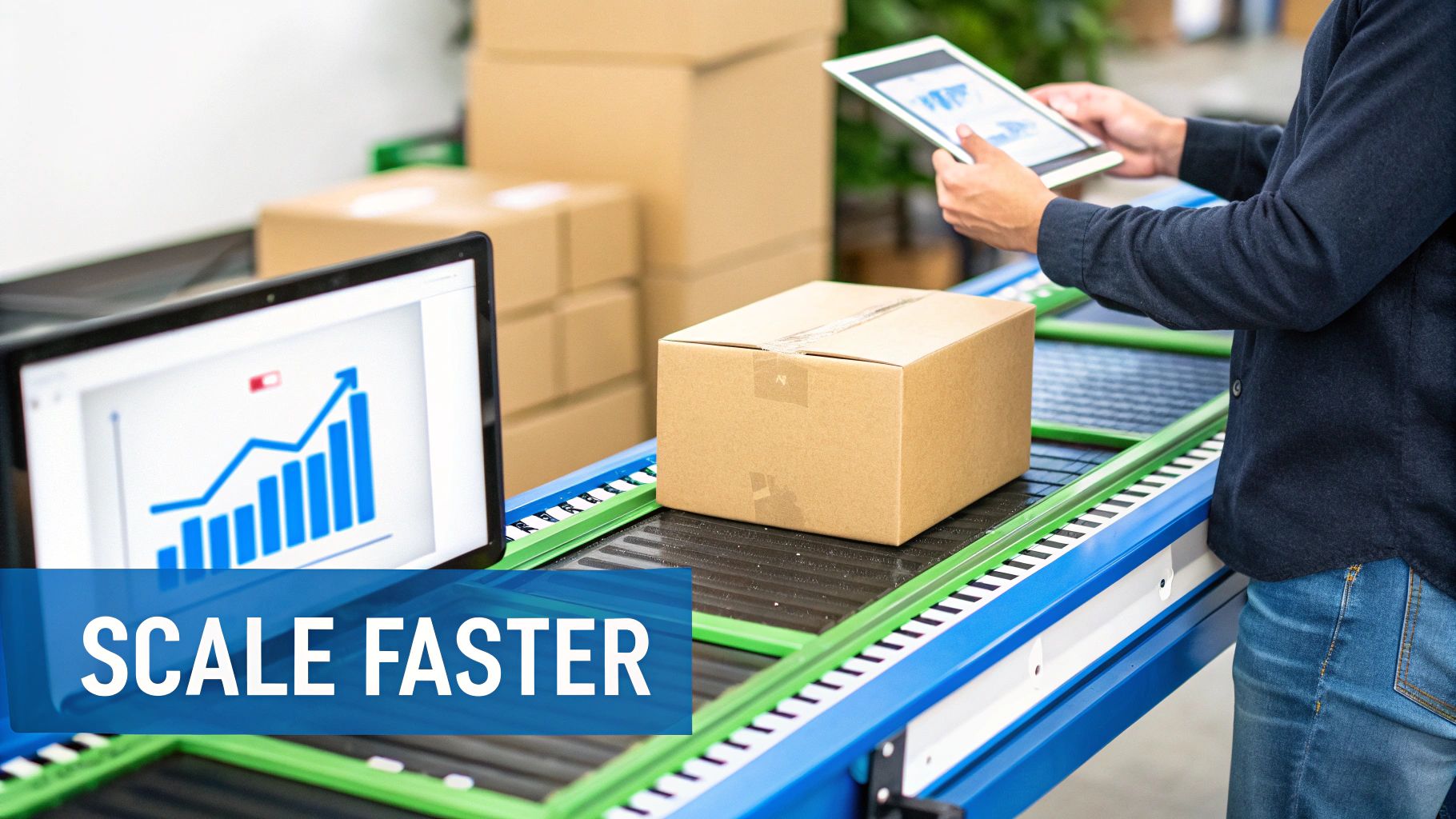
Think about what happens when a huge holiday order surge hits. Without automation, it can mean all-nighters and a lot of stress. With automation, your business just handles it. You can scale sales volume without scaling your manual effort, and that efficiency goes straight to your bottom line.
Driving Growth and Reducing Costs
Every manual task—from entering order details to sending a shipping notification—has a hidden cost. It costs you time and opens the door for mistakes. Automation helps close that door. A simple workflow can grab an order, ping the right warehouse, print the shipping label, and let the customer know their package is on its way, all without a single click from you.
This is huge because it frees up your team to do what they do best: focus on the big-picture stuff. We're talking about marketing strategy, new product development, and building genuine customer relationships.
The numbers back this up. The global e-commerce automation market was recently valued at $8.5 billion and is projected to grow significantly. You can discover more insights on the market's rapid growth and see why so many businesses are adopting these tools. By automating routine operations, you're not just making your business faster; you're making it more resilient and profitable.
How Automation Transforms Key Business Areas
| Business Area | Example Automation | Expected Outcome |
|---|---|---|
| Order Processing | Automatically route new orders, verify payments, and send confirmations. | Faster fulfillment, fewer errors, and a better customer experience from the start. |
| Inventory | Sync stock levels across all channels (Shopify, Amazon, etc.) in real-time. | No more overselling, fewer stockouts, and improved inventory forecasting. |
| Customer Support | Deploy an AI chatbot to handle FAQs like "Where's my order?" | Instant 24/7 support for common questions, freeing up your team for complex issues. |
| Marketing | Send personalized abandoned cart emails or segment customers for targeted ads. | Higher conversion rates, increased customer lifetime value, and more relevant marketing. |
| Fulfillment | Generate shipping labels, send tracking updates, and process returns automatically. | Reduced shipping errors, lower operational costs, and proactive customer communication. |
Core Automation Workflows for Your Store
Knowing that e-commerce automation can help is one thing; figuring out where to start is another. It’s tempting to try automating everything at once, but the real wins come from focusing on a few foundational workflows that tackle the most common headaches.
These are the areas designed to save you time, claw back lost sales, and keep your customers happy—all without you having to manually intervene. Let's break down where you'll see the biggest impact right away.
Marketing and Sales Automation
Your marketing is probably the most fertile ground for automation. Two workflows, in particular, tend to deliver an immediate, measurable return.
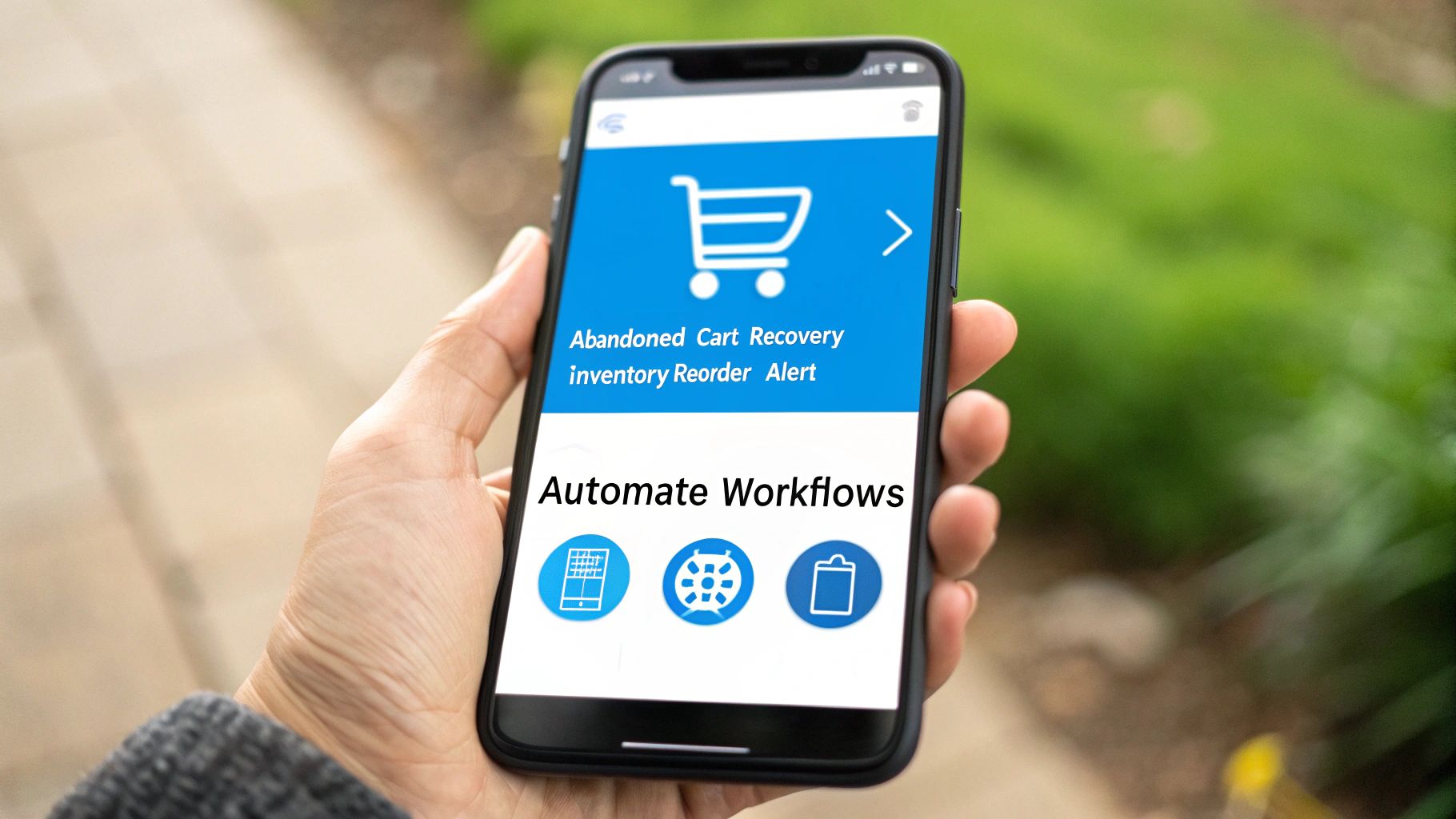
First is the abandoned cart sequence. A staggering number of online shopping carts are left behind before checkout. An automated email can give those customers a gentle nudge, perhaps with a small discount. This system works 24/7 to recover sales you would have otherwise lost.
Next is personalized communication. You can set up automated email campaigns triggered by customer actions. A "welcome" series for new subscribers is a great start, or a follow-up email a week after delivery asking for a review. This helps build a real relationship over time.
Inventory and Order Processing
On the operational side, automation is all about eliminating guesswork. An automated inventory system can sync your stock levels across every place you sell in real-time. When a product sells on your website, the system instantly updates the count on Amazon and eBay, stopping you from accidentally selling an item you no longer have.
You can also set up rules to automatically reorder products when stock dips below a certain number. And don't forget about billing—if you offer subscriptions, looking into setting up recurring payments efficiently is a must for steady cash flow.
Customer Support Automation
Answering the same questions over and over—"Where's my order?" or "What's your return policy?"—is a huge time-sink. This is exactly where AI-powered chatbots can completely change the game.
A chatbot can be trained on your store’s data to give instant, accurate answers to common questions, day or night. This frees up your human agents to handle more complex conversations that need a personal touch. For example, using a chatbot for that initial cart reminder is a powerful first step, and you can explore more abandoned cart recovery with chatbots strategies for success to see how effective it can be.
How to Implement Your E-Commerce Automation Plan
Jumping into automation doesn't have to be a massive project. The secret is to start small. Focus on the tasks that will give you the biggest return for the least amount of heavy lifting. Think of it like mapping out a road trip before you get in the car.
The best way to start is with a simple audit of your daily operations. Grab a notepad and jot down every repetitive, manual task your team does. Which jobs are eating up the most hours? Where are mistakes most likely to happen? These are your golden opportunities.
Identify and Prioritize Quick Wins
Once you have that list, it’s time to prioritize. You're looking for "quick wins"—automations that will either save a ton of time or put money directly back into your pocket. Whatever you do, don't try to automate everything at once. That's a surefire way to get overwhelmed.
Instead, pick one or two high-impact areas. For many online stores, this means tackling abandoned cart reminders or setting up a simple AI chatbot for "Where's my order?" questions. These actions give you a clear, measurable return and build the confidence you need for bigger projects. A great first step can be learning how to integrate AI agents into your Shopify or WooCommerce store.
Select the Right Tools
With your priorities straight, the next move is picking your tools. You don't need a massive, all-in-one enterprise platform on day one. Many businesses see amazing results by connecting specialized apps they already use with platforms like Zapier or Make.
The goal is to choose tools that solve your specific problems and play nicely together without adding unnecessary complexity.
Actionable Takeaway: Your Quick-Start Checklist
- Audit Your Processes: List every manual, repetitive task your team performs daily. No task is too small.
- Prioritize for Impact: Rank those tasks by how much time they'll save or how much revenue they could generate.
- Start Small: Choose just one or two high-value automations to implement first, like an abandoned cart sequence.
- Select Your Tools: Pick software that solves your immediate need and integrates easily with what you already have.
- Measure Everything: Track key metrics (like cart recovery rate or support ticket volume) to prove the ROI before you expand.
Using AI to Personalize the Customer Journey
Today's shoppers want to feel like you get them. This is where e commerce automation powered by AI becomes your secret weapon, letting you create unique, personalized journeys for every person who lands on your site.
For example, you can serve up tailored product recommendations based on what a customer is viewing, combined with what they’ve bought before. Think about how giants like Amazon always seem to know what you want next. That same tactic can boost your average order value by showing shoppers exactly what they’re likely to love.

Beyond Answers: AI Chatbots as Sales Guides
AI chatbots have grown up. They're no longer just simple FAQ machines. Modern bots can act as proactive shopping assistants, guiding customers through your product catalog and helping them find the perfect item. They can ask smart follow-up questions to narrow down options, making the process feel more like a helpful conversation.
By digging into chat logs and customer interactions—a key feature in tools like FastBots.ai—you get incredible insights into what your customers are really looking for. These conversations are a goldmine, revealing pain points and product questions. It's like having a direct line into your customers' minds.
This isn't some far-off trend. Many e-commerce businesses are already using AI to create smoother, more tailored journeys. AI-powered product recommendations are predicted to increase sales, and chatbots that suggest products have been shown to lift conversions. You can discover more insights about AI's impact on e-commerce to get the full picture.
What to Watch Out For: Limitations and Considerations
While e-commerce automation is a powerful step forward, it's not a magic bullet. If you dive in without a clear strategy, you can create a new set of problems just as frustrating as the manual work you were trying to leave behind.
One of the biggest mistakes we see is over-automating customer service. It’s tempting to let a bot handle everything, but this can make your brand feel cold. A customer with a complex or sensitive issue doesn't want to fight an automated menu; they typically need a real person.
Finding the Right Human-Bot Balance
The goal isn't to replace your team—it's to empower them. Use automation to handle simple, high-volume questions. This frees up your human agents to provide thoughtful, high-value support when it matters most. Your automations should always have a clear escape hatch for a customer to say, "I need to talk to a person."
Another common headache is choosing tools that are too complex or don't play nicely with your existing software. This leads to what’s known as “tech debt,” where you spend more time managing your tools than benefiting from them. A clunky system just creates more manual work, defeating the whole point.
For example, a boutique clothing store we worked with tried to connect five different marketing and sales tools that didn't integrate well. Their team ended up spending hours each week manually exporting and importing customer lists, which completely negated the time savings they hoped for.
Your Quick-Check Guide to Avoiding Pitfalls
To sidestep these common traps, run through this quick checklist before you flip the switch on a new automation:
- Does this feel human? Make sure your automated messages sound like your brand and always offer an easy way to reach a real person.
- Will this tool integrate smoothly? Check for native integrations or compatibility with platforms like Zapier before you commit.
- Is our data clean? Before automating, take the time to clean up your customer and product records. A little data hygiene goes a long way.
Next Steps: Bringing Automation to Your Store
If you're thinking about automating parts of your online store, you probably have a few questions. Drawing from our experience, here are honest answers to the concerns we hear most often.
"Is Automation Too Expensive for My Small Business?"
Not anymore. This is probably the biggest myth out there. Many of today’s powerful automation tools, especially AI chatbot platforms like FastBots.ai, have free or incredibly affordable plans built for businesses just like yours.
The trick is to start smart. Focus on the quick wins—high-impact tasks like abandoned cart recovery or an FAQ chatbot. The return on investment here is usually fast and obvious. The money you save on manual work and the sales you recover can easily pay for the software.
"Will Automation Make My Brand Feel Impersonal?"
This is a valid worry, but good automation should do the opposite. By letting bots handle the repetitive stuff, you free up your team for the conversations that matter. They can provide genuine, high-touch support where a human connection is needed.
Plus, modern AI can use customer data to create genuinely helpful, personalized experiences. One way to do this is by offering recommendations and sending messages that make each shopper feel seen and understood—not like just another order number.
"Okay, I'm In. Where Should I Start?"
Simple: start with your biggest headache. Pinpoint the tasks that are repetitive, eat up your team's time, or are prone to human error.
For most online stores, the best starting points are:
- Answering the same customer questions over and over again.
- Manually sending out order status updates.
- Following up on abandoned shopping carts.
Tackling one of these first will give you an immediate, tangible win and show you just how powerful this approach can be.
Ready to see how an AI chatbot can handle your repetitive tasks and boost sales? With FastBots.ai, you can build a custom AI agent trained on your business data in minutes and deploy it on your website, WhatsApp, and more. Start for free at FastBots.ai.