10 Essential Customer Service Best Practices for Today's Business

In a competitive market, great customer service is more than just solving problems—it's about creating memorable experiences that build lasting loyalty. As customer expectations evolve, the old rulebook no longer applies. Modern customers demand instant, personalized, and convenient support on the channels they already use, 24/7. If your business still relies on slow email queues and limited-hour phone support, you're likely missing more than just queries; you're missing opportunities.
This article gives you a practical roadmap to mastering the customer service best practices that successful businesses are using to thrive. We'll move beyond generic advice and focus on actionable strategies you can implement right away. You will learn how to deploy effective AI chatbots, personalize interactions using customer data, and create seamless handovers to your human agents when a personal touch is needed.
Our goal is to show you how to transform your support from a reactive cost center into a proactive growth engine. We'll explore ten key practices, from automating lead capture to leveraging analytics for continuous improvement. Whether you're an ecommerce store owner or leading a support team, these insights will equip you to not only meet customer expectations but consistently exceed them.
Why Excellent Customer Service Matters
Before diving into the "how," let's quickly touch on the "why." Strong customer service directly impacts your bottom line. Data consistently shows that customers are willing to pay more for a better experience, and a single negative interaction can drive them to a competitor.
Conversely, positive experiences create loyal customers who spend more and become brand advocates. By investing in these best practices, you're not just improving support; you're building a more resilient and profitable business.
1. Implement 24/7 Automated First Response with AI Chatbots
In today's on-demand economy, your customers expect instant answers, regardless of the time or day. Leaving them waiting for hours, or even until the next business day, can be a major point of friction.
This is where implementing AI chatbots for 24/7 automated first response becomes one of the most impactful customer service best practices. This strategy ensures every customer receives an immediate acknowledgment and initial support.
AI-powered chatbots act as your digital frontline, capable of instantly handling a high volume of common inquiries like order status, return policies, or product details. For example, many online retailers now use chatbots to assist with everything from product recommendations to order tracking. This frees up their human agents to focus on more complex, high-value interactions.
How to Get Started
Getting started is more straightforward than you might think. With no-code platforms, you can often deploy a custom-trained bot in minutes.
- Train Your Bot: Upload your website content, FAQs, and product knowledge base. The AI will learn this data to provide accurate answers.
- Start Small: Begin by programming the chatbot to answer your top 5-10 most frequently asked questions.
- Define Escalation Paths: Set clear rules for when the bot should hand a conversation over to a live human agent.
- Review and Refine: Regularly check chat transcripts to identify knowledge gaps and continuously improve your bot’s performance.
2. Enable Seamless Human Handover When Needed
While AI chatbots are phenomenal for instant first-line support, one of the most critical customer service best practices is knowing when to bring a human into the conversation.
Enabling a seamless human handover ensures that when an issue becomes too complex or emotionally charged for a bot, customers are smoothly transitioned to an agent who can provide the necessary empathy and expertise. This hybrid approach preserves efficiency while guaranteeing high-quality resolutions.

This strategy prevents the dreaded "chatbot loop" where a customer gets stuck asking a question the bot can't answer. A good system allows a human agent to take over the conversation instantly, with the full context of what has already been discussed. This ensures your customer never has to repeat themselves, which is key to maintaining a positive experience.
How to Implement This
Setting up an effective handover process is about defining clear rules and empowering your team. You can get started by focusing on the transition points.
- Set Clear Triggers: Program your bot to automatically escalate to a human after a set number of failed attempts (e.g., three), or when specific keywords like "speak to agent" are used.
- Provide Full Context: Ensure the chat transcript is passed to the human agent so they understand the customer's issue from the start.
- Train Your Team: Educate your support agents on the chatbot's capabilities and limitations. This helps them know where to pick up the conversation effectively.
- Monitor Handover Metrics: Track how often handovers occur and why. Mastering the art of the chatbot-to-human handoff is essential for a successful hybrid support model.
3. Personalize Customer Interactions Based on Data
Generic, one-size-fits-all service no longer meets customer expectations. A crucial customer service best practice is to leverage customer data to create personalized interactions.
By using information like purchase history or past support tickets, you can tailor responses and recommendations. This simple step can make each customer feel understood and valued.
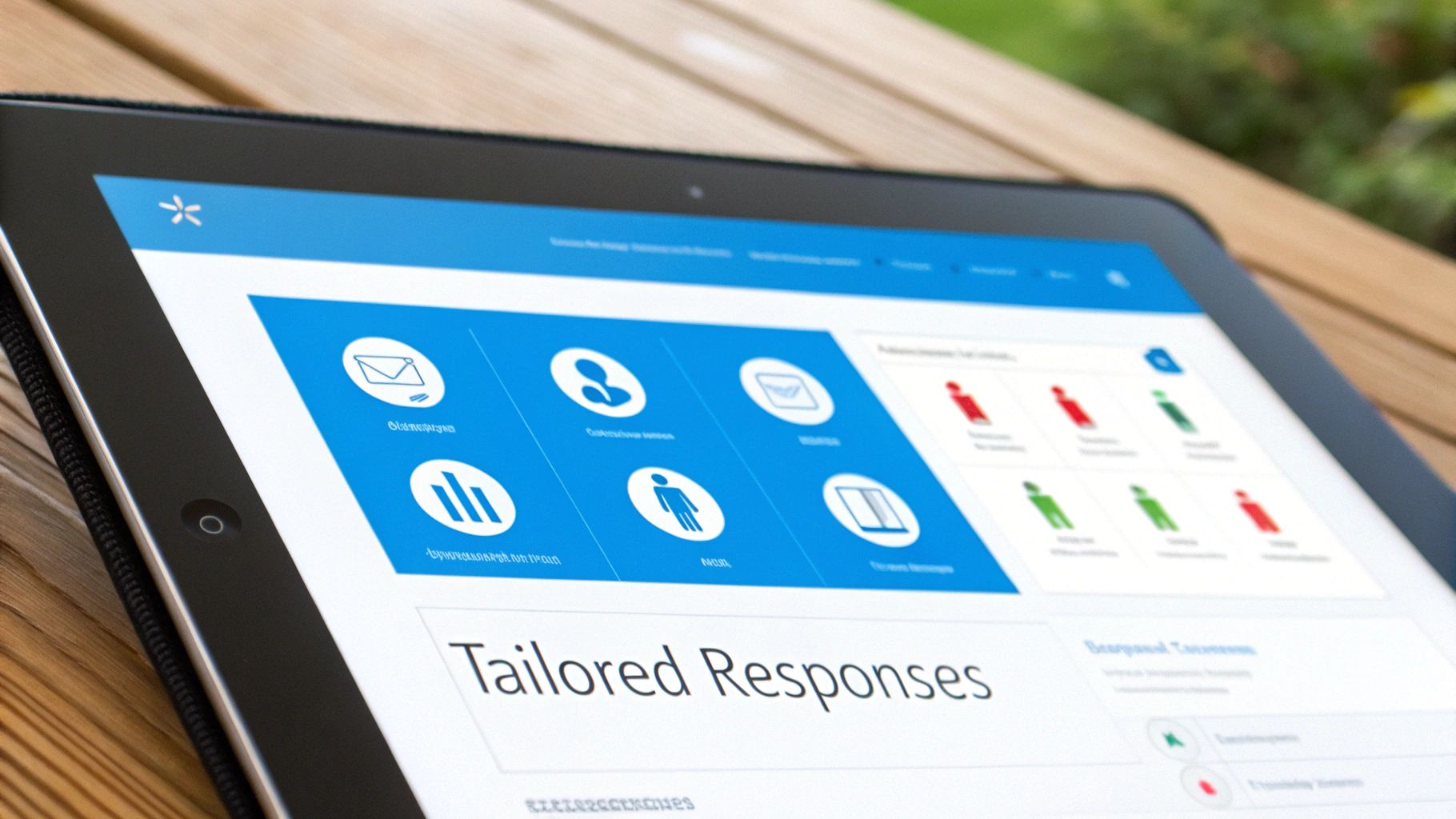
This level of personalization creates a more relevant and efficient experience. For instance, an AI chatbot can recognize a returning customer by name, reference their recent order, and proactively ask if their inquiry is related to that purchase, saving everyone time.
How to Implement This
You can begin personalizing interactions without a complex data science team. Modern tools make it easy to connect your customer data to your support channels.
- Connect Your Data Sources: Use integrations to link your CRM (like HubSpot or Salesforce) to your AI chatbot. This allows the bot to access customer history.
- Segment Your Audience: Group customers based on criteria like purchase history or loyalty status. You can then create tailored conversational flows for each segment.
- Use Data in Conversations: Program your bot to use the customer's name and reference past interactions to create a sense of familiarity and context.
- Offer Proactive Suggestions: Based on a customer's history, your bot can suggest complementary products or helpful tutorials.
4. Create a Comprehensive Knowledge Base for Your Bot
An AI chatbot is only as smart as the information it can access. One of the most critical customer service best practices for successful automation is building a rich, well-organized knowledge base.
This centralized repository of information is what your bot uses to find accurate answers. A robust knowledge base directly reduces the bot’s reliance on human agents and dramatically improves the quality of its responses.

Think of your knowledge base as your bot's brain. For example, a Shopify store can upload its entire product catalog, return policies, and shipping details. The bot can then instantly answer questions like "Do you have this shirt in blue?" or "What's your international shipping policy?"
How to Implement This
Building a comprehensive knowledge base is an ongoing process, but modern platforms make getting started simple. You can upload entire websites, PDFs, and text documents in minutes to begin training.
- Start with FAQs: Begin by compiling and uploading your top 10-20 most frequently asked questions.
- Upload Core Content: Use a tool that can scrape and index your entire website automatically. Include key pages like product details, pricing, and policies.
- Add Supporting Documents: Upload relevant PDFs, product catalogs, user manuals, and internal documentation.
- Keep It Fresh: Choose a chatbot platform that offers automatic retraining to keep the bot’s knowledge current.
5. Leverage Analytics and Chat Logs to Drive Continuous Improvement
Exceptional customer service isn't a "set it and forget it" activity; it's a dynamic process of listening, learning, and adapting. A powerful customer service best practice is to treat every interaction as a source of valuable data.
By regularly analyzing metrics and chat transcripts, you can uncover customer pain points, identify knowledge gaps, and spot emerging trends. This creates a powerful feedback loop that drives continuous improvement.
This data-driven approach transforms your support function from a cost center into a strategic asset. For instance, analyzing support conversations can help you refine your FAQ content and response templates. This data allows you to proactively address issues before they escalate.
How to Implement This
Turning raw data into actionable insights is easier than it sounds. You can start building this habit with a simple, consistent process.
- Set a Review Cadence: Schedule weekly or bi-weekly reviews of your most common customer questions and chat logs.
- Track Key Metrics: Monitor your bot's resolution rate (the percentage of queries solved without human escalation) and customer satisfaction (CSAT) scores.
- Identify Knowledge Gaps: Look for questions your chatbot consistently fails to answer. This is a clear signal to update its knowledge base.
- Share Insights: Create a simple monthly report of the top customer issues and share it with your product, marketing, and sales teams.
6. Offer Multi-Channel Support Across Customer Preferred Platforms
Your customers don't live on a single platform, and your support shouldn't either. One of the most important customer service best practices is to meet your audience where they are most comfortable, whether that's your website, WhatsApp, or Facebook Messenger.
Offering multi-channel support removes friction and makes it incredibly easy for customers to get the help they need. This approach boosts engagement and shows customers you value their convenience.
To do this well, you should unify conversations from multiple sources into a single agent view. AI platforms can help by letting you build one chatbot and deploy it instantly across your website, WhatsApp, Telegram, and more. This ensures a consistent experience everywhere, so a customer starting a conversation on Facebook can receive the same quality of service as someone on your website.
How to Implement This
Unifying your support channels is simpler than it sounds with modern tools. Here’s a quick guide to getting started.
- Identify Key Channels: Survey your customers or use analytics to find out which 2-3 platforms they use most frequently.
- Use a Unified Tool: Implement a solution that lets you manage and deploy support across all chosen channels from a single dashboard.
- Customize Your Persona: Slightly tweak your bot's tone to match the informal nature of platforms like Instagram versus the more formal context of your website.
- Promote Your Channels: Let customers know they can reach you on their favorite platforms by adding icons to your website footer and email signatures. This is a key part of an effective omnichannel customer service strategy.
7. Automate Lead Capture and CRM Synchronization
Your customer service interactions are not just about solving problems; they are valuable opportunities to identify potential sales leads.
Automating lead capture and CRM synchronization is a customer service best practice that bridges the gap between support and sales, ensuring no opportunity is missed.
This process involves using your chatbot to intelligently identify and qualify leads during a conversation and then automatically pushing that data into your CRM. For example, a visitor asking about pricing can be prompted for their name and email. The system can then sync this data directly to Salesforce or HubSpot, allowing sales reps to follow up instantly with full context.
How to Implement This
Connecting your customer service channels to your sales pipeline can be done efficiently with modern integration tools.
- Map Key Information: Identify the essential data points your sales team needs (e.g., name, email, company size, pain point).
- Design a Conversational Flow: Create chatbot scripts that naturally ask for this information when it's relevant.
- Connect Your Tools: Use an integration platform to build a bridge between your chatbot and CRM. For instance, you can easily connect FastBots.ai to thousands of apps, including Salesforce and Pipedrive.
- Set Up Alerts: Configure your CRM to notify the appropriate sales representative as soon as a new lead is captured by the bot.
8. Maintain Consistent Branding and Tone Across All Interactions
Every interaction a customer has with your business shapes their perception of your brand. A disjointed experience, where your website is professional but your chatbot is overly casual, can erode trust.
Maintaining a consistent brand voice across all touchpoints is a critical customer service best practice. This reinforces your identity and builds a cohesive, reliable customer journey.
This goes beyond just logos and colors; it's about personality. For example, a brand known for its playful voice should ensure its chatbot reflects that tone. By defining and applying your unique voice, you turn a simple support chat into a memorable brand experience.
How to Implement This
You can easily configure your automated tools to reflect your brand's personality, especially with platforms designed for customization.
- Define Your Brand Voice: First, document your persona. Is it friendly and casual, or formal and authoritative?
- Develop a Chatbot Persona: Give your bot a name and a personality that aligns with your brand voice.
- Customize Appearance: Use tools like FastBots.ai to white-label your chatbot, matching its colors and logos to your website's design.
- Script Key Responses: Write initial greetings and closing messages in your brand's specific tone to set the stage for every conversation.
9. Proactively Engage Customers with Targeted Outreach
Exceptional customer service isn't just about reacting to problems; it's about anticipating needs. Proactively engaging customers is a powerful best practice that transforms the support dynamic from reactive to preventative.
Instead of waiting for a customer to report a problem, you reach out with timely, relevant information that adds value and builds loyalty.
This approach leverages customer data and behavior to deliver personalized experiences. For example, an e-commerce site might use automated messages to recover abandoned carts. These actions don't just solve a potential problem (a lost sale); they show the customer you're paying attention.
How to Implement This
You can automate proactive outreach using AI tools that connect customer actions to messaging triggers. This makes scaling personalized engagement achievable for any business.
- Segment Your Audience: Group customers based on their behavior, such as browsing history or purchase frequency.
- Set Up Triggers: Use integrations to trigger messages from specific actions. For example, a customer visiting a pricing page three times could trigger a message offering assistance.
- Craft Your Message: Write concise, helpful messages. A proactive message could be a shipping delay update or a product recommendation.
- Choose the Right Channel: Use channels like WhatsApp or SMS for timely, personal notifications.
10. Prioritize Security, Privacy, and Compliance in All Interactions
In an era of frequent data breaches, building trust is non-negotiable. Customers will only share their information if they are confident it's being handled securely.
Prioritizing security and compliance throughout your customer support system is a fundamental aspect of excellent customer service. This practice protects your customers and your business, solidifies your reputation, and ensures you operate legally.
This commitment to data protection demonstrates respect for your customers. For example, any business serving EU customers must adhere to GDPR, a strict data protection regulation. Making compliance a cornerstone of your service is one of the most critical customer service best practices you can implement.
How to Implement This
Integrating robust security measures is a critical step that requires careful planning and the right tools.
- Choose Compliant Tools: Verify that your core platforms, especially your AI chatbot, are SOC 2 and GDPR compliant.
- Create Clear Policies: Develop and publish an easy-to-understand privacy policy that explains exactly how customer data is handled.
- Implement Access Controls: Ensure only authorized team members can view sensitive customer information.
- Train Your Team: Regularly educate your support staff on data protection principles and your company's security protocols. For more details, you can learn more about GDPR compliance for AI chatbots.
What to Watch Out For: Limitations and Considerations
While these practices can significantly improve your customer service, it's important to be aware of potential trade-offs.
For example, over-automating without a clear path to a human agent can lead to frustration. The goal is to assist, not to create a robotic fortress. Similarly, personalization must be handled with care to respect user privacy; being helpful is good, but being intrusive is not.
Finally, remember that technology is a tool, not a complete solution. The success of any of these customer service best practices depends on a solid strategy and a team that is trained to use them effectively.
Putting It All Together: Your Next Steps
We've explored ten foundational customer service best practices, from implementing AI chatbots to prioritizing security. Exceptional customer service today is about building an ecosystem where technology empowers human connection and data drives intelligent interactions.
The journey from good to great customer service is ongoing. The practices we've detailed are components of a dynamic strategy that must evolve with your customers' expectations.
Actionable Takeaway: Your Implementation Roadmap
To truly embed these customer service best practices, it’s important to move from reading to doing. A phased approach is often the most effective.
Quick Checklist for Action:
- Assess Your Biggest Pain Point: Is it slow response times? Are agents overwhelmed with repetitive questions? Identify your single biggest opportunity for improvement.
- Start with the Highest-Impact Practice: If after-hours support is the issue, implementing a 24/7 AI chatbot is a logical first step. If your team is buried in simple questions, focus on building out a comprehensive knowledge base.
- Define a Pilot Project: Choose one channel or one specific goal (e.g., automating "Where is my order?" questions) to launch your first initiative. This allows you to learn and refine your approach.
- Measure and Iterate: As we discussed, leveraging analytics is key. Set clear metrics for your pilot project, track them, and use the data to make informed decisions and expand what works.
The True Value of Mastering Customer Service
Implementing these practices is more than an operational upgrade; it's an investment in your brand's future. When you provide fast, personalized, and reliable support, you build trust and foster loyalty.
Each positive interaction strengthens the customer relationship, increasing the likelihood of repeat purchases and positive word-of-mouth referrals. In a competitive market, the quality of your customer service is often your most significant differentiator.
Ready to put these best practices into action? The easiest way to start is by automating your first line of support. With an AI chatbot, you can instantly elevate your capabilities. Explore how FastBots.ai can transform your customer service today.