A Modern Guide To Chatbots Lead Generation
Have you ever wondered what chatbots for lead generation really are? Think of it as swapping out those static, boring web forms for a dynamic, 24/7 conversation. It’s an automated way for you to greet website visitors, figure out what they need, and turn them into qualified leads for your sales team.
The goal is to guide people toward a specific action—like booking a demo or sharing their contact details—through an interactive chat instead of a passive form. This makes the entire process feel more helpful and less like a chore.
Why Chatbots Are Reshaping Lead Generation
Ever landed on a website with a quick question, couldn't find the answer, and just left? That’s the exact problem chatbots solve. Traditional methods like "contact us" forms create a painful delay for your potential customers.
A visitor is interested right now, but they have to fill out a form and wait. That gap is where you lose people.
AI chatbots completely flip the script. They offer immediate, around-the-clock engagement, making sure you never miss a chance to connect with someone who’s ready to talk. In today's market, customers simply expect instant answers.
The Power of Immediate Engagement
The real magic of using chatbots for lead generation is their ability to strike while the iron is hot. You’re interacting with prospects at the absolute peak of their interest. Instead of making them wait for an email, a chatbot jumps right in.
- It answers questions instantly. This builds trust and shows you know your stuff from the very first click.
- It qualifies leads in real-time. The bot can ask smart, targeted questions about their needs, budget, or timeline.
- It guides users to the right place. Whether that's a key blog post, a specific product page, or a calendar link to book a meeting.
This turns a passive visit into an active, productive conversation. For example, a real estate agency’s bot can ask a visitor about their dream location and price range. Just like that, it has qualified them and can even start showing relevant listings. That’s a world away from a generic form and a 24-hour wait.
From Static Forms To Dynamic Conversations
When you look at why chatbots are better for lead capture, the difference is clear. One is a passive data collector; the other is an active conversational partner.
Chatbot Engagement vs Traditional Web Forms
| Feature | Traditional Web Form | AI Chatbot |
|---|---|---|
| Response Time | Delayed (hours or days) | Instant, 24/7 |
| Interaction Style | One-way data entry | Two-way conversation |
| Qualification | Post-submission, manual | Real-time, automated |
| User Experience | Impersonal and static | Interactive and personalized |
| Data Collection | All at once, can feel intrusive | Progressive, asks one question at a time |
| Proactive Help | None. It just sits there. | Can initiate conversation based on user behavior |
The bottom line? A web form is a dead end until a human on your team picks it up. A chatbot is the start of a relationship.
The chatbot lead generation market is growing for a reason. Typically, businesses using AI chatbots see a jump in qualified leads, with many leaders reporting a rise in high-quality leads specifically. In the B2B world, these real-time chats have been shown to lift conversion rates significantly.
Understanding how technology is changing customer expectations is key. Keeping an eye on broader trends, like the food service industry trends shaping 2025, shows that this shift is happening everywhere. The principle is universal: meet customers where they are with immediate, helpful interactions. We dive deeper into this in our article on the top benefits of chatbot lead generation.
Crafting Conversations That Actually Convert
A powerful chatbot isn't just another piece of tech; it's your digital frontline ambassador. The success of using chatbots for lead generation comes down to one thing: the quality of the conversation.
A clunky, robotic script will send visitors running, but a thoughtfully designed flow can turn a casual browser into a genuinely interested lead. The goal here is to make the interaction feel less like filling out a sterile form and more like a helpful, natural conversation.
The Anatomy of a High-Converting Chat Flow
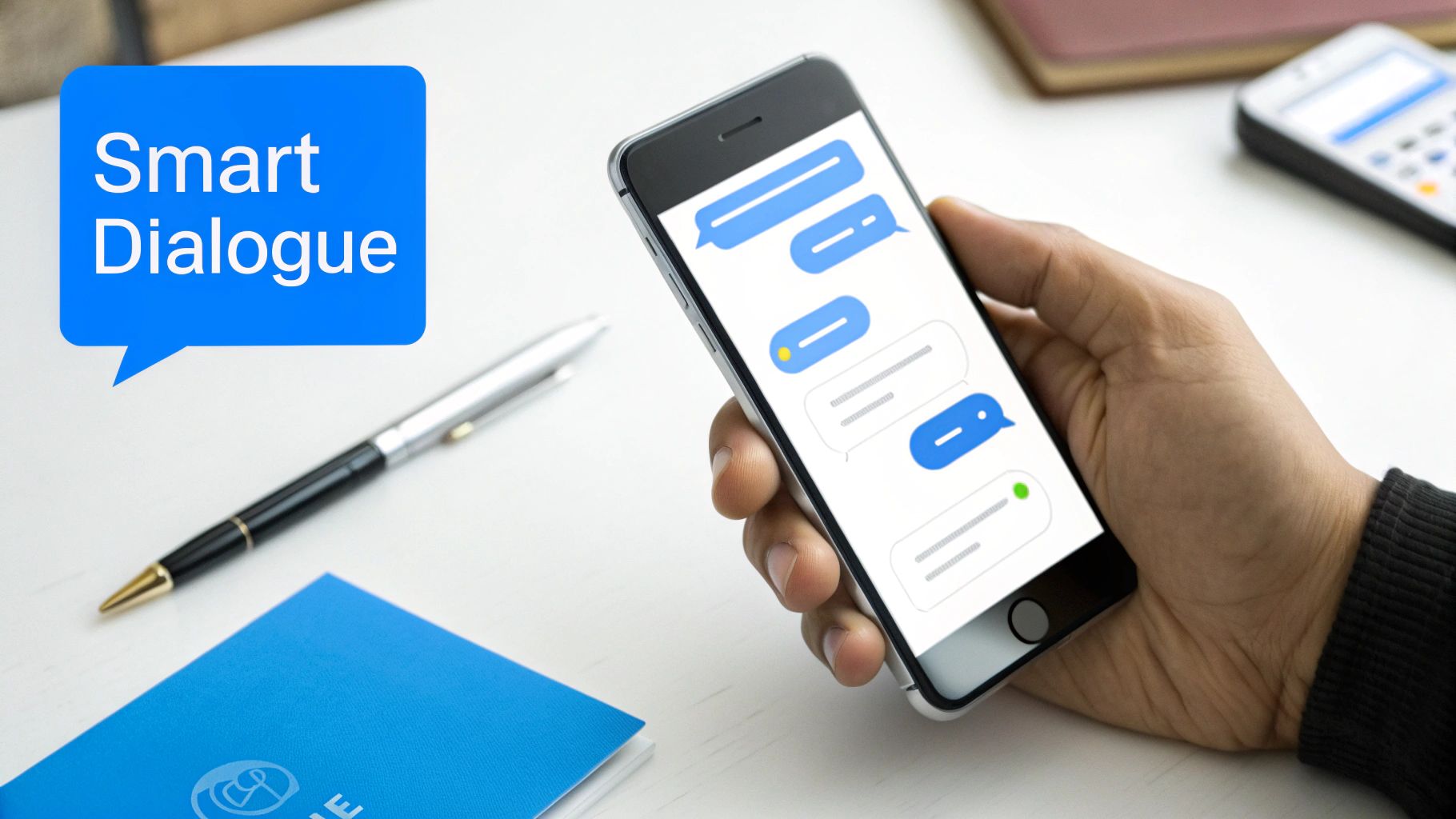
So, where do you start? A great chatbot conversation isn’t a single, rigid script. You should think of it more like a branching tree of possibilities, anticipating what your visitors might need and guiding them down the right path. It’s almost like a choose-your-own-adventure story for your business.
Each response from the user opens up a new, relevant line of questioning that gets you one step closer to qualifying them.
Start With a Compelling Welcome
First impressions are everything, especially online. Your welcome message is the hook that decides whether someone engages or instantly closes the chat window. A generic "How can I help you?" is often too passive to get anyone excited.
Instead, try to be proactive and context-aware. Let's say a visitor is browsing your pricing page. A smart bot could pop up with, "Exploring our plans? I can help you find the perfect fit. What's your team size?" This immediately shows relevance and offers real value.
A great welcome message accomplishes three things: it acknowledges the user's context, offers specific help, and provides a clear next step. For a deeper dive, our guide on chatbot conversation design is a masterclass in creating flows that keep users hooked.
Ask the Right Questions Without Being Pushy
Once you've got their attention, it's time to qualify them. The secret is to gather information bit by bit, making it feel like a natural back-and-forth. Bombarding someone with five questions at once is just a glorified web form.
Here are a few ways you can frame your qualifying questions:
- Problem-Based: "What's the biggest challenge you're facing with [your industry problem] right now?" This gets right to their pain points.
- Goal-Oriented: "What are you hoping to achieve in the next quarter?" This uncovers their motivations.
- Budget & Timeline: "To point you to the right solution, do you have a budget in mind?" or "What's your ideal timeline for getting started?"
A real estate bot, for instance, wouldn't just demand a name and email upfront. It might start with, "Are you looking to buy or rent?" followed by "Cool, what neighborhoods are on your radar?" Only after providing value does it make sense to ask for contact details.
Knowing When to Ask For Contact Info
The "ask" is a critical moment, and timing is everything. You should only request contact information after you’ve established some trust and delivered genuine value.
A good rule of thumb is to ask for their email or phone number when it's the logical next step to help them further. For instance, after a B2B SaaS bot has identified a user's needs, it could say, "It sounds like our Enterprise plan would be a great match. I can send a detailed pricing sheet over. What's the best email to use?" This frames the request as a service, not a demand.
Mapping Different Conversation Paths
Your website attracts all sorts of visitors, so a one-size-fits-all conversation just won't cut it. You need to map out different paths for different user intentions.
For an e-commerce site, this might mean having separate flows for:
- Product Discovery: For the user who isn't sure what they want. The bot can act like a personal shopper.
- Order Tracking: For a returning customer checking on their order status. The bot should provide this info quickly.
- High-Intent Buyers: For a visitor who has viewed a product three times. The bot can proactively offer a discount.
This level of personalization shows the user you understand their unique journey. And that is fundamental to making chatbots lead generation actually work.
Bringing Your First Lead Generation Bot To Life
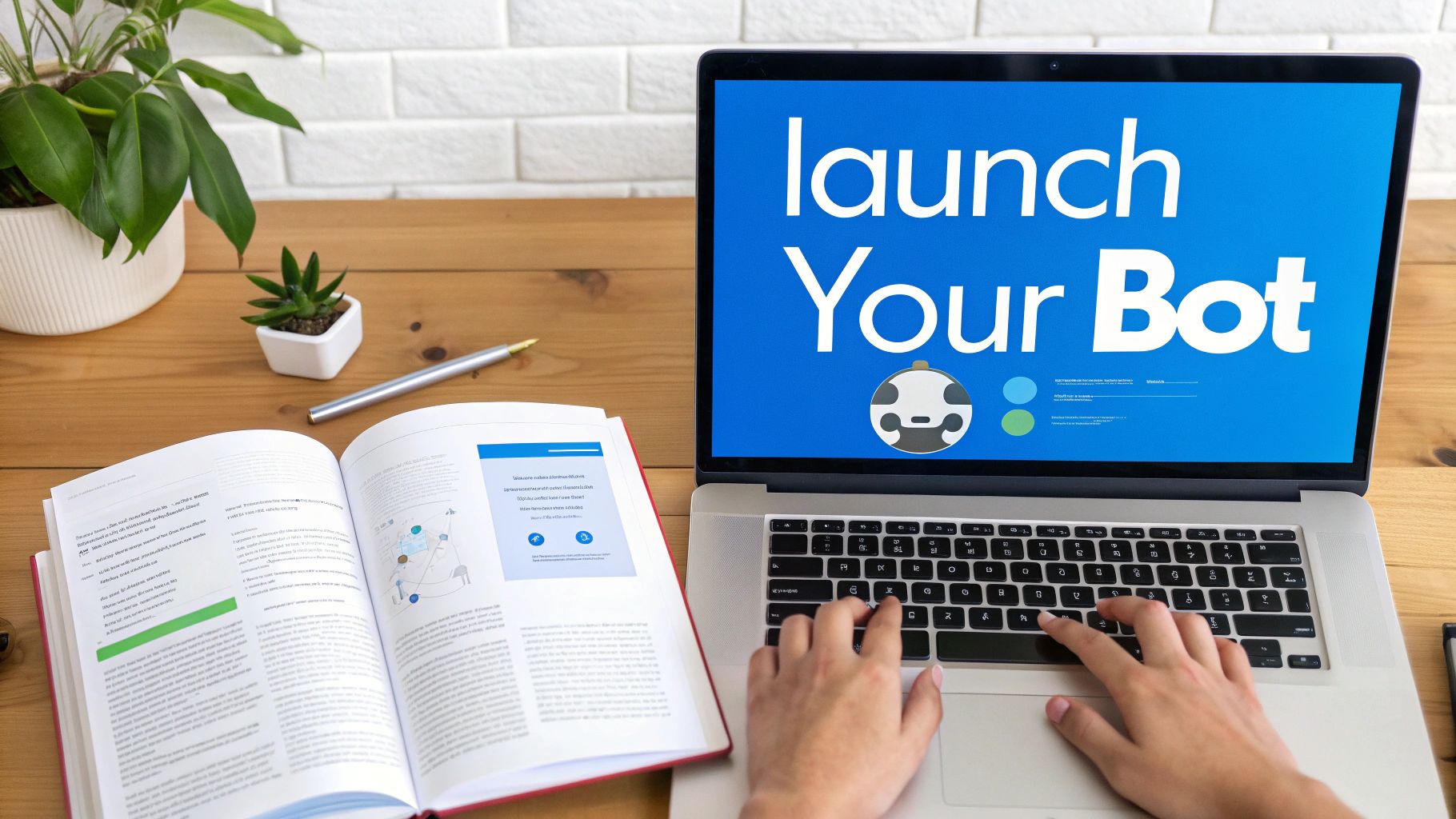
Alright, this is where the theory ends and the action begins. Moving from a conversation map to a live, working chatbot is the most exciting part of the process. We'll walk you through how to build and launch your very first lead bot.
The good news? Modern AI chatbot platforms are designed to be intuitive. You'll be focusing more on your strategy and less on tangled lines of code. The most critical thing to remember is that a great bot isn't built from scratch; it's built from the knowledge you already have.
Training Your Bot on Your Business Data
The smartest, most reliable chatbots are trained on a company’s own, hand-picked information. This ensures every answer is accurate, stays on-brand, and pushes your business goals forward. Think of it as giving your new digital team member a crash course on everything they need to know.
You can simply upload your existing business documents to create the bot's "brain." This knowledge base is what the AI taps into to answer questions, guide conversations, and ultimately, nail your chatbots lead generation goals.
Here are the most common data sources we see businesses use:
- Website Content: Just drop in your website URL. The platform will crawl your pages to learn about your products and services.
- Documents: Upload files like product PDFs, pricing sheets, technical spec documents, or detailed FAQs.
- Spreadsheets: If you have structured data in CSV or XLS files, the chatbot can pull specific answers directly from them.
This initial training is what makes the difference between a bot that says "I don't understand" and one that acts as a valuable extension of your team.
Defining Your Chatbot’s Persona and Voice
Once your bot has the facts straight, it's time to give it some personality. How it says something is just as important as what it says. A chatbot’s persona should feel like a natural part of your brand.
Are you a fun e-commerce store or a buttoned-up B2B consultancy? Your bot’s tone needs to reflect that. Most platforms let you set this with simple instructions. For instance, you could tell your bot: "You are a friendly and helpful support assistant. Keep your answers short and feel free to use emojis."
Defining a clear persona creates a consistent experience. A visitor shouldn't get whiplash moving from the friendly tone of your website to a cold, robotic chatbot.
Deploying Your Bot Across Multiple Channels
Your customers aren't just on your website, and your chatbot shouldn't be either. To truly maximize your lead opportunities, you need to meet people where they are.
Luckily, deploying your bot is often as simple as copying and pasting a bit of code. From there, you can connect that same bot to different messaging apps, creating one unified experience.
Your Deployment Checklist:
- Website: Embed the chat widget on high-traffic pages like your homepage and pricing page.
- WhatsApp: Hook your bot up to a WhatsApp Business account to answer questions right inside the app.
- Facebook Messenger: Integrate with your business’s Facebook page to automate responses from your social audience.
Imagine a marketing agency running a Facebook Ad. Someone comments, and the chatbot instantly engages them in Messenger. It asks a few qualifying questions and, if it's a good fit, books a call with a strategist—all without the person ever leaving Facebook. This seamless journey is a game-changer for improving chatbots lead generation from paid ads.
Connecting Your Chatbot To Your Sales Stack
Capturing a lead with your chatbot is a great start, but it's only half the battle. The real magic happens after the conversation ends. If that valuable lead data just sits in your chatbot's inbox, you’re letting it go cold.
This is where integrations come in. By connecting your chatbot to the sales and marketing tools you already use, you can build an automated workflow that turns a qualified lead into a sales opportunity—no manual effort required.
Seamless CRM Integration
Your Customer Relationship Management (CRM) system is the heart of your sales process. Automatically sending chatbot leads there is non-negotiable. This ensures every interaction is logged, every lead is assigned, and no one falls through the cracks.
Picture this: a visitor qualifies as a hot lead. A direct integration can instantly:
- Create a new contact in your CRM (like HubSpot or Salesforce).
- Log the entire chat transcript to that contact's record.
- Assign the new lead to the right sales rep.
This automation hands your sales team a complete picture of the lead's needs. No more manual data entry, which saves time and cuts out human error. As we've covered before, a CRM-connected chatbot is a foundational piece of an effective sales stack.
Powering Up Your Workflow With Automation Tools
While direct CRM integrations are crucial, you can unlock even more power by connecting your chatbot to automation platforms like Zapier or Make. These tools act as a central hub, allowing your chatbot to trigger thousands of different actions.
For example, a marketing agency could set up a workflow where a qualified chatbot lead kicks off a multi-step automation:
- The lead’s contact info is added to a HubSpot CRM record.
- The sales manager gets an instant SMS notification about the hot new lead.
- The lead is automatically added to a specific email nurture sequence in Mailchimp.
This level of automation ensures immediate follow-up and keeps leads warm without requiring anyone on your team to lift a finger.
Actionable Takeaway: Your Automation Quickstart
Here’s how you can apply this in your business today:
- Map your process: Write down every manual step your team takes after a new lead comes in.
- Identify bottlenecks: Where do delays happen? (e.g., waiting for someone to assign the lead).
- Start simple: Your first automation should be sending chatbot leads directly to your CRM.
- Add one trigger: Next, set up an automatic email or Slack notification to the right salesperson.
This simple two-step automation can dramatically speed up your response time and prevent leads from going cold.
What to Watch Out For: Limitations and Considerations
Rolling out a chatbot for lead generation is a huge win, but it’s not a “set it and forget it” project. To build a system that visitors trust and your sales team loves, you need to get ahead of a few common snags.
Ignoring these potential issues can create a frustrating experience for users. A little upfront planning goes a long way toward building a more resilient and effective strategy for your chatbots lead generation.
The Dreaded "Bot Dead-End"
There’s almost nothing more frustrating for a user than getting stuck in a conversational loop with a bot that doesn’t get it. This can happen when a question is too complex or outside of what the bot was trained on. This is where a seamless human handover process becomes non-negotiable.
Your chatbot must be smart enough to know its own limits. When it detects confusion or gets a direct request to speak with a person, it should offer an immediate and easy escape route to your team. This could be a direct connection to a live chat agent or a simple way to book a call.
Navigating Data Privacy and Compliance
The moment your bot starts collecting personal information, you've entered the world of data privacy and compliance. Regulations like GDPR are serious, and customers are savvy about how their data is being used.
Transparency is key. You should inform users that they’re talking to a bot and provide a clear link to your privacy policy. Only collect the data you truly need and make sure you're storing it securely. Being upfront not only builds trust but also keeps you on the right side of the law.
Measuring Performance and Optimizing Your Bot
Getting your chatbot live is a huge step, but it’s just the starting line. To get the most out of your bot, you need to treat it like any other part of your marketing machine. That means measuring its performance and constantly tweaking it to make it better.
Launching a bot without tracking its performance is like driving with your eyes closed. You need hard data to see what's working, what's falling flat, and where your biggest opportunities are hiding.
Key Metrics to Track for Lead Generation
When you start digging into analytics, it's easy to get sidetracked by vanity metrics like "total conversations." Instead, you should zero in on the metrics that tie directly back to your lead generation goals.
Here are the core performance indicators for your dashboard:
- Lead Capture Rate: What percentage of conversations end with the bot successfully grabbing contact info? This is your most important measure of success.
- Qualification Rate: Of all the leads captured, how many met your criteria (e.g., budget, company size)? This tells you if the bot is bringing in the right kind of leads.
- Conversation Drop-Off Points: Where in the conversation are people leaving? Finding these friction points is the first step to fixing them.
- Cost Per Qualified Lead (CPQL): If you're running paid ads to a landing page with your chatbot, this metric gives you a clear picture of your ROI.
Analyzing Conversations to Find Gold
Your chat transcripts are a goldmine of customer insights. Make it a habit to review these conversations, especially the ones that didn't end in a lead. This is where you'll find intel on your customers' real questions, pain points, and objections.
Look for patterns. Are five different people asking the same question that your website doesn't answer? That’s a signal to update your site content and your bot’s knowledge base. You can learn more about refining your bot’s knowledge in our guide to using AI for small businesses.
By analyzing chat logs, you’re getting direct, unfiltered feedback from your target audience. This is often more valuable than any survey.
Testing and Iteration: Your Path to Better Results
Once you have data and a few insights, it's time to start experimenting. Continuous optimization is what separates a static bot from a high-converting one. One of the best ways to do this is with A/B testing.
You can test almost any part of your bot’s conversation flow. For instance, you could try:
- Welcome Messages: Pit a proactive greeting ("Looking for help with X?") against a more general welcome ("Hi, how can I help?").
- Question Phrasing: Does asking "What's your budget?" perform differently than a softer approach like, "Do you have a price range in mind?".
- Call to Action: Compare the performance of "Book a demo" versus "Schedule a 15-minute call."
By making small, deliberate changes and measuring the impact, you can systematically improve your bot's effectiveness over time. This iterative process ensures your chatbots lead generation efforts are always moving in the right direction.
Ready to see how a custom AI chatbot can transform your lead generation? At FastBots.ai, you can build a bot trained on your data in minutes, no coding required. Start your free trial and launch your first chatbot today!