Mastering Chatbots in Facebook Messenger

Ever felt like you need an extra pair of hands to handle your Facebook messages? That's exactly where a Facebook chatbot comes in. Think of it as a tireless digital assistant who’s always on, ready to chat with customers on Messenger or Instagram DMs, answer their questions, and guide them along 24/7. It’s the tool that turns your social media from a simple broadcast channel into a lively, two-way conversation street.
What Are Facebook Chatbots Really
At its heart, a Facebook chatbot is like an interactive FAQ page that actually talks back. The moment a user messages your page or clicks a "Send Message" button on an ad, the bot jumps into action. It follows a pre-designed script or, even better, uses artificial intelligence to figure out what the user needs and respond accordingly.
But we're not just talking about canned, robotic replies here. Today's chatbots in Facebook can handle surprisingly complex, almost human-like conversations. They get the context, ask smart follow-up questions, and can walk a user through anything from troubleshooting a problem to placing an order.
How Chatbots Communicate and Function
So, how do these digital helpers work their magic? It's a mix of triggers, rules, and a dash of AI. A "trigger" could be as simple as a user typing a specific keyword like "pricing" or tapping a button in your ad. Once that happens, the bot kicks off its programmed conversation flow to deliver a smooth experience.
Behind the scenes, a few key pieces are working together:
- Natural Language Processing (NLP): This is the brainpower that lets the bot understand what people are actually saying, even with typos, slang, or weird phrasing. It deciphers the intent behind the words.
- Conversation Flows: Think of these as conversational roadmaps. They are the pathways you design to guide a user from their initial question to a successful answer, making sure the chat flows logically.
- API Integrations: To do really useful things like check an order status or book a meeting, chatbots need to talk to your other business software. They do this through APIs, and the Facebook Graph API is the foundational technology that makes these powerful connections possible.
A truly smart chatbot doesn't just answer questions; it anticipates them. By learning from user interactions, it can proactively offer help or suggest relevant products, making the entire customer journey feel personal and incredibly efficient.
The goal is to automate communication without making it feel, well, automated. If you want to dive deeper into the nuts and bolts, our guide on how a Facebook chatbot works breaks it all down. Understanding the mechanics is the first step toward making bots a game-changing part of your business strategy.
Putting Your Chatbot to Work for Your Business
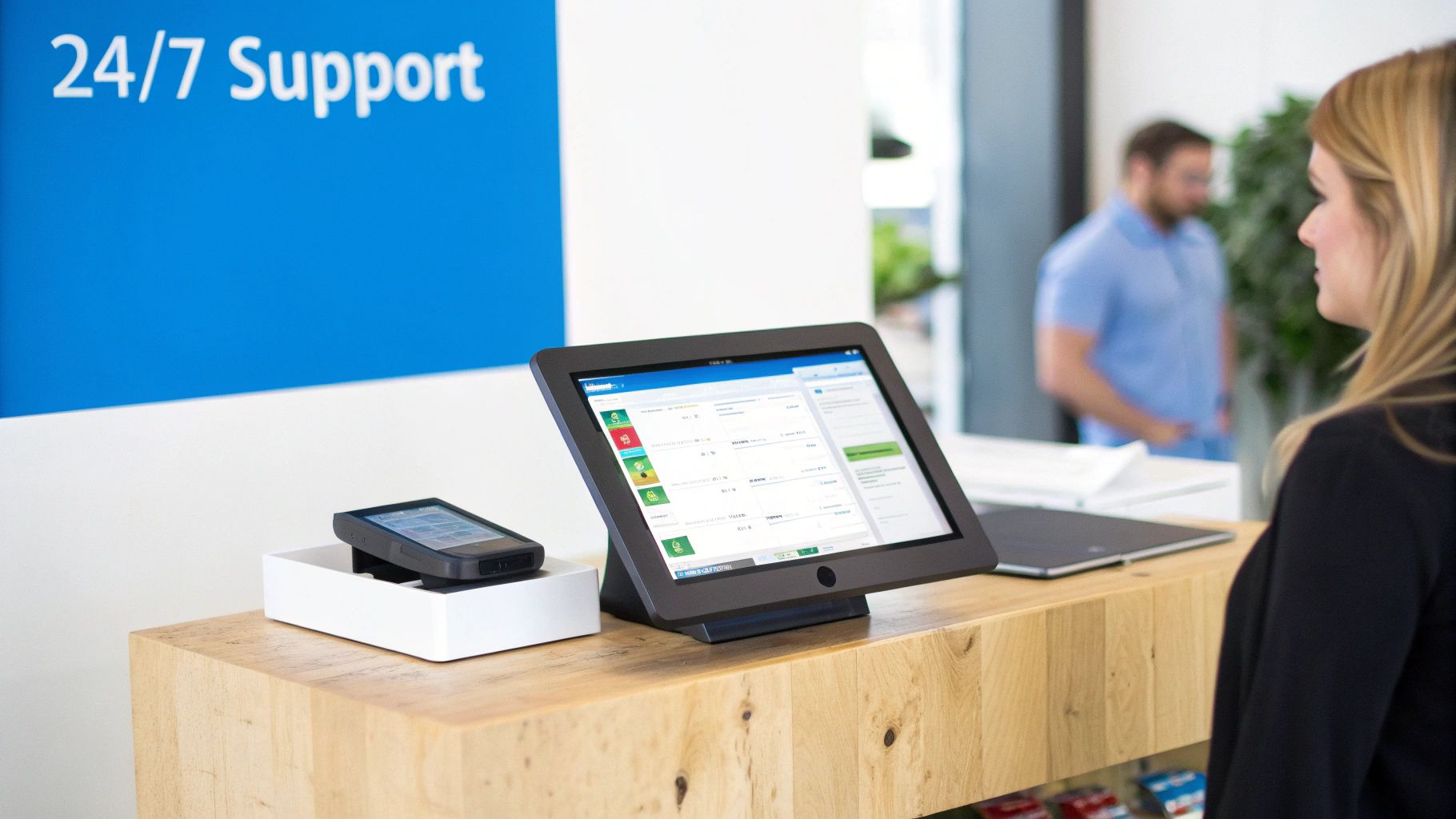
A well-built chatbot is so much more than a simple messaging gimmick; it's a genuine engine for business growth. When you automate the right interactions, your chatbots in Facebook turn your social media presence into a hub for support, sales, and customer engagement that never clocks out.
Think of it as your most reliable employee. It doesn’t need sleep, coffee, or holidays. It’s always online, ready to help a customer the moment they send a message. This kind of instant response is exactly what modern customers have come to expect.
Provide Instant 24/7 Customer Support
One of the biggest wins right out of the gate is automating customer support. Instead of forcing customers to wait hours (or even days) for a reply, a chatbot can solve common problems on the spot.
Imagine a customer messaging your page at 2 a.m. asking, "Where is my order?" Your bot can instantly pull up their order details and shoot back a real-time tracking update. This single interaction frees up your human agents to handle the complicated, high-stakes problems that actually need a human touch. It's no wonder chatbots are expected to save businesses 30% of their customer support costs.
Become a Lead Generation Machine
Your chatbot can also put on its sales hat and become a proactive lead generation specialist. When someone clicks on a Facebook ad and lands in your Messenger, the bot can greet them immediately, turning a flicker of interest into a real conversation.
It can ask smart, qualifying questions to figure out a prospect's needs, budget, and timeline. Once it has that intel, it can smoothly grab their contact info or even schedule a call directly with your sales team. Learning how to generate leads on Facebook is one thing, but having a bot do the initial legwork for you is a total game-changer.
By qualifying leads automatically, a chatbot ensures your sales team spends their time on high-potential prospects, dramatically shortening the sales cycle and boosting conversion rates.
Power-Up E-commerce Sales
For e-commerce brands, a chatbot can feel like a personal shopper living right inside Messenger or Instagram DMs. It can ask customers about their style and preferences, then recommend products—creating a guided shopping experience that feels personal and helpful.
Here’s how a sales-focused bot can directly drive revenue:
- Product Recommendations: Based on what a user says, it can pull up relevant items in a clean, visual carousel format.
- Answering Product Questions: It can instantly provide details on sizing, materials, or stock levels.
- Cart Recovery: If someone leaves items in their cart, the bot can send a friendly nudge a little while later to remind them to check out.
This conversational approach makes the path to purchase incredibly simple, removing friction and boosting sales without ever making the customer leave the chat.
The market numbers back this up. The global chatbot market was valued at $15.57 billion in 2025 and is projected to skyrocket to $46.64 billion by 2029. This explosive growth is happening for one simple reason: businesses are seeing real, tangible results.
Choosing Your Arena: Messenger vs. Instagram DMs
Deciding where your chatbot will live is a huge strategic choice. While both Messenger and Instagram are part of the Meta family, they are completely different arenas with their own rules of engagement. Picking the right platform means matching your chatbot's job with how people actually behave there.
Think of Facebook Messenger as the mature, feature-rich environment. It’s where users are already used to more detailed conversations, like checking an order status, getting real support, or navigating a multi-step purchase. Its established infrastructure is built for complex, functional chats.
Instagram, on the other hand, is a fast-paced, visual-first world. Interactions are often quicker and more spontaneous, sparked by a Story, Reel, or post. The audience is generally younger and expects snappy, engaging conversations that get right to the point.
Messenger: The Utility Powerhouse
Facebook Messenger is the workhorse of conversational automation. Its real strength is handling complex, task-oriented conversations. This is where your chatbots in Facebook can truly shine as practical tools that solve problems and guide users through detailed processes.
Messenger is the perfect choice for things like:
- In-Depth Customer Support: Walking customers through troubleshooting steps, handling returns, or answering complicated questions.
- Complex Sales Funnels: Guiding users through product configurations, offering detailed quotes, and even completing the purchase right in the chat.
- Appointment Booking: Hooking into calendars to schedule demos, consultations, or services without the user ever leaving the app.
The platform’s solid support for interactive elements like buttons, carousels, and persistent menus makes these structured conversations feel smooth and efficient.
Instagram: The Engagement Hub
Instagram DMs are all about grabbing attention and building relationships. While the tech is catching up fast, an Instagram chatbot’s main job is to capitalize on the immediate interest generated by your visual content.
A bot on Instagram acts as an instant bridge from inspiration to interaction. When a user replies to a Story or comments on a Reel, the chatbot can immediately engage them, turning a fleeting moment of interest into a valuable lead or customer conversation.
This platform is ideal for driving brand discovery and quick sales. A bot here can answer fast product questions, capture leads from Story replies, or run interactive giveaways—all while keeping the energetic, visual vibe of the platform.
To help you decide, here’s a quick breakdown of how the two platforms stack up for chatbot deployment:
Facebook Messenger vs. Instagram DM Chatbots
| Feature | Facebook Messenger Chatbots | Instagram DM Chatbots |
|---|---|---|
| Primary Use Case | In-depth support, multi-step sales, appointment booking, detailed FAQ handling. | Lead capture from Stories/Reels, quick product questions, influencer marketing, flash sales. |
| Audience Demographics | Broader age range (18-65+), often used for connecting with established brands and services. | Younger audience (13-34), highly visual, focused on discovery and trends. |
| Conversation Style | More structured and task-oriented. Can handle longer, more complex conversational flows. | Quick, snappy, and often emoji-heavy. Best for short, to-the-point interactions. |
| Key Features | Persistent menus, webviews for payments/forms, carousels, advanced button options. | Story reply triggers, keyword triggers in DMs, quick replies, product tagging integration. |
| Best For... | Businesses focused on customer service, B2B lead generation, and e-commerce with complex products. | D2C brands, creators, fashion, beauty, and businesses with a strong visual identity. |
Ultimately, your choice depends entirely on your business goals and where your target audience spends their time. For a deeper dive into the visual world of IG bots, our complete guide explains exactly what Instagram chatbots are and how to use them for maximum impact.
How to Build Your First Chatbot Without Code
The idea of building a chatbot from the ground up probably sounds like a job for a team of developers. Not anymore. Thanks to modern no-code platforms, anyone can create a powerful, AI-driven assistant in minutes, not months. The whole process has become surprisingly simple.
You can forget about complex coding or wading through technical jargon. The new wave of chatbot builders is all about speed and simplicity, letting you turn an idea into a working bot without writing a single line of code. It's about giving you the power to automate conversations and improve your customer experience, no matter your technical background.
Define Your Chatbot's Core Purpose
Before you touch a single setting, the most important step is to figure out your chatbot's main goal. What is the one job you need it to do? Trying to build a bot that does everything is a surefire recipe for a confusing mess.
Instead, start small and focused. Common goals include:
- Answering FAQs: Instantly handle the top 20 questions your support team gets hit with every single day.
- Capturing Leads: Engage visitors who click your Facebook ad and collect their contact info.
- Booking Appointments: Link up with a calendar to schedule demos or consultations automatically.
- Guiding Shoppers: Act like a personal shopper, recommending products based on what a customer says they need.
By picking one core function, you can design a tight, effective conversation that gets users where they need to go. That kind of clarity is the foundation of any great chatbot.
Train Your Bot with Your Own Data
This is where the magic of modern chatbots in Facebook really kicks in. Instead of spending hours manually typing out hundreds of question-and-answer combinations, you can train your bot just by feeding it your existing company info. Platforms like FastBots.ai make this ridiculously easy.
You don't need to be an AI expert to build an expert bot. If you can copy and paste a URL or upload a file, you have all the skills required to train a custom AI chatbot on your business data.
All you have to do is provide sources like your website URL, help desk articles, product catalogs, or even PDF documents. The AI reads and understands all of it, turning that content into a knowledge base it can use to answer questions instantly and accurately.
For a step-by-step walkthrough, check out our guide on how to build free bots for Facebook Messenger. It breaks down this simple but powerful training process.
Designing Conversations That People Actually Like
A chatbot can be the smartest piece of tech in the world, but if talking to it feels clunky, confusing, or just plain robotic, it’s a failure. The real secret to successful chatbots in Facebook isn't just about the AI—it's about the art of designing conversations that are actually helpful and feel natural. This is where we shift our focus from pure automation to creating a genuinely good user experience.
The very first step? Manage expectations from the first "hello." Be upfront that the user is talking to a bot and tell them exactly what it can do. A simple opener like, "Hi, I'm the official bot for [Your Brand]! I can help you track orders, browse products, or answer common questions. Just let me know what you need," works wonders.
This kind of transparency builds trust right away and stops people from asking super complex questions the bot wasn't built for, saving them from a frustrating dead end.
Create Intuitive and Clear Pathways
Nobody should ever feel trapped in a conversation with a bot. The best interactions provide clear guidance, almost like a well-designed website menu. This is where you lean on interactive elements like buttons and quick replies. They let users navigate the chat easily without having to guess what keywords to type.
Here are a few design principles that make all the difference:
- Offer Clear Choices: Instead of an open-ended "How can I help you?", give them buttons like "Track My Order," "Product Questions," or "Speak to an Agent."
- Keep Responses Short: Break down big chunks of information into small, digestible messages. No one wants to read a wall of text in a chat window.
- Give an Escape Hatch: Always, always include an obvious way for users to connect with a human. A persistent "Talk to Support" button is a non-negotiable safety net.
The goal is to make the conversation feel completely effortless. A user should get what they need with a few simple taps, feeling guided and supported every step of the way—not confused or stuck in a loop.
Master the Human Handover
Let’s be real: no bot can handle everything. Knowing when automation hits its limit and how to smoothly pass the conversation to a live agent is probably the most critical part of a great user experience. This "human handover" shouldn't feel like a system failure; it should feel like a seamless transition.
When a question gets too complex, sensitive, or someone just types "talk to a person," the bot needs to gracefully step aside. A proper handover involves the bot gathering the essential info first—like the user's name, order number, and a quick summary of the issue—and passing it directly to the human agent. That way, the customer doesn't have to repeat themselves, which instantly makes for a better support experience.
And people are definitely getting used to this. User engagement data shows that over 375,000 people chat with Messenger bots daily, and a whopping 65% of users do it at least weekly. The demand for high-quality, smooth conversations is already here. You can explore more data on user behavior to get a deeper sense of these patterns.
How Do You Know If Your Chatbot Is Actually Working?
So, you’ve built and launched your chatbot. That’s a great first step, but it’s just the beginning. The real question is: is it actually doing the job you hired it for?
You can’t just look at surface-level numbers like "total conversations" and call it a day. That doesn't tell you anything meaningful. You need to dig deeper and measure whether the bot is successfully achieving its primary goal.
The most important metric, hands down, is the Goal Completion Rate (GCR). This tells you how often users successfully finish the task you designed the bot to handle. It could be anything—getting a straight answer to a question, booking a demo, or finding a specific product. If your bot’s job is to deflect simple FAQs and 80% of users get their answer without needing a human, that's a solid GCR.
Core Metrics to Keep an Eye On
To get the full story of your bot's performance, you'll want to track a few key performance indicators (KPIs). These numbers aren't just data points; they're clues that reveal how users feel about the experience and how the bot is directly impacting your business.
Here are the essentials:
- User Satisfaction Score: This is as simple as it gets. After a chat, just ask for a thumbs up/down or a star rating. It's direct, instant feedback on how helpful people find your bot.
- Lead Capture Efficiency: If your bot is there to generate leads, this is your money metric. Track what percentage of conversations end with a captured email or phone number. This ties the bot's performance directly to your sales funnel.
- Human Handover Rate: Keep a close watch on how often a conversation has to be passed over to a live agent. If this number is high, it’s a red flag that your bot might have knowledge gaps or confusing conversation flows that need fixing.
Think of your chatbot's conversation logs as a goldmine. Seriously. Digging through them to see where users get stuck or what questions the bot fumbles is the fastest way to find opportunities for improvement.
This isn't just about patching up problems. It's about proactively making your chatbots in Facebook smarter and more intuitive. Every insight you gather is a chance to tweak a conversation path, add new information, and build a genuinely helpful assistant for your customers.
Common Questions About Facebook Chatbots
Jumping into the world of chatbots on Facebook usually sparks a few questions. Let's tackle the ones that pop up most often for business owners, giving you clear, straightforward answers so you can move forward with confidence.
A lot of people get hung up on the technical side of things, but that's a common myth. Building a powerful AI chatbot isn’t a job for a developer anymore. It’s a tool for everyone.
Do I Need Coding Skills to Build a Facebook Chatbot?
Absolutely not. Modern platforms like FastBots.ai are built from the ground up for simplicity. They use intuitive, no-code interfaces that let you build, train, and launch a powerful AI chatbot just by feeding it your website link or uploading a few business documents. All the complicated stuff is handled for you.
How Much Does It Cost to Run a Chatbot?
The cost can be anything from a free basic plan to a premium subscription for more advanced AI features. The price usually hinges on factors like how many conversations it handles each month or specific features you need.
The real way to think about it is in terms of return on investment. A good chatbot saves countless hours in support costs while actively grabbing new leads and sales. It often pays for itself very quickly.
Can a Chatbot Handle Multiple Languages?
Yes, and this is a huge advantage of modern AI chatbots. Platforms built on advanced language models can often understand and reply in dozens of languages automatically, even if you've only trained them in English.
This incredible feature lets you offer seamless, instant support to customers all over the world without any extra setup. It breaks down language barriers, making sure every customer feels understood, no matter where they are. This alone makes chatbots a must-have for any business looking to grow internationally.
Ready to see how an AI-powered chatbot can transform your Facebook communications? With FastBots.ai, you can build and deploy a custom chatbot trained on your own business data in minutes—no coding required. Start generating leads, providing 24/7 support, and driving sales automatically. Create your free chatbot today!