A Practical Guide to Chatbot Integration With Your Website

Adding a chatbot to your website isn't just about sticking a new widget in the corner; it's about giving your site a pulse. When you integrate a chatbot, you get an automated assistant ready to provide instant support and capture leads 24/7. This one move can transform your website from a static digital brochure into an interactive guide that engages visitors, answers questions on the spot, and gently guides them toward a sale or inquiry.
We believe it’s one of the most direct ways to boost both user experience and operational efficiency at the same time.
Why Smart Businesses Integrate Chatbots on Their Websites

If you're looking for a move that can genuinely impact your bottom line, this is one to consider. A chatbot integration with your website can be a powerful strategy for driving sales, keeping customers happy, and streamlining how you operate. Think of it as your most dependable employee—always on and always helpful.
The numbers suggest significant growth in this area. The global chatbot market was valued at $7.76 billion in 2024 and is projected to reach $61.69 billion by 2032. This isn't just hype; it's often driven by real results. Many businesses are seeing their bots handle a high percentage of routine support questions, which frees up their human teams to tackle more complex issues.
From Passive Brochure to Active Sales Tool
Your typical website sits and waits for a visitor to dig for information or fill out a contact form. An AI chatbot can flip that script completely. By proactively starting a conversation, it turns a passive browse into an active, engaging dialogue.
This immediate engagement can have a direct line to your revenue. By answering questions and qualifying leads in real-time, you capture opportunities that might have otherwise clicked away. One of the biggest reasons businesses implement chatbots is to increase website conversions and make their site work harder for them.
So, what are the core benefits you can typically expect?
- 24/7 Lead Capture: Your bot never sleeps. It engages visitors, asks qualifying questions, and gathers contact details around the clock.
- Instant Customer Support: It delivers immediate answers to common questions, which can slash customer wait times and improve satisfaction.
- Increased Sales: By guiding users to the right products and clearing up their doubts on the spot, a chatbot can help someone feel more confident in their purchase.
- Operational Efficiency: Automating repetitive inquiries lets your team focus on the complex, high-value conversations that need a human touch.
To give you a clearer picture, here’s a quick breakdown of the impact you might see across different parts of your business.
Key Business Outcomes from Website Chatbot Integration
This table shows some of the core benefits businesses typically see after putting an AI chatbot on their website, highlighting the potential impact across different departments.
| Business Area | Typical Improvement |
|---|---|
| Sales | Higher lead conversion rates, shorter sales cycles, automated lead qualification. |
| Customer Support | Reduced support ticket volume, faster response times, increased customer satisfaction. |
| Marketing | Better engagement on landing pages, more effective lead nurturing. |
| Operations | Decreased operational costs, improved team productivity and focus. |
As you can see, the benefits can ripple out, making it a powerful tool for growth and efficiency.
Laying the Groundwork for a Successful Chatbot Launch

Before you touch any code or click "embed," a little prep work goes a long way. Think of it as your pre-flight checklist. A successful chatbot integration with your website doesn’t start with the tech; it starts with a clear sense of purpose and the right information to make it genuinely helpful from the first interaction.
Many people make the mistake of jumping straight into the setup. The result? You get a chatbot that sounds robotic, gives unhelpful answers, and ultimately frustrates your visitors. To sidestep that common pitfall, you need to first nail down its main job and then gather the info it needs to do that job well.
Define Your Chatbot’s Primary Purpose
First things first: what is this chatbot's one main job? Trying to make it do everything at once is a recipe for mediocrity. Picking a primary goal is crucial because it shapes every other decision you'll make, from the bot's personality to the data you feed it.
For a SaaS company, the main goal might be deflecting basic support tickets. An e-commerce store, on the other hand, would probably want its bot to guide shoppers and smooth out the checkout process. Getting crystal clear on this purpose is the single most important thing you can do upfront.
For example, a local plumbing business decided their bot's primary goal was to schedule non-emergency appointments. By focusing only on that, they built a highly effective tool that reduced phone calls by 30% and let their staff focus on urgent jobs.
Curate Your Data Sources
A chatbot is only as smart as the information you give it. Modern AI chatbots, like the ones from FastBots.ai, don't need complex coding; they learn directly from your existing content. That means organizing these "data sources" is the key to getting accurate, relevant answers.
The good news? You probably have almost everything you need already. Just start pulling together your most valuable business knowledge. A good platform will handle various formats without much trouble.
Here are the most common and effective data sources to prepare:
- Website URLs: This is the easiest and often most powerful place to start. Point the chatbot to your main website, blog, or help center, and it will crawl the content to learn automatically.
- PDF Documents: Perfect for feeding it denser information, like user manuals, service brochures, or company policies.
- Text Files or Spreadsheets: A well-structured FAQ document is pure gold for a chatbot. A simple spreadsheet with common questions in one column and your approved answers in the other is a quick win.
The goal here is to build a knowledge base that's comprehensive and up-to-date. A well-fed bot is a helpful bot, ensuring your chatbot integration with your website provides real value.
Actionable Takeaway: A Quick Checklist
Before you move on to the technical bits, run through this quick list to make sure your foundation is solid.
- Define One Core Goal: Is it lead gen, customer support, or sales assistance? Write it down in a single sentence.
- Gather Your FAQs: Pull together a list of the top 10-20 questions your customers ask all the time. This is your training ground.
- Collect Key Documents: Find 3-5 essential documents, like a product guide, your return policy, or a service overview.
- Identify Website Links: List the most important URLs on your site that hold crucial customer-facing information.
With this prep work done, you're not just installing a piece of software; you're launching a knowledgeable assistant ready to help your customers and grow your business.
How to Embed Your Chatbot on Any Website
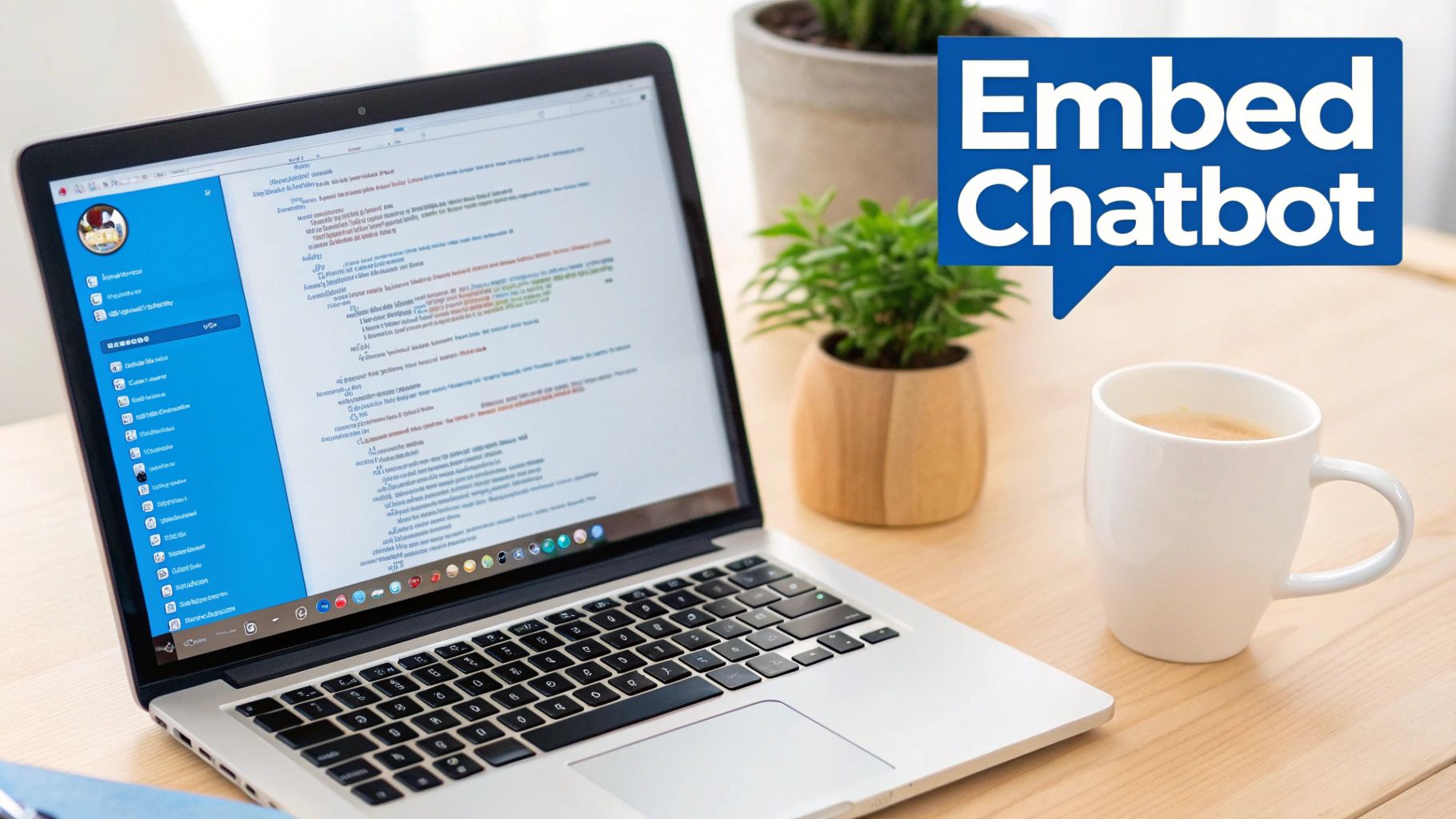
After you’ve figured out your chatbot's purpose and given it the right knowledge, the actual chatbot integration with your website is usually the easiest part. Good chatbot platforms are built for non-developers, making the process incredibly straightforward.
Believe it or not, you can get your new AI assistant live in just a few minutes, no matter what platform your website runs on. Let's walk through the most common ways to do it.
Embedding on a Custom HTML Website
If you have a website built from scratch with HTML, CSS, and JavaScript, getting your chatbot live is as simple as a quick copy-and-paste. Most providers, including FastBots.ai, give you a ready-made JavaScript snippet.
All you have to do is paste this block of code into your site's HTML, usually right before the closing </body> tag. This ensures the chat widget script loads on every page. Once you save the file and push it live, the chatbot should appear instantly. For a more detailed walkthrough, this embedding guide for interactive elements is a great resource.
Integrating with WordPress
For the millions of businesses running on WordPress, adding a chatbot is even simpler. While you can use the code snippet method by editing your theme's footer file, a more common approach is to use a plugin.
Many chatbot platforms offer a dedicated WordPress plugin that handles everything for you. You just install the plugin from your dashboard, connect it to your chatbot account, and the widget appears on your site. This method is often preferred because it's completely code-free.
Adding Your Chatbot to Shopify
A chatbot can be a valuable sales assistant for e-commerce stores on Shopify. Integrating one is just as easy as on other platforms. You'll get a code snippet that you need to add to your Shopify theme's code.
Typically, you'll head to your theme editor in the Shopify admin panel, find the theme.liquid file, and paste the code right before the closing </body> tag. This makes the chatbot available everywhere—from the homepage to checkout—to help reduce cart abandonment.
Customizing Your Chat Widget
Getting the chatbot onto your site is step one. Making it look like it belongs there is step two. A good platform will give you control over the widget’s appearance without you having to touch a single line of CSS.
Here are a few things you should be able to customize easily:
- Colors and Branding: Tweak the widget’s colors to match your brand palette.
- Company Logo: Upload your logo to sit in the chat header to build trust.
- Welcome Message: Write a custom greeting that matches your brand's voice.
- Chat Icon: Pick an icon and position for the chat bubble that doesn’t clash with your site’s design.
This customization helps separate a generic add-on from a truly integrated feature of your website.
Limitations and What to Watch Out For
While a chatbot integration with your website offers many benefits, it’s not a magic bullet. Being aware of the common challenges is the first step toward building something that works for the long term.
One of the biggest mistakes is setting unrealistic expectations. If you tell everyone your chatbot can "do anything," users may get frustrated when it can't solve a highly specific problem. It's often better to be upfront about its purpose. A message like, "Ask me about shipping or returns," guides people toward a successful interaction.
Protecting User Data and Building Trust
In today's world, data privacy is a foundation. The moment a chatbot asks for a user's name or email, you are responsible for protecting that information. Mishandling security can damage your brand’s reputation.
This is why choosing a platform that is SOC 2 and GDPR compliant is so important. These certifications are proof that the provider takes data security seriously. That trust is crucial if you want people to feel comfortable engaging with your bot.
Designing a Seamless Human Handover
No AI is perfect. Sooner or later, your chatbot will encounter a question it can’t answer. The worst thing you can do is create a dead end where the bot simply says, "I don't understand."
The solution is a well-designed human handover. Your system needs a clear way for a user to request a real person. A good platform, like FastBots.ai, bakes this right in with a live chat feature, letting an agent jump into the conversation with the full chat history for context.
Avoiding the 'Stale' Chatbot Problem
A chatbot's knowledge has a shelf life. A classic mistake is the "set it and forget it" approach. You launch the chatbot and never touch it again. But then your products change or your policies get updated, and suddenly your chatbot is giving out wrong answers—which is worse than no answer at all.
To prevent this, you need a simple maintenance plan. Review your chat logs regularly to find unanswered questions, and make it someone's responsibility to update the bot's data sources at least once a month. This ensures your bot remains a valuable and accurate tool.
Integrating Your Chatbot Beyond Your Website

A solid chatbot integration with a website is a great start, but your homepage isn't the only place your customers hang out. To get the most out of your AI, you need to meet people where they already are.
Extending your chatbot to messaging apps turns a simple website tool into a true omnichannel assistant. You could capture a lead directly from an Instagram DM or provide support in a Slack channel. It’s all about creating one seamless brand experience, no matter where the conversation starts.
Meeting Customers Where They Are
Today's customer journey is fragmented. Someone might find you on Instagram, check your site on their laptop, and then ask a question on WhatsApp. If your chatbot is present at these touchpoints, you're not just being convenient—you're being smart.
The data supports this omnichannel approach. You can dig deeper into these AI chatbot statistics and their impact on customer service. By being available on multiple channels, you create a more cohesive and helpful customer experience.
Connecting to Messaging and Social Platforms
Getting your chatbot onto other platforms sounds complicated, but it's often surprisingly simple. Many tools, including FastBots.ai/, offer direct integrations that require just a few clicks.
Here are some key channels to consider:
- WhatsApp: Perfect for direct communication like order updates or appointment reminders.
- Facebook Messenger & Instagram DMs: A natural fit for engaging with people who find you on social media and capturing leads from your social traffic.
- Slack: A great option for B2B companies, either for internal support or dedicated client channels.
Automating Workflows with Zapier and Make
This is where your chatbot evolves from a communication tool to a core part of your business operations. Automation platforms like Zapier and Make act as the glue connecting your chatbot to the other apps you already use.
The system works on a simple "trigger" and "action" model. For example, when the chatbot captures a new lead (the trigger), it automatically adds that lead to your CRM (the action). No more copy-pasting.
Here are a few real-world examples you can set up:
- Lead Management: A hot lead comes through the chatbot. It instantly creates a new contact in your Salesforce or HubSpot account.
- Customer Support: A user has a complex issue. The bot can create a new ticket in a system like Zendesk, complete with the chat transcript.
These automated workflows do more than just save time. They help eliminate human error and ensure nothing important slips through the cracks. Suddenly, your chatbot integration with your website becomes the command center for a smarter, more efficient business.
Measuring Success and Optimizing Performance
Alright, your chatbot is live on your website. So... now what?
Getting a chatbot integration with a website up and running is just the starting line. The real magic happens when you start digging into its conversational data to make it smarter over time. This is how you turn a neat feature into a seriously valuable business asset.
The first step is to get comfortable with your analytics and chat logs. Think of these as a direct line to your customers' minds. They’ll show you exactly what people are asking, where the bot gets stumped, and what your audience really wants.
Key Metrics You Should Be Tracking
To figure out if your chatbot is doing its job, you need to look past the total number of conversations. The right metrics tell a story about whether your bot is solving problems or just creating new ones.
Here are the core numbers we recommend keeping an eye on:
- Resolution Rate: What percentage of chats does the bot handle without needing a human? A high resolution rate means your bot is effective.
- User Satisfaction (CSAT): This is usually a quick survey at the end of a chat. It gives you direct feedback on how users feel about the experience.
- Fallback Rate: This tracks how often your bot has to say, "Sorry, I don't understand." A high number here is a signal to expand its knowledge base.
- Lead Conversion Rate: If your bot’s goal is to generate leads, this is your money metric. How many conversations result in a user providing their contact info?
By checking these numbers regularly, you can build a clear picture of what’s working. For a deeper dive, check out our guide on how to measure the ROI of your chatbot for business growth.
Turning Insights into Action
Data is useless if you don't do anything with it.
Let's say you see ten people asked about your international shipping policy this week, but the bot had no answer. That’s not a failure; it’s a gift. It’s a clear signal to update your knowledge base to cover that exact topic. For a deeper dive, check out our full post on how to smoothly integrate an AI-powered website chat widget.
This cycle of listening, learning, and improving is what separates a decent bot from a fantastic one. You can even put some of it on autopilot. Modern platforms like FastBots.ai offer automated retraining, which periodically re-crawls your website to keep the bot’s knowledge in sync with your latest content.
This proactive approach ensures your chatbot integration with your website keeps delivering real value long after you first hit "publish."
Frequently Asked Questions
Got questions? You're not alone. Here are some of the most common things people ask when they're thinking about adding an AI chatbot to their website.
Is This Going to Be a Huge Technical Headache to Set Up?
Honestly, it's typically easier than you might think. With modern platforms, you're not wrestling with complex code. It’s usually as simple as copying a small snippet of code and pasting it where it needs to go. Most people can get their first bot live in just a few minutes.
Can I Make the Chatbot Look Like it Belongs on My Site?
Absolutely. You'd never want a chatbot that sticks out like a sore thumb. Top-tier platforms give you full control over the look and feel.
You can tweak things like:
- The exact colours to match your brand palette
- Uploading your own logo
- Choosing a custom chat icon
- Writing your own welcome messages from scratch
This way, the bot feels like a seamless part of your website, which is a huge factor in building trust with visitors.
What Happens When the Bot Gets Stumped?
It's a great question, because no bot knows everything. A well-built chatbot has a plan for this exact scenario: a smooth "human handover."
When a conversation gets too complex, it can automatically flag a human team member to jump in. Platforms like FastBots.ai even have live chat built right in, so your customer never hits a dead end. Your agent gets the full conversation history, so the customer doesn't have to repeat themselves.
How Do I Know My Customer Data is Safe?
Data security isn't just a feature; it's a necessity. Any reputable chatbot provider will treat this as their top priority. All conversations should be encrypted, and the platform must comply with major data protection standards like SOC 2 and GDPR. Protecting your customers' information is non-negotiable for maintaining trust.
Ready to turn your website into a machine that generates leads and supports customers 24/7? With FastBots.ai, you can build and launch a custom AI chatbot in minutes.
Start your free trial today and see the difference for yourself!