A Chatbot For Lead Generation: Your Practical Guide


Think of a lead generation chatbot as your website's ultimate sales assistant. It's an automated tool that works 24/7, striking up real-time conversations with visitors to qualify them and grab their contact details. By asking the right questions and giving instant answers, it turns casual browsers into a steady stream of interested leads for your sales team, long after everyone else has gone home.
Why Your Business Needs a Lead Generation Chatbot
Let's cut through the noise and get straight to the strategic value a chatbot adds to your lead generation. The modern customer journey isn't a straight line anymore. Prospects research, compare, and demand answers at all hours of the day and night. If you’re only relying on old-school contact forms and office-hours phone calls, you're leaving money on the table. You're missing out on a huge chunk of potential leads who are ready to talk right now.
A chatbot is your always-on front line, making sure no opportunity slips through the cracks. It’s a massive shift from passive data collection (like a form) to active, immediate engagement.
Capture and Qualify Leads Around the Clock
The most obvious win is the ability to capture high-intent leads 24/7. Simple as that. When a prospect lands on your pricing page at 11 PM on a Sunday, a chatbot can pop up to offer help, answer that one critical question holding them back, and even book a demo for the next morning. Without it, that lead might have just bounced and headed straight to a competitor. This isn't just about being available; it's about meeting buyer intent the second it happens.
This proactive approach is everything. The chatbot market in the UK is booming, and its power in lead generation is a big reason why. It's estimated that 53% of UK buyers now prefer to deal with businesses that offer messaging services, which shows you just how much chatbots are shaping what customers expect.
Stop Wasting Sales Time on Low-Quality Enquiries
One of the biggest time-sinks for any sales team is sifting through junk enquiries. A well-designed chatbot acts as an intelligent gatekeeper. By asking a few smart, pre-qualifying questions, it can quickly segment visitors.
A chatbot’s true power isn’t just in capturing leads, but in enriching them. It hands your sales team a warm, qualified prospect with a full conversation history, turning a cold call into a strategic follow-up.
This means your sales reps can stop wasting their energy on prospects who aren't a good fit and focus exclusively on closing deals with people who are. This seamless flow creates a far more efficient and motivated sales team. For any business looking for a tireless assistant that instantly engages leads, embracing this kind of automated engagement is the key to scaling up.
Here are a few other strategic advantages you gain:
Instantaneous Lead Routing: High-value leads can be immediately flagged and sent to the right sales rep's calendar or CRM.
Reduced Lead Decay: By engaging leads in seconds, you massively increase the chance of conversion compared to following up on a form submission hours later.
Deeper Customer Insights: Chat transcripts are a goldmine of information, revealing common questions and pain points that can feed back into your marketing and product development.
By automating these first few steps, you build a powerful and incredibly efficient system. If you want to dive deeper, you might find our detailed article on the top benefits of chatbot lead generation useful.
Designing Conversations That Convert
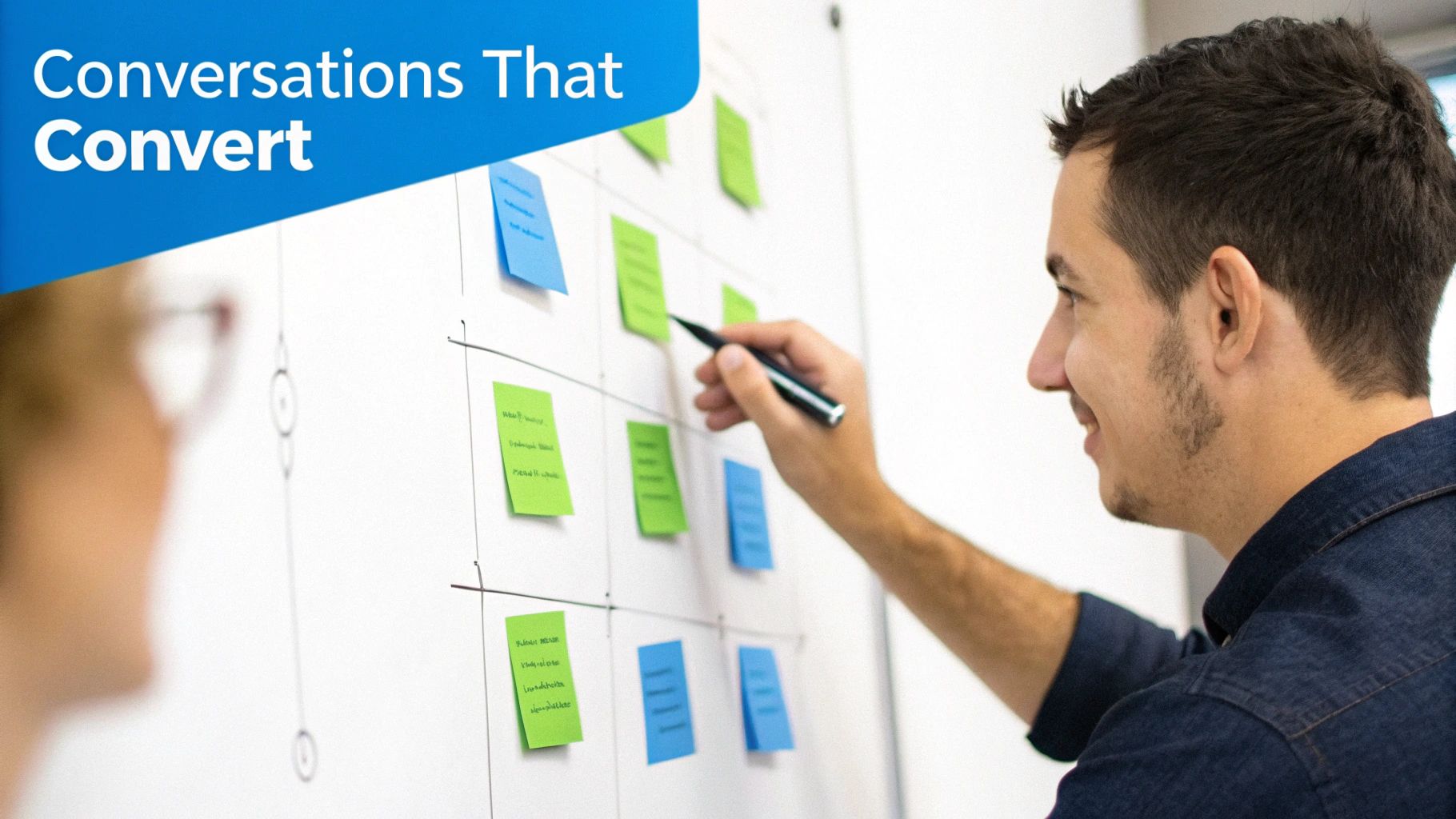
A chatbot is only as good as the conversation it’s designed to have. Let's be honest, a clunky, robotic flow is more than just annoying—it actively pushes potential leads away. The real art is in crafting an experience that feels genuinely helpful and human, guiding visitors from casual curiosity to real interest without it feeling like an interrogation.
The secret isn’t just what you ask, but how and when you ask it. A truly effective lead gen bot understands the user's context, builds a bit of rapport, and offers value before it ever asks for anything in return. Forget the one-size-fits-all scripts; this is about tailoring the dialogue to where the visitor is in their journey.
Moving Beyond Generic Scripts
Think about it: a visitor on your pricing page has a completely different mindset to someone just browsing a blog post. Your chatbot's opening line needs to reflect that. A lazy "How can I help you?" is a massive missed opportunity. You need to be proactive and contextual.
Here are a few scenarios where this really comes to life:
On a Pricing Page: This person is deep in evaluation mode; their intent is high. A proactive nudge like, "Choosing the right plan can be tricky. Want some help comparing features or finding the best fit for your team?" works wonders.
On a Product Page: The visitor is kicking the tyres, looking at features. They might have a specific question that’s holding them back. Your bot could jump in with, "Got a question about our integrations or setup? I can answer instantly or connect you with a specialist."
On a Blog Post: This user is in learning mode, not buying mode. A hard sell will just make them close the tab. Instead, use the bot to offer more value: "Enjoying this article? I can send you our complete guide on [Topic] as a PDF. Just let me know where to email it."
The goal is to design conversations that feel like a natural extension of what the user is already doing. By understanding their context and offering immediate, relevant value, you earn the right to ask for their contact details.
The Psychology of Conversational Marketing
Building genuine rapport is the cornerstone of converting visitors into leads. This means designing flows that are empathetic, not intrusive. At its heart, it's a two-way exchange of value. The chatbot provides information, clarity, or a useful resource, and in return, the user feels comfortable sharing their details.
This requires a delicate balance. Hitting them with an email request straight out of the gate is jarring. You need to warm them up first, maybe with a few simple questions that also help qualify them. For a deeper dive into the nuances of this, our guide on chatbot conversation design is a great place to start.
Mastering Data Capture Patterns
Knowing what information to ask for—and when—is absolutely crucial for maximising your conversion rate. The single biggest mistake I see is asking for too much, too soon. This is where progressive profiling becomes your best friend. Instead of dropping a massive form on them, you gather information piece by piece throughout a natural conversation.
Always start with the lowest-friction ask: their name. A simple opener like, "Hi there! What's your name?" immediately allows the bot to personalise the entire exchange.
What comes next depends entirely on your objective.
Email is King: For most B2B lead generation, the email address is the prize. You can frame the request around value, not just a demand. For example: "Great to meet you, [Name]! Can I grab your work email? I'll send over that pricing comparison we just talked about."
Phone for High-Intent Leads: A phone number is a much bigger ask. You should reserve this for leads who are showing strong buying signals, like asking about enterprise plans or implementation details. The request could be something like, "It sounds like a quick chat would be really helpful here. What's the best number to reach you on for a 10-minute call?"
By breaking down the data capture process, you dramatically reduce friction and make people far more likely to share their information. Each small "yes" builds momentum, making the next ask feel less intimidating. It’s a simple psychological tactic, but it makes a world of difference to your chatbot’s success.
Building and Deploying Your First Chatbot
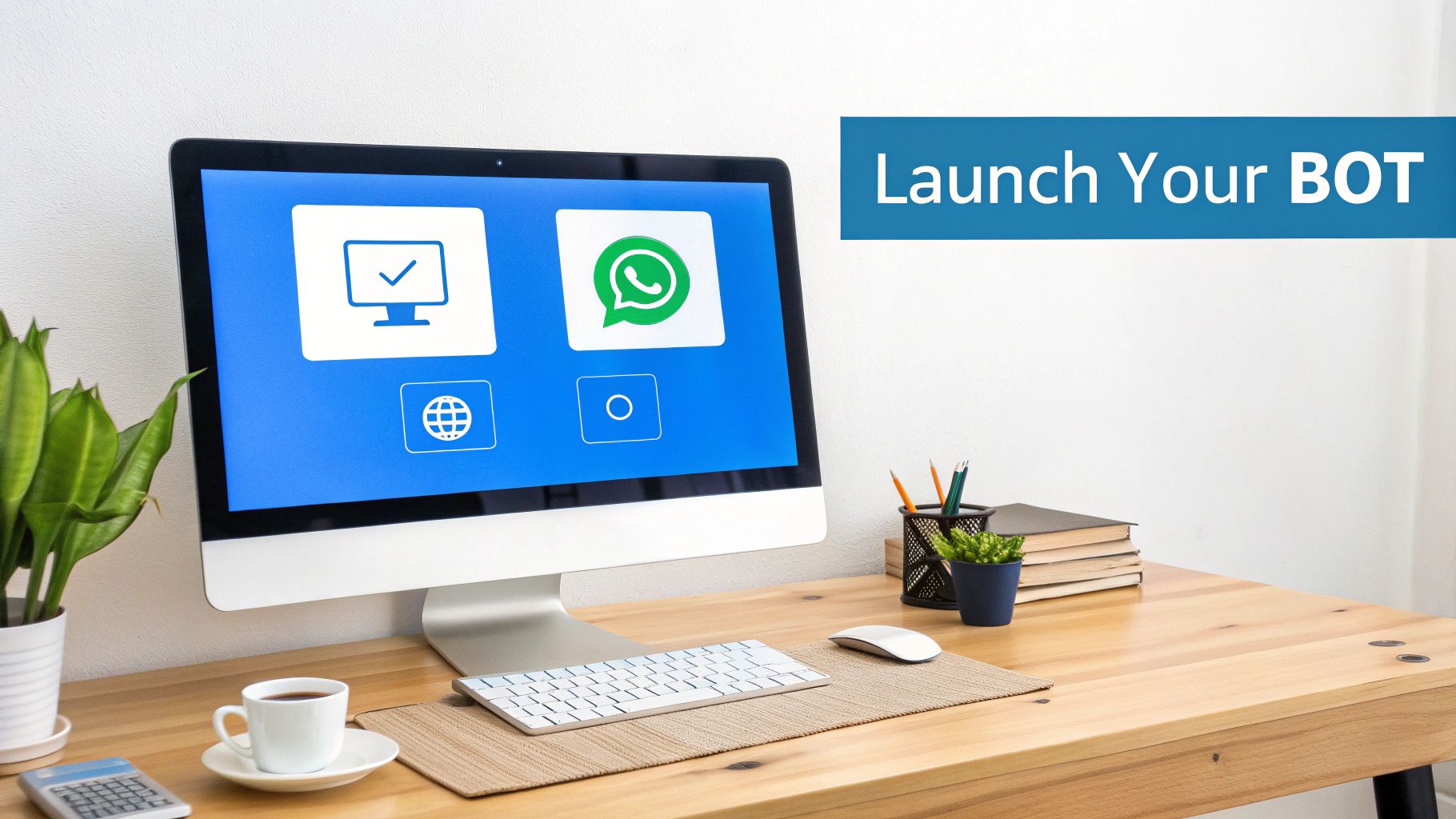
Moving from a conversation map on a whiteboard to a live, working chatbot can feel like a massive leap. But honestly, it's more accessible than you'd think. You don’t need a team of developers on standby to get a powerful lead generation bot up and running these days. Modern platforms are built for marketers, with intuitive interfaces that make the whole process straightforward.
The real secret is having a solid plan before you even log into a chatbot builder. Get your goals, lead qualification criteria, and brand voice nailed down first. This prep work is what separates a successful bot from one that just becomes digital background noise.
Choosing the Right Chatbot Platform
The market is crowded with chatbot builders, and each has its own quirks and specialities. Your mission is to find the one that fits neatly with your lead generation needs and your existing tech stack. Trying to shoehorn a bot designed for customer service into a sales role, for instance, is just asking for a headache.
When you're weighing up your options, look past the flashy features and zero in on the fundamentals that will actually drive results.
Here’s a quick list of what I consider non-negotiable for a lead gen bot:
CRM Integration: The bot must be able to automatically push lead data into your CRM (like HubSpot, Salesforce, or Zoho). If you're stuck doing manual data entry, you've missed the whole point of automation.
Customisation Options: Your chatbot is a direct extension of your brand. You need control over its look, feel, and tone to keep the user experience consistent.
No-Code Builder: Look for a platform with a visual, drag-and-drop interface. This lets your marketing team build, tweak, and improve conversation flows without ever needing to write code.
Analytics Dashboard: You can't improve what you don't measure. A good dashboard will track essential metrics like conversation-to-lead rate, engagement levels, and where people are dropping off.
The impact of getting this right is huge. Recent UK data shows just how much AI agents are changing the lead generation game. Sales digital assistants now convert around 28% of website visitors into leads, and they automate almost a quarter of all enquiry-to-sale conversions without any human help. What's more, 35% of UK business leaders say these bots are helping them close deals faster. You can explore more UK chatbot conversion insights to get the full picture.
My advice? Don't just pick the platform with the best reviews. Sign up for a free trial with two or three of your top contenders. Build a very simple test flow in each one and see which feels the most intuitive for you and your team.
Choosing the right platform is critical. To help you compare some of the big players, here's a quick look at how they stack up on features essential for lead generation.
Your Pre-Launch Setup Checklist
Okay, you've picked your platform. Now it’s time to build. A structured approach here will save you from endless tweaking and frustration down the line. Think of this as your pre-flight check before launching.
First, lock in your primary objective. Is this bot’s main job to book demos? Qualify MQLs? Or just grab email addresses for your newsletter? That single goal will shape every decision you make, from the opening line to the final call-to-action.
Next, give your bot a personality. Is it friendly and informal, or more professional and to the point? Give it a name and a profile picture to make the whole interaction feel less robotic. It’s a small detail, but it makes a surprisingly big difference to how users engage.
Here’s a practical checklist to run through:
Define Lead Qualification Criteria: Decide on the exact questions the bot needs to ask to figure out if a lead is a good fit. Think company size, budget, job role, etc.
Map Out the Core Conversation Flow: Use a simple flowchart tool (or even just pen and paper) to visualise the conversation path, from the first "hello" to the final lead capture.
Write Your Script: Now, draft the actual dialogue. Keep your sentences short and your language clear. Use button responses wherever possible to make it effortless for the user.
Configure CRM Integration: This is a big one. Connect the chatbot to your CRM and map the data fields correctly. Test it to make sure details like name, email, and company are flowing through as expected.
Set Up Human Handover: Plan for the moments when the bot needs to step aside. Define the triggers and the process for escalating a conversation to a live agent.
Deploying Across Multiple Channels
Your website is the natural starting point, but your audience is scattered across the internet. Meeting them where they already are is the key to maximising your lead capture. A good chatbot platform will let you deploy the same bot on different channels without having to rebuild it from scratch.
Think about these key locations:
Website: Use targeted triggers. Don't just pop the bot up for everyone. Launch it on high-intent pages like your pricing or contact pages for better results.
Facebook Messenger & Instagram: Engage with people who interact with your social posts or ads. You can capture leads right inside the messaging app, which is a beautifully seamless experience.
WhatsApp: This is a must-have in regions where WhatsApp is the primary communication tool. It allows for direct, personal lead nurturing that feels less like marketing and more like a conversation.
By deploying your lead generation chatbot across these channels, you create a consistent and accessible experience for potential customers, ensuring you never miss a chance to connect.
Making Your Chatbot Part of Your Tech Stack
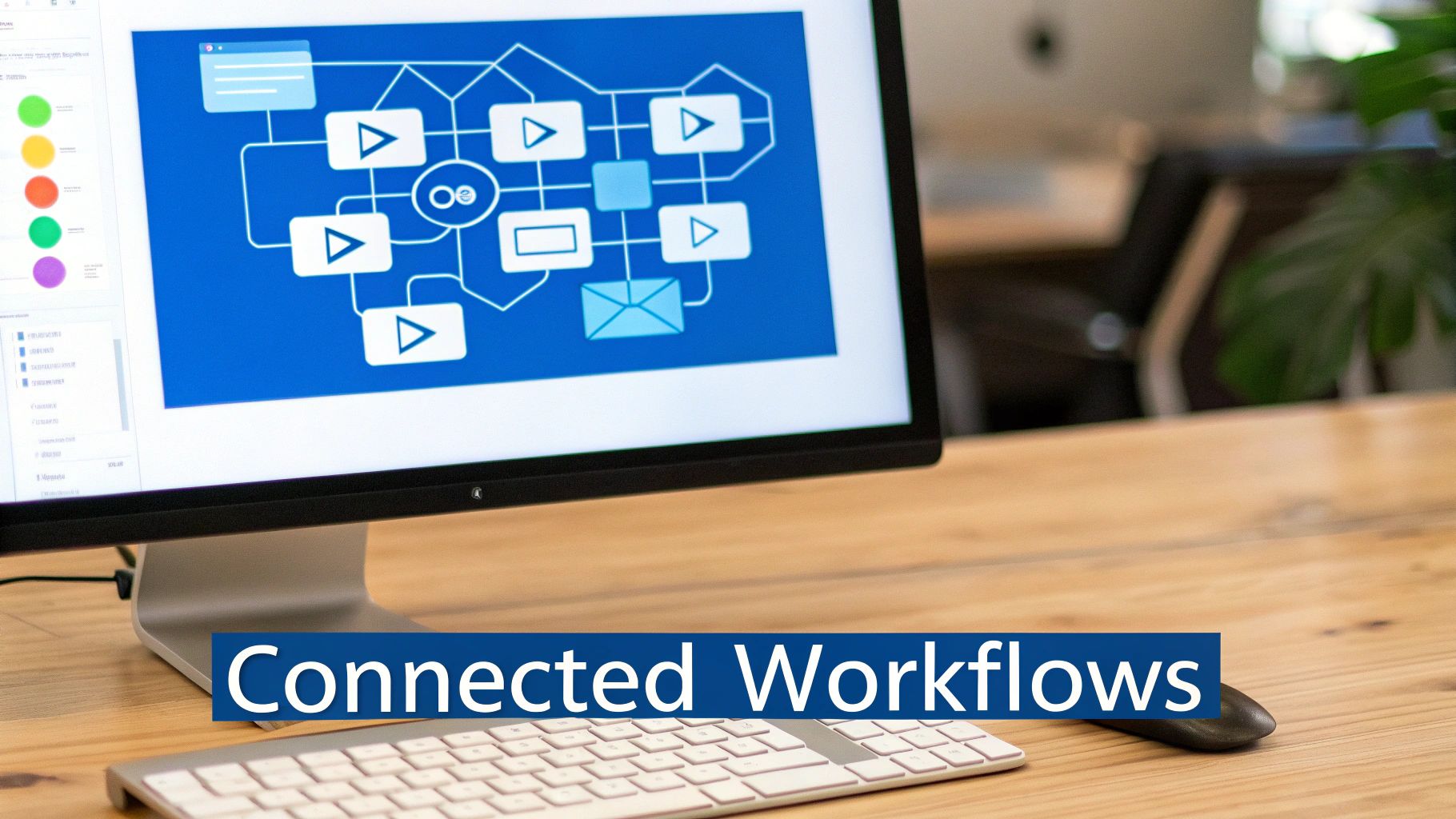
A lead generation chatbot working in isolation is like having a fantastic salesperson who never writes anything down. Sure, they have great conversations, but nothing ever gets followed up. The real magic happens when your bot becomes a fully connected part of your revenue engine, feeding crucial data into the tools your team already uses every single day.
If you don't integrate, you're just creating more admin. Leads get stuck in the chatbot's backend, conversation details are lost, and your sales team has to waste time piecing everything together. Connecting your bot to your core sales and marketing platforms transforms it from a simple data capture tool into an active, intelligent player in your growth strategy.
Connecting Your CRM for Real-Time Lead Management
Your Customer Relationship Management (CRM) system is the heart of your sales operation. Integrating your chatbot directly with it isn't just a nice-to-have; it's non-negotiable. This connection ensures every qualified lead is instantly and automatically created or updated in your CRM.
Picture this: a high-intent prospect answers your bot's qualifying questions on your website at 10 PM on a Friday. With a direct integration to a CRM like HubSpot or Salesforce, a new contact record is created in real-time. It’s filled not just with their name and email, but also with the full chat transcript and key qualifying details they shared, like their company size or budget.
When your sales rep logs in on Monday morning, the lead is already there, enriched with valuable context. This completely eliminates "lead decay"—that sharp drop in conversion probability that happens with every minute of delay. In fact, a five-minute delay can slash your chance of qualifying a lead by a staggering 80%. That makes instant CRM sync a mission-critical feature.
A chatbot without CRM integration is a lead capture tool. A chatbot with CRM integration is a sales acceleration engine. The difference is the immediate, automated flow of intelligence to the people who can act on it.
This automation goes beyond just creating new contacts. Your chatbot can also update existing records. If a known contact returns to your site and provides new info, the bot can intelligently append these details to their CRM profile, building an ever-richer picture of your prospects over time.
Triggering Automated Marketing and Sales Workflows
Once your chatbot and CRM are talking, the real fun begins. You can start building powerful, automated workflows that nurture leads and alert your team at the perfect moment. This is where you can get really strategic and personalise the follow-up process at scale.
For example, based on a user's answers, the bot can tag them in your marketing automation platform, like Mailchimp or ActiveCampaign. This simple action can set off a whole sequence of automated follow-ups tailored to their specific interests.
Here are a few practical workflow examples you could set up:
Segmented Email Nurturing: A visitor who asks about "enterprise pricing" can be automatically added to a nurturing sequence designed for large companies, where they’ll receive relevant case studies and content.
Instant Sales Notifications: When a chatbot identifies a "hot" lead (say, someone from a target account who asks to book a demo), it can instantly ping a specific sales rep via Slack or Microsoft Teams. This message can include the lead's name, company, and a direct link to their shiny new CRM record.
Personalised Follow-Up Tasks: The integration can automatically create a "Follow-Up" task in the CRM for the assigned sales rep, complete with a due date and notes from the chat conversation.
These automated handoffs make sure every single lead gets the right follow-up at the right time, without anyone needing to lift a finger. This is the kind of efficiency that lets you scale your lead generation efforts without proportionally increasing your team's workload. It’s all about working smarter, not harder.
Measuring and Optimising Chatbot Performance
Getting your lead generation chatbot live is a great first step, but it’s far from the finish line. The real wins come from digging into the data and constantly refining its performance. If you just set it and forget it, you're leaving a massive amount of potential revenue on the table.
Success is all about understanding what works, what doesn't, and—most importantly—why. This means looking beyond surface-level numbers like total conversations. To really boost your return, you need to laser-focus on the key performance indicators (KPIs) that directly affect your bottom line. It's a continuous cycle of improvement, not a one-time setup.
Defining Your Core Lead Generation KPIs
You can't improve what you don't measure. Your chatbot's analytics dashboard is a goldmine, but only if you know exactly what to look for. By tracking a handful of crucial KPIs, you’ll get a crystal-clear picture of your bot's health and how much it’s really contributing to your sales pipeline.
Here are the metrics that truly matter:
Conversation-to-Lead Rate: This is your headline figure. It tells you the percentage of conversations that successfully capture a lead (like an email address). If this number is low, it could mean your opening message isn't grabbing attention, or your questions are creating too much friction.
Lead Quality Score: Let's be honest, not all leads are created equal. By tracking which leads actually turn into customers, you can start scoring the quality of leads your bot is generating. This helps you figure out if you're attracting high-value prospects or just tyre-kickers.
Cost Per Qualified Lead (CPQL): This one connects your chatbot's performance directly to your marketing spend. It shows you exactly how much it costs to generate a lead that your sales team actually wants to follow up with.
For a more comprehensive look at the data you should be tracking, check out our complete guide to chatbot analytics for essential metrics to monitor.
Here's a quick-glance table to help you keep these KPIs straight.
Key Performance Indicators for a Lead Generation Chatbot
This table breaks down the most important metrics to track for your chatbot, including the formula for each and what it tells you about performance.
| KPI | What It Measures | How to Improve It |
|---|---|---|
| Conversation-to-Lead Rate | The percentage of chats that result in a captured lead. | A/B test opening hooks, simplify questions, and make your call-to-action more compelling. |
| Lead Qualification Rate | The percentage of captured leads that meet your MQL/SQL criteria. | Refine your qualifying questions to better filter out irrelevant prospects early on. |
| Lead Quality Score | The value of leads based on how likely they are to convert. | Analyse closed-won deals to identify patterns and adjust your bot’s targeting. |
| Cost Per Qualified Lead | The total cost to generate one sales-ready lead. | Optimise conversation flows to reduce friction and improve the lead qualification rate. |
| Average Conversation Length | The time it takes for a user to complete the lead generation flow. | Streamline the conversation. Remove unnecessary steps and make it easier for users to get to the point. |
Tracking these metrics gives you a solid framework for making data-driven decisions instead of just guessing what might work.
A Framework for Continuous Optimisation
Once you've got your baseline numbers, the real fun begins: the optimisation cycle. This is all about making targeted changes and carefully measuring their impact. It’s a scientific approach that takes the guesswork out of the equation and leads to predictable improvements over time.
A brilliant place to start is with A/B testing. This simply means running two different versions of a conversation flow at the same time to see which one performs better. You could test different opening lines, change the order of your qualifying questions, or try out different calls-to-action. For example, does "Book a demo" convert better than "Talk to an expert"? Only testing will tell you for sure.
For UK small and medium-sized enterprises (SMEs), these optimisation efforts can deliver serious returns. AI-powered tools are now more accessible than ever, and a solid implementation typically yields a 3 to 5 times return on investment (ROI) within the first quarter. This impressive ROI is often driven by a reported 2.8 times increase in qualified leads when these tools are deployed correctly.
Don't just look at the numbers; dive into the conversations themselves. Reading through chat transcripts is one of the most powerful ways to understand your customers' real-world pain points, objections, and the language they use.
Analysing these transcripts can uncover priceless qualitative insights. Are users repeatedly asking a question your bot can't answer? Are they getting stuck and dropping off at a specific point in the conversation? This feedback is pure gold, not just for improving your chatbot but for informing your entire marketing and product strategy. Listen closely, and you can turn your chatbot into a powerful source of customer intelligence.
Got Questions About Lead Generation Chatbots?
As you start mapping out your chatbot strategy, it's completely normal for a few questions to pop up. Bringing a chatbot on board isn't just a tech decision; it's about understanding the costs, how it fits in with your team, and the responsibilities that come with collecting user data.
Let's cut straight to it and tackle the most common queries we hear from businesses before they take the plunge. We'll give you clear, straightforward answers to help you move forward with confidence.
How Much Does a Lead Generation Chatbot Cost?
The price tag for a chatbot can swing wildly, from less than your team's monthly coffee budget to a hefty five-figure investment. It all boils down to the complexity and scale you're after. Think of it like buying a vehicle: you could get a reliable scooter or a custom-built lorry. Both get you from A to B, but in very different ways.
Generally, your options fall into one of three buckets:
DIY SaaS Platforms: These are the most accessible, with prices typically starting from £20 to £300 a month. Platforms like FastBots.ai are built for marketers and business owners, offering no-code, drag-and-drop builders. They're a fantastic fit for small to medium businesses that need powerful features like CRM integration without a dedicated development team.
Managed Chatbot Services: If you want the expertise without the hands-on work, you can hire an agency to build and manage the bot for you. This usually involves a setup fee (anywhere from £1,000 to £5,000) plus a monthly retainer. It’s a great middle ground if you have the budget but not the time.
Custom Enterprise Solutions: For large organisations with very specific, complex needs, a fully bespoke bot is the top-tier choice. These projects can run anywhere from £15,000 to £50,000+, involving developers, AI specialists, and deep integration work. This is the route you take when an off-the-shelf solution just won’t cut it.
Will a Chatbot Replace My Sales Team?
This is a common fear, but honestly, it’s completely unfounded. A lead generation chatbot isn’t here to replace your sales team; it’s a powerful assistant that makes them better at their jobs. It takes care of the repetitive, top-of-funnel tasks that eat up so much time, freeing up your human experts to do what they do best: build relationships and close deals.
A chatbot’s role is to handle the volume of initial enquiries and qualify them. Your sales team’s role is to handle the value of the resulting conversations. The bot does the sifting, so your team can do the selling.
Picture the workflow. The chatbot is on duty 24/7, engaging every single visitor, answering their basic questions, and filtering out the tyre-kickers. It then hands over warm, qualified leads—complete with the full conversation history—to your sales reps. This means your team walks into every conversation with context and a clear picture of the prospect's needs, turning cold interactions into meaningful, strategic follow-ups.
What About Data Privacy and GDPR?
In the UK and Europe, data privacy isn't just good manners; it's the law. When your chatbot collects personal information like names, emails, or phone numbers, you absolutely must be compliant with the General Data Protection Regulation (GDPR). Getting this wrong can lead to eye-watering fines and, perhaps worse, a total loss of customer trust.
The good news is that compliance is pretty straightforward if you stick to a few core principles. Transparency is key. Your chatbot needs to be upfront about what data it's collecting and why.
Here’s a quick checklist to keep you on the right side of the regulations:
Get Explicit Consent: Before capturing any personal data, your bot has to ask for clear, affirmative consent. A simple checkbox that the user has to actively tick is the standard way to do this.
Link to a Clear Privacy Policy: Your chatbot should offer an easy-to-find link to your company’s privacy policy, right there in the chat window.
Explain the "Why": Be open about how you'll use their information. For instance, "Can I take your email so I can send over that case study we just discussed?" feels much more trustworthy than a blunt "What's your email?"
Choose a Compliant Platform: Make sure your chatbot provider is GDPR-compliant and has solid security measures, like data encryption, to protect the information you gather.
By building your chatbot with privacy in mind from day one, you create an experience that feels safe and builds trust, encouraging more visitors to engage and become valuable leads.
Ready to transform your lead generation process? FastBots.ai offers a powerful, no-code platform that makes it easy to build and deploy an AI chatbot trained on your own data. Start capturing more high-quality leads 24/7. https://fastbots.ai