10 Essential Chat Bot Best Practices for a Superior Customer Experience

In today's competitive market, a chatbot is no longer a "nice-to-have" feature; it’s a fundamental part of your customer experience. But launching a bot that truly helps, instead of frustrates, requires a thoughtful strategy. Getting it right can transform your customer support, boost sales, and provide invaluable insights. This guide will walk you through the proven chat bot best practices that deliver tangible results.
Before you dive in, it’s wise to confirm your business case. Evaluating if Does Your Website Need A Chatbot? can help ensure your goals align with what this technology can realistically achieve, setting a solid foundation for your project.
Once you're committed, success hinges on a holistic approach. We'll break down the ten most critical strategies you need to master, from defining clear user goals to leveraging analytics for continuous improvement. You'll learn how to build conversations that feel authentic, handle errors gracefully, and maintain a consistent experience.
Why Chatbot Strategy Matters
A well-implemented chatbot can be a game-changer. For example, many e-commerce stores are seeing a reduction in abandoned carts by using bots to proactively answer questions about shipping or offer discounts at the right moment. Similarly, SaaS companies often use bots to handle repetitive onboarding questions, freeing up their support teams for more complex issues.
The core benefit is efficiency at scale. A bot can handle thousands of conversations simultaneously, 24/7, without a drop in quality. This not only improves customer satisfaction by providing instant answers but also lowers operational costs.
1. Define Clear User Intents and Use Cases
Before you write a single line of dialogue, the most critical step is to define precisely what you want your chatbot to achieve. This means mapping out common user journeys and identifying the most frequent questions your customers ask.
A well-defined scope is the bedrock of all successful chat bot best practices. It ensures your bot solves real problems effectively instead of trying to be everything to everyone.
Why a Narrow Scope is a Strong Start
A common mistake is building a generalist chatbot designed to handle any query. This approach often leads to high failure rates and user frustration. Instead, a targeted strategy delivers immediate value.
For example, an e-commerce bot might initially focus only on two high-impact intents: order tracking ("Where is my order?") and processing returns. This clarity prevents scope creep and allows you to measure success against clear benchmarks, like a 30% reduction in support tickets for those topics.
Here's how you can apply this in your business:
To pinpoint the right intents, you need to dive into your customer data. Analyze support ticket logs, review live chat transcripts, and consult with your customer service team to identify recurring issues.
- Analyze Support Tickets: Look for the top 5-10 most common questions that have straightforward answers.
- Review Chat Transcripts: Identify patterns in how customers phrase their problems.
- Survey Your Team: Ask your support agents what repetitive queries consume most of their time.
- Check Website Analytics: See which FAQ or help pages get the most traffic. These are prime candidates for automation.
2. Implement Fallback Handling and Graceful Degradation
No chatbot is perfect. The most critical moments in the user experience often occur when your bot doesn't understand a query. A robust fallback strategy ensures that when the bot reaches its limits, it fails gracefully instead of leaving the user at a dead end.
This process, known as graceful degradation, is fundamental to maintaining user trust. A well-designed fallback mechanism acknowledges the bot’s limitations and provides a clear path to an alternative solution, like connecting with a human agent.
Why a Graceful Failure Builds Trust
When a user encounters a bot that simply replies "I don't understand" repeatedly, they quickly abandon the conversation. A graceful failure, however, manages expectations and provides solutions.
For instance, if a user asks a complex question, a well-designed bot might respond, "I can help with one thing at a time. Were you asking about 'shipping costs' or 'return policies'?" If it still fails, it can seamlessly escalate to a live agent, providing them with the chat transcript so the user doesn't have to repeat themselves.
Quick checklist for your fallback strategy:
- Set Confidence Thresholds: Configure your bot to only respond when its confidence is high.
- Design Clarification Prompts: Create 2-3 re-phrasing attempts, like "Sorry, I didn't get that. Can you ask me about 'order status' or 'payment issues'?"
- Offer Menu Options: If clarification fails, present a menu of the top things your bot can do.
- Provide a Clear Human Handoff: Always include an easy-to-find option like "Talk to an agent."
- Log and Analyze Failures: Every failed interaction is a learning opportunity.
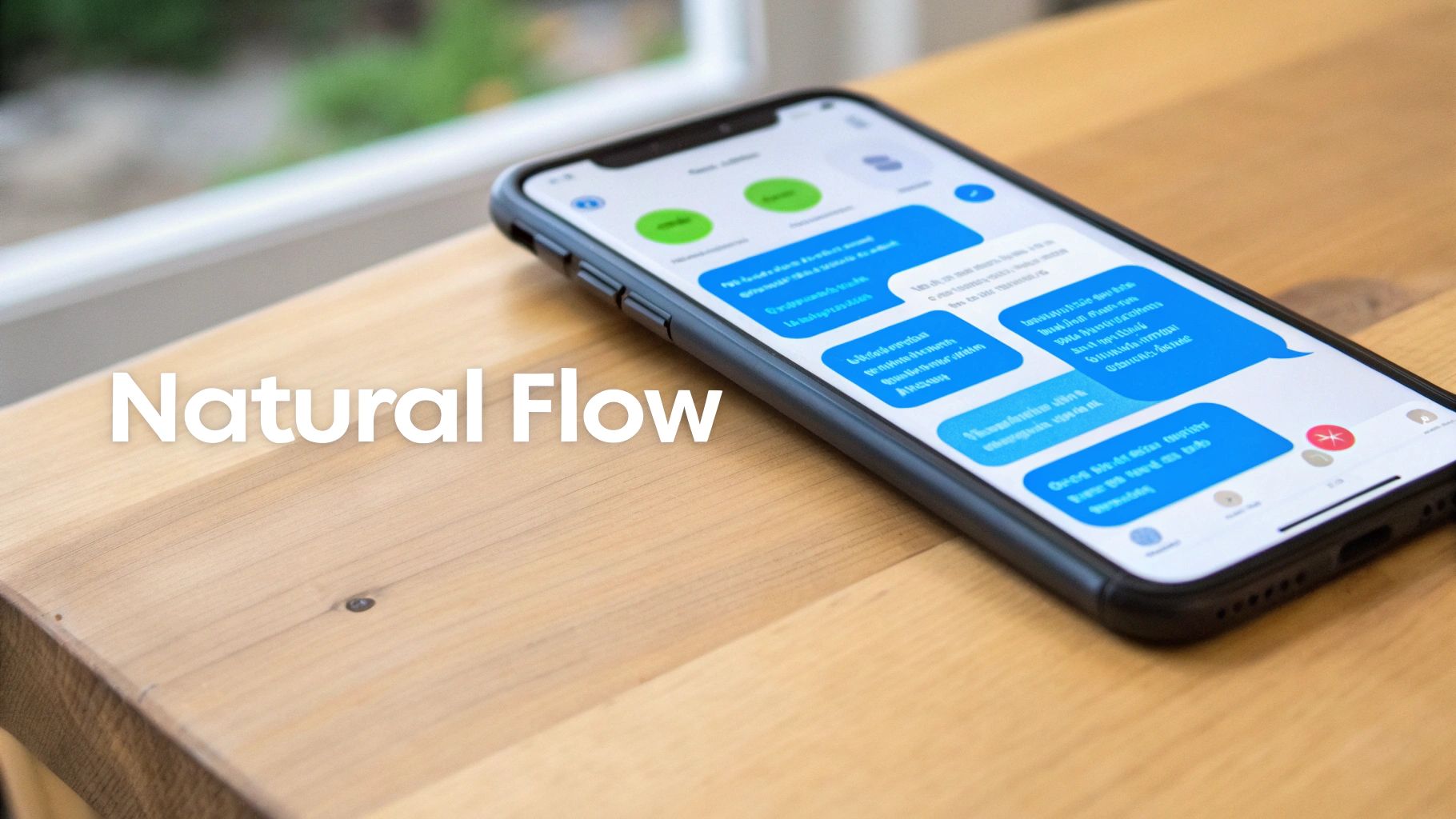
3. Maintain Natural Conversational Flow and Personality
Beyond just providing correct answers, the way your chatbot communicates is crucial. You should design dialogue that feels natural and human-like rather than robotic. A well-defined personality, aligned with your brand, transforms a tool into an engaging partner.
Giving your bot a distinct voice is one of the most effective chat bot best practices for building rapport. Whether it's friendly and witty or formal and professional, a consistent character makes users more likely to return.
Why Personality Builds Trust
A chatbot with a flat, robotic tone can feel cold and unhelpful, even if its answers are accurate. By infusing personality, you create an emotional connection and manage user expectations.
For example, a banking bot would typically adopt a professional and secure tone to build confidence. In contrast, a bot for a travel agency might use an enthusiastic and adventurous personality to make trip planning feel more exciting. For a deeper dive, you can learn how to make your chatbot sound more human.
How to Define a Bot Persona
Start by creating a brand voice guide for your chatbot. This document should outline its tone, vocabulary, and even its sense of humor (or lack thereof). Consistency is key.
- Create a Brand Voice Guide: Define key personality traits (e.g., friendly, professional, witty, empathetic).
- Use Conversational Language: Use contractions (like "you're" and "it's") and avoid overly technical jargon.
- Vary Your Responses: Create several versions of common greetings to avoid sounding repetitive.
- Remember Context: Program your bot to recall previous messages to make the conversation feel more natural.
4. Leverage NLP for Better Intent Recognition
To move beyond rigid, keyword-based conversations, you need to empower your bot to understand what users mean, not just what they type. This is where Natural Language Processing (NLP) comes in. It allows your bot to interpret variations in phrasing, handle typos, and grasp the underlying goal of a request.
Implementing advanced NLP is a core component of modern chat bot best practices. It's the difference between a bot that constantly says "I don't understand" and one that can decipher "my package is missing" just as easily as "where is my order?"
Why NLP Outperforms Rule-Based Logic
A purely rule-based bot relies on predefined keywords. If a user asks, "Can I change my delivery address?" but you only programmed the bot to recognize "update shipping address," the conversation fails.
NLP models, however, are trained to understand context. They can recognize that "missing item," "package not here," and "didn't get my stuff" all correspond to the "order tracking issue" intent. This flexibility allows you to build a more intuitive user experience.
How to Train a Smarter Bot
Effective intent recognition starts with high-quality training data. Your goal is to provide the model with numerous examples of how a user might phrase a specific request.
- Collect Training Phrases: For each intent (e.g., "Reset Password"), gather at least 50-100 unique examples ("I forgot my password," "can't log in").
- Use a Modern NLP Platform: Leverage established tools that provide pre-built models and user-friendly interfaces.
- Continuously Retrain: Regularly review misunderstood conversations and use that data to improve your model's accuracy.
5. Personalize Experiences with Data and Context
Moving beyond generic, one-size-fits-all responses is what separates a good chatbot from a great one. To elevate the user experience, you can leverage data and conversational context to deliver personalized interactions.
Effective personalization transforms a simple Q&A tool into an intelligent assistant that anticipates user needs. When a chatbot remembers a user's preferences or past issues, it demonstrates value and boosts satisfaction.
Why Context is King
A chatbot without memory forces users to repeat themselves, which is a frustrating experience. By retaining context, your bot can create seamless dialogues. For instance, if a user asks, "What are your shipping options?" and then follows up with "How much is the fastest one?", a context-aware bot understands "one" refers to shipping options.
A retail bot that knows a customer recently viewed a specific product can proactively offer a discount on that item. This level of personalization makes the interaction feel more human and efficient. For more on this, see how contextual chatbots understand user preferences for personalised support.
How to Implement Personalization Safely
Gathering and using data requires a transparent and ethical approach. Always prioritize user privacy and be clear about what information you collect and why.
- Obtain Explicit Consent: Always ask for permission before collecting or using personal data, in compliance with regulations like GDPR.
- Start with the Basics: Begin by using the customer's first name and referencing the immediate past conversation.
- Leverage Past Interactions: Use ticket history or previous chat logs to understand the user's journey.
- Integrate Your CRM: Connect your chatbot to your Customer Relationship Management system to access purchase history for tailored recommendations.
What to Watch Out For: Limitations and Trade-offs
While chatbots offer immense benefits, it's important to be aware of their limitations to build trust with your users. Being honest about what your bot can and cannot do is a key part of implementing chat bot best practices.
One major trade-off is the balance between automation and the human touch. While bots are great for repetitive, high-volume queries, they can struggle with emotionally charged or highly complex issues. Forcing a user with a sensitive complaint to interact with a bot can do more harm than good. This is why a seamless human handoff is not just a feature, but a necessity.
Another consideration is the "uncanny valley" of bot personality. If you try too hard to make your bot sound human, users may find it unsettling or deceptive. It is typically better to be transparent that the user is interacting with a bot, which helps manage expectations from the start.
Finally, remember that AI is only as good as the data it's trained on. If your knowledge base is outdated or inaccurate, your chatbot will provide incorrect information, eroding trust. This requires an ongoing commitment to content maintenance.
6. Monitor Performance Metrics and Continuously Improve
Launching your chatbot is not the end of the project; it’s the beginning. The most effective bots are those that are constantly measured, analyzed, and refined based on real user interactions.
A commitment to continuous monitoring is a non-negotiable aspect of successful chatbot implementation. It transforms your bot from a static tool into a dynamic asset that evolves with your customers' needs.
Why Data-Driven Iteration is Essential
A chatbot that isn't learning is a chatbot that's failing. User needs change, product questions evolve, and conversational patterns shift. Continuous improvement ensures your bot remains relevant and helpful.
For instance, by reviewing analytics weekly, a support team might notice a high fallback rate for a specific new product query. This data provides a clear signal to update the bot’s knowledge base, directly improving the user experience.
Quick checklist for measuring success:
- Track Operational Metrics: Monitor intent recognition accuracy and resolution rate (percentage of queries solved by the bot).
- Measure Business Impact: Analyze user satisfaction scores (CSAT), containment rate (deflected support tickets), and lead conversions.
- Implement In-Chat Surveys: Ask for a quick thumbs-up/down at the end of a conversation to gather immediate feedback.
- Review Conversation Logs: Dedicate time each week to read through failed conversations to identify pain points.
7. Prioritize Security, Privacy, and Compliance
In an age of growing privacy concerns, how you handle user information can make or break your chatbot’s success. Prioritizing security isn’t just a legal necessity; it’s a foundational element of user trust.
Security is one of the most non-negotiable chat bot best practices. When users share personal information, they expect it to be handled with the utmost care. A single security lapse can lead to severe penalties and a loss of customer confidence.

Why Security Cannot Be an Afterthought
From the beginning of your project, all data handling processes must be designed with privacy in mind. This means protecting data both when it's being transmitted and when it's stored.
For example, a healthcare chatbot must be built on a HIPAA-compliant platform, while a banking bot must adhere to PCI-DSS standards. It is also crucial for your chatbot strategy to adhere to detailed privacy policies that respect GDPR rights, such as data access and deletion requests.
How to Implement Strong Security and Compliance
- Encrypt Everything: Use end-to-end encryption for all data.
- Mask Sensitive Data: Automatically redact personally identifiable information (PII) like names and credit card numbers from your logs.
- Establish Data Policies: Create clear data retention and deletion policies.
- Conduct Regular Audits: Perform security audits to identify and patch vulnerabilities.
Conclusion and Next Steps
Building an effective chatbot is less about deploying a single piece of technology and more about cultivating an intelligent communication channel. The journey from a basic FAQ bot to a sophisticated partner involves a strategic blend of design, data, and continuous refinement.
You've learned the importance of starting with a clear purpose, crafting a persona, and designing a natural conversational flow. We've seen how crucial it is to handle failures gracefully and seamlessly transition to a human agent when necessary.
Remember, a "set it and forget it" approach simply doesn't work. The most successful chatbots are living projects that evolve through constant monitoring and user feedback.
Your Quick-Start Implementation Checklist
Implementing all of these chat bot best practices at once can feel daunting. Instead, use this checklist to focus your efforts and build a strong foundation.
- Define Your Core Purpose: Pinpoint the top 3-5 critical problems your bot will solve.
- Craft a Believable Persona: Give your bot a name, a consistent tone of voice, and a personality.
- Map Your Fallbacks and Handovers: Document the exact process for when the bot can't answer.
- Gather Your Training Data: Compile a knowledge base of trusted information.
- Set Your KPIs: How will you define success? Choose measurable metrics like resolution rate or user satisfaction.
- Review Your Security: Ensure your chosen platform adheres to data privacy regulations like GDPR or CCPA.
By methodically addressing these foundational steps, you can deploy a powerful tool that enhances customer engagement, streamlines operations, and delivers measurable business value.
Ready to put these chat bot best practices into action? FastBots.ai provides an intuitive platform that lets you build a sophisticated AI chatbot trained on your own data in minutes. Turn your website content and documents into a 24/7 expert by visiting FastBots.ai to start your free trial today.