Bots As A Service: The Definitive Guide to Business Automation
Imagine having a perfect team member who works 24/7, knows your business inside and out, and can chat with customers in any language. That’s the core promise of Bots as a Service (BaaS).
Think of it like a streaming service, but for your business automation. Instead of building all the complex tech yourself, you can simply subscribe and deploy powerful AI agents wherever you and your customers hang out.
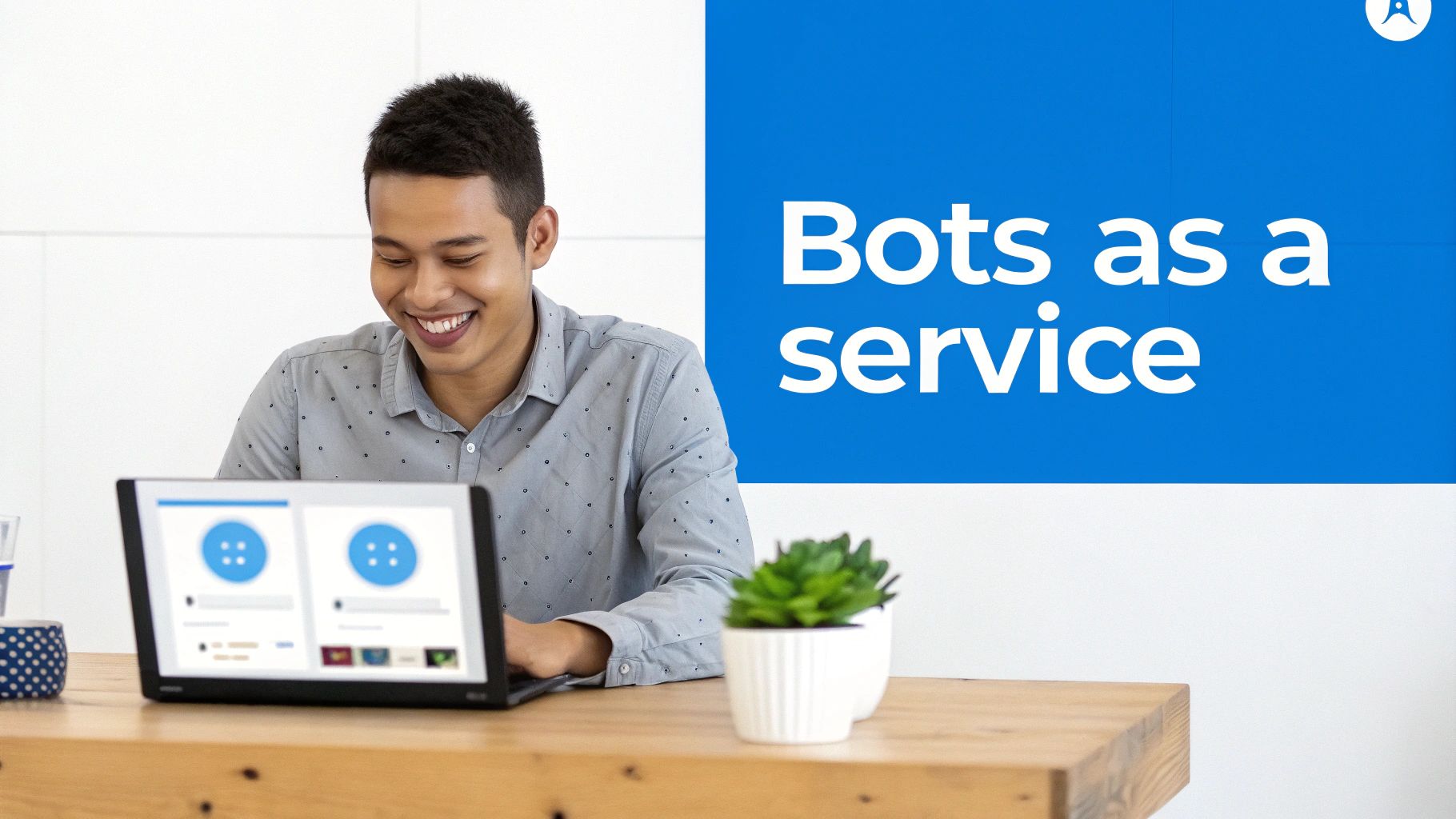
Why Bots as a Service Matters Now
At its heart, Bots as a Service is a cloud-based platform that lets you build, launch, and manage AI chatbots without needing to be a tech wizard. You can forget hiring developers to code a bot from scratch. With BaaS, you get a toolkit with all the underlying technology and integrations you need to get going fast.
This model is often a game-changer for small and medium-sized businesses. You can launch a sophisticated AI assistant trained on your own data—like your website content, product info, or support docs—in a matter of minutes, not months. It's a fundamental shift from building to subscribing.
The Momentum Behind BaaS
Let's face it: the demand for instant, intelligent answers is higher than ever. Your customers expect 24/7 support, and your business needs efficient ways to handle questions and capture leads without bloating the payroll. BaaS hits that sweet spot by offering automation that is both scalable and affordable.
The numbers back this up. The global bot services market is projected to skyrocket in the coming years, showing just how many businesses are turning to BaaS platforms to automate conversations and become more efficient.
This AI evolution means that 'bots as a service' platforms can now empower even non-technical users. For example, some AI MVP builders can help turn a product idea into a working app in days, completely changing how quickly you can innovate. That kind of accessibility is what's driving the massive adoption we're seeing.
Think of it this way: Just as website builders made it possible for anyone to create a professional website, BaaS platforms like FastBots.ai make it possible for any business to deploy a custom AI agent.
The Core Value Proposition
So, what makes this approach so compelling? The real value comes down to a few key benefits that solve everyday business headaches. If you're new to the whole concept, you can learn more about what chatbot technology is and its core benefits in our detailed guide.
Here are the main advantages you can typically expect:
- Speed to Market: You can deploy a fully functional bot in under an hour, delivering immediate value to your customers and internal teams.
- Reduced Costs: It often gets rid of the huge upfront investment in development and infrastructure, swapping it for a predictable monthly subscription.
- Scalability: A bot can handle one conversation or thousands at the same time without breaking a sweat—something a human team just can't do.
- Accessibility: No-code interfaces mean your marketing, sales, or support teams can build and manage bots without having to rely on the IT department.
Core Capabilities of Bots as a Service
Modern Bots as a Service platforms do a lot more than just field basic questions. They offer a whole suite of capabilities that can fundamentally change how you run your business. Forget simple Q&A bots; these tools are active participants in your customer journey and internal workflows.
You can think of a modern AI bot less like a support agent and more like a digital employee that works across departments. It can handle 24/7 customer service, qualify leads for your sales team, and much, much more. Let's dig into the specific features that make this happen.
24/7 Automated Customer Support
Customer support is where you’ll likely see one of the most immediate wins. You can train your bot on your entire knowledge base—FAQs, help articles, product manuals—and it'll provide instant, accurate answers around the clock. Your customers get the help they need right away, no more waiting for business hours.
Imagine resolving up to 80% of routine inquiries automatically. This takes the pressure off your human agents, freeing them from repetitive questions like "Where is my order?" or "What are your hours?" They can then pour their expertise into the complex, high-value interactions that actually need a human touch.
For example, a typical e-commerce store can see customer satisfaction soar after bringing on bots, mostly because they slash wait times. You can dig deeper into this trend by checking out this market analysis on bot services.
A Tireless Lead Generation Agent
Beyond support, a BaaS platform can turn your bot into a proactive sales and marketing assistant. Just embed it on your website or drop it into social channels like Instagram or WhatsApp, and you’ve opened up a brand-new, interactive channel for capturing leads.
The bot can greet your website visitors, ask qualifying questions, and gather contact details—turning passive browsers into active leads without anyone on your sales team lifting a finger.
Streamlining Internal Operations
The magic of bots as a service isn't just for your customers. You can also deploy bots internally to boost employee productivity and clean up common processes. Think of them as a central knowledge hub for your own team.
For instance, a new hire could ask the bot questions about company policies or benefits, which can speed up the onboarding process. An internal bot can also tackle common HR questions or walk employees through IT troubleshooting, cutting down the ticket load on those departments. By automating access to internal info, you give your team the power to find answers instantly.
How to Implement Your First Bot: A Step-By-Step Guide
Launching your first bot with a bots as a service platform is way more straightforward than you might think. Forget needing a team of developers; this is something you can likely knock out in an afternoon. This guide breaks the process down into simple steps, taking you from idea to a live AI assistant.
Let's get rid of the guesswork so you can deploy with total confidence.
Step 1: Define Your Primary Goal
Before you write a single prompt or upload a single document, you need to answer one question: What do I want this bot to do? A bot without a clear purpose won't be effective. Are you trying to slash support tickets, capture more leads, or help your internal team find HR documents faster?
Picking one primary objective is the most important first step. This focus will guide every other decision you make, from the data you feed it to the personality you give it.
Step 2: Gather Your Knowledge Base
Your bot is only as smart as the information you give it. This is where you build its "brain." With platforms like FastBots.ai, this is often as simple as uploading the content you already have.
You can feed your bot a mix of sources:
- Website Content: The easiest starting point. Just paste your website's URL, and the bot will crawl and learn from your pages.
- Documents: Upload your product manuals, spec sheets, or internal policy documents as PDFs, DOCX, or even CSV files.
- Live Data: You can even connect it to a Google Sheet for info that changes all the time, like inventory levels or event schedules.
The key here is providing clean, accurate, and relevant data. A well-curated knowledge base is the foundation of a helpful bot.
Step 3: Customise Your Bot’s Persona
Next up is giving your bot a personality. A generic, robotic tone feels cold and can turn customers off. You have the power to shape its persona, making sure every interaction feels authentic and on-brand.
Think about your brand's voice. Is it friendly and casual, or more formal and professional? You can set these instructions directly, telling the bot to "always respond in a helpful and slightly witty tone" or to "act as a professional technical support expert."
Step 4: Deploy and Test
With your bot trained and customised, it's time to put it to work. Embedding it on your website is usually as easy as copying and pasting a single line of code into your site's header or footer.
You aren't just limited to your website, either. You can often connect it to other channels where your customers hang out, like Facebook Messenger, WhatsApp, or Slack. Before you announce it, do some testing. Ask a few team members to try and break it. This is your chance to spot any gaps in its knowledge and fine-tune its responses.
Actionable Takeaway: Quick Checklist for Your First Bot
Here’s how you can apply this to get your bot capturing leads like a pro:
- Program a Proactive Welcome: Set the bot to pop up and greet visitors on key pages (like your pricing page) after a few seconds.
- Ask Qualifying Questions: Arm it with questions like, "What is your biggest business challenge?" or "What is your company size?" to segment leads.
- Integrate with Your CRM: Use a platform like FastBots.ai to connect with tools like Zapier or Make. This pipes new lead info directly into your CRM.
- Offer Value: Have the bot offer a resource—a free guide or a demo—in exchange for an email address.
What to Watch Out For with Bots as a Service
While Bots as a Service technology is powerful, a bit of realism is key to making it work long-term. Jumping in without understanding the trade-offs can lead to frustration for both you and your customers. Knowing these potential hurdles will help you build a smarter, more effective bot strategy.
Limitation 1: Your Bot Is Only as Good as Its Data
An AI bot is a lot like a star student: its performance depends entirely on the quality of its study materials. If you feed it an outdated, messy, or incomplete knowledge base, you can't expect it to give back accurate and helpful answers. This is one of the biggest reasons bots fail to meet expectations.
Before you build, audit your content. Are your FAQs up-to-date? Are your product manuals clear? A bot simply mirrors the data it's given, so a little housekeeping goes a long way.
For any organization trying to get a better handle on what their audience is thinking, specialized tools like AI search tracker tools can take things a step further by automating market intelligence.
Limitation 2: Knowing When a Human Touch Is Needed
Automation is fantastic for efficiency, but it can't replace human empathy. While the bot-for-service market is booming, success hinges on knowing exactly when to hand a conversation over to a person. Many consumers are happy using bots for quick fixes but expect an option to speak to a human for more difficult problems. You can explore more about chatbot adoption trends on grandviewresearch.com.
A great bot strategy isn't about replacing your team; it's about making them more powerful. This is why a seamless human handover process is non-negotiable. One way to do this is to look for a bots as a service platform like FastBots.ai that includes built-in live chat, letting the bot transfer the conversation smoothly to a team member.
Consideration 3: Prioritizing Security and Data Privacy
When a bot interacts with your customers, it often handles sensitive information. This makes security a critical piece of the puzzle. Choosing a platform that cuts corners on data protection is a huge risk that could damage your brand's reputation.
You should ensure your chosen BaaS provider follows rigorous security standards. We recommend looking for vendors that are SOC 2 and GDPR compliant, as this shows a commitment to protecting customer data through strict controls and regular audits. This isn't just a technical detail; it's a fundamental part of building trust.
How to Choose the Right BaaS Platform for You
With a booming market for bots as a service, picking the right provider can feel overwhelming. How do you know which platform will actually fit your business? Making the right call comes down to looking at a few essential things.
The best platform should empower your team, not create more headaches. It needs to fit into your existing workflow, connecting with the tools you already use every day. Let’s break down what really matters when you’re comparing options.
Ease of Use and No-Code Capabilities
First, can your non-technical team members actually build and manage a bot on their own? The best BaaS platforms are built for business users, not just engineers. Look for a simple, intuitive interface where you can upload documents and tweak your bot without writing a single line of code.
If your marketing manager or customer support lead can get a bot up and running in under an hour, you've likely found a winner. This puts the power to automate into the hands of the people who know your customers best.
Depth of Integrations
A bot that works in a silo is just a fancy FAQ page. Its real power comes alive when it connects with the other software that runs your business. Before you commit, dig into its integration capabilities. Does it play nicely with the tools you already rely on?
Think about your daily operations. You'll want a platform that can seamlessly link to your CRM, calendar, and communication tools. For a deeper dive, check out our guide on the best practices for selecting chatbots to help you frame your evaluation process.
Customization and Analytics
Your bot is an extension of your brand, so it absolutely needs to look and sound the part. A good BaaS platform will give you full control over its appearance and persona.
You also can't improve what you don't measure. A top-tier bots as a service platform has to provide clear, actionable analytics. Look for a dashboard that tracks key metrics like conversation volume, user satisfaction scores, and common unanswered questions. This data is pure gold for making your bot better over time.
Next Steps
Jumping into something new like bots-as-a-service always brings up a few questions. That's a good thing. We’ve found that the best way to understand the potential is to see it for yourself.
A bot's superpower is tackling the high volume of routine questions—the stuff that makes up around 80% of all support requests. It’s the perfect tool for instantly answering common queries, which frees up your human team to focus on the work that truly needs their expertise. For complex or sensitive situations, a seamless human handover ensures customers get the right help, right away.
Measuring the return on a bots as a service platform is refreshingly direct. You can track a handful of key metrics that show you exactly how it’s impacting your efficiency and, most importantly, your bottom line. Look for a drop in support tickets, an increase in captured leads, and better customer satisfaction scores.
Ready to see how a custom AI chatbot can work for your business? With FastBots.ai, you can build an AI agent trained on your own data in minutes and deploy it anywhere. Start your free trial today and experience the future of automation.