A Practical Guide to Automating Your Supply Chain for Growth

When we talk about automating your supply chain, we're really talking about using technology to handle tasks that used to eat up your team's time. This isn't just about futuristic robots; it can be as simple as software that tracks inventory in real time.
The goal is always the same: get things done faster, with fewer mistakes, and at a lower cost. It’s about moving from a reactive "put out the fire" mindset to a proactive, data-informed operation.
Why You Can No Longer Afford a Manual Supply Chain

In today’s market, speed and accuracy are non-negotiable. The conversation around supply chain automation has shifted from a "nice-to-have" for big corporations to a must-have for survival and growth.
The pressure is on from every direction. Customers expect next-day delivery, and rising operational costs are squeezing margins thin. A supply chain run on spreadsheets and manual data entry is often too slow and fragile to keep up.
The True Cost of Manual Processes
Think about the hidden costs dragging down your manual supply chain. It's not just the payroll hours your team spends on repetitive work like processing orders or chasing invoices.
The real damage often comes from small mistakes that create huge ripple effects. A simple typo during data entry can lead to a wrong shipment, triggering expensive returns, wasted shipping fees, and an unhappy customer.
For many businesses, the "cost" of a manual supply chain isn't just a line item on a budget. It's lost customers, missed growth opportunities, and the constant stress of firefighting preventable problems.
Turning Operations into an Advantage
When you automate your supply chain, you're building a stronger, more competitive business. Automation turns core operational areas from potential liabilities into genuine strengths that help you win.
To give you a better idea of where automation can make a difference, here's a quick look at some key areas and the kind of impact you can typically expect.
Key Automation Areas and Their Business Impact
| Automation Area | Primary Technology | Expected Business Impact |
|---|---|---|
| Inventory Management | WMS, AI Forecasting | Reduced carrying costs, fewer stockouts, better cash flow. |
| Order Fulfilment | Robotics, Automated Pick/Pack | 24/7 operation, higher order accuracy, faster delivery times. |
| Logistics & Shipping | AI Route Optimization, TMS | Lower transportation costs, consolidated shipments, improved on-time delivery. |
| Customer Service | AI Chatbots (FastBots.ai) | Instant order status updates, faster issue resolution, reduced support tickets. |
| Procurement | Automated Ordering Systems | Fewer manual errors, better supplier terms, ensures material availability. |
Ultimately, bringing in the right technology isn't just about doing the same old things faster. It’s about creating a smarter, more agile operation that can pivot with market changes and build a solid foundation for growth.
Finding Your Best Automation Opportunities
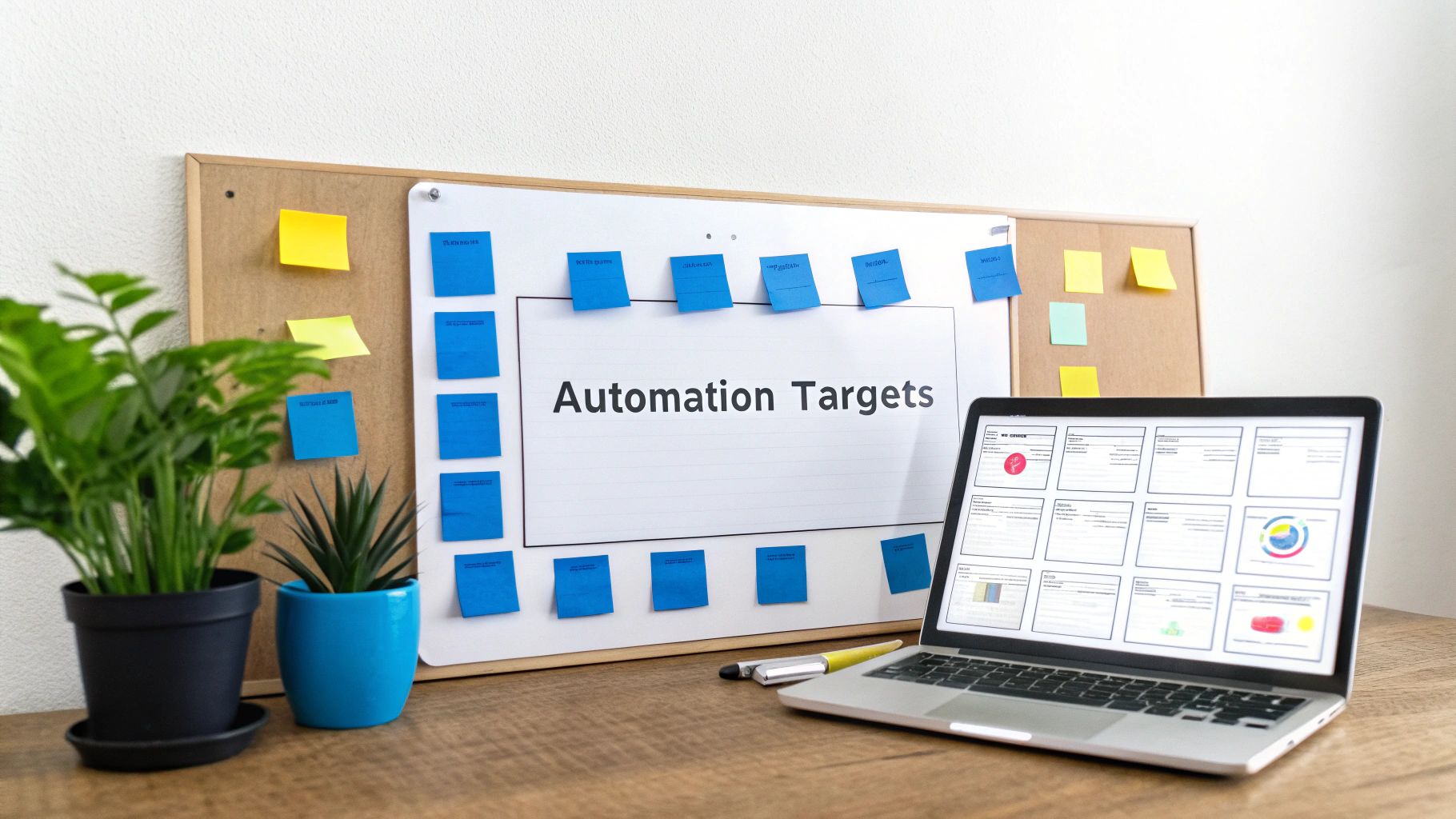
Before you think about new software, the first step to automate your supply chain is to understand exactly how it works right now. This means you've got to step back and map out your current operations.
Trace the entire journey of a product, from purchase order to final delivery confirmation. Get into the weeds and see the small, everyday tasks that eat up your team's time.
Pinpointing the Pain Points
As you map everything out, you'll start seeing patterns. The goal is to find the bottlenecks, the mind-numbing repetitive tasks, and the steps where mistakes always seem to happen.
Manual data entry is a classic example. Think about the hours your team sinks into keying in invoice details or copying shipping info. It's not just slow—it's a breeding ground for costly human errors.
Another common one? Answering the same questions over and over. If your team spends half their day responding to "Where is my order?", that’s a massive resource drain.
The Impact vs. Effort Framework
So you have a list of potential automation projects. Where do you begin? A simple Impact vs. Effort framework is one of the best ways to prioritize.
You're basically scoring each opportunity on two things:
- Potential Impact: How much value will this bring in terms of time saved, costs cut, or errors eliminated?
- Implementation Effort: What will it take to get this done, including cost, setup time, and team training?
What you're hunting for are the "quick wins"—the high-impact, low-effort tasks that give you immediate value and build momentum.
A small e-commerce business we know was manually syncing inventory between their online store and their accounting software. Automating it was a low-effort, high-impact fix that prevented them from overselling during a flash sale—a massive win for their small team.
If you need more ideas on where to look, this ultimate guide to retail automation gives a solid overview of common solutions.
Actionable Takeaway: A Prioritization Checklist
Here's how you can apply this in your business. Run each potential project through these questions to build a realistic roadmap.
- Frequency: How often does this task happen? Automating a daily task typically delivers a better return than a monthly one.
- Time Consumption: How many team hours go into this task each week? Do the math to see the direct impact.
- Error Rate: How often do mistakes happen here, and what do they cost you? Processes riddled with errors are perfect candidates for automation.
- Scalability: Is this manual process holding you back from growing? If your only solution to handle more volume is to hire more people, you need to automate.
By methodically looking at your operations, you move from just wanting to automate your supply chain to having a clear, strategic plan to make it happen.
Choosing the Right Technology for Your Business Needs
Once you’ve mapped your processes, it's time to play matchmaker with technology. The trick is to remember that different tools are built to solve very different problems.
You don't need a massive, all-in-one system from day one. Instead, focus on finding the right tool for the job you’ve already identified.
Matching Tools to Your Specific Challenges
To get automation right, you need to understand the two main categories of tools: physical and digital. Physical automation involves robots, while digital automation uses software to handle data and administrative tasks.
Here’s a quick rundown of common technologies:
- Warehouse Management Systems (WMS): This is the digital brain of your warehouse, giving you real-time visibility into inventory levels and order status.
- Robotic Process Automation (RPA): Think of RPA as a digital employee that handles repetitive, rules-based tasks like data entry or generating shipping labels.
- Automated Guided Vehicles (AGVs) & Autonomous Mobile Robots (AMRs): These are the workhorses of physical warehouse automation that move inventory and assist with picking and sorting.
The Role of AI in Modern Supply Chains
Artificial intelligence adds a layer of smarts on top of standard automation. AI can analyze data to predict future demand, optimize shipping routes, or manage customer interactions.
For example, AI-powered chatbots are becoming essential for handling routine service questions. A chatbot can instantly provide order tracking updates, freeing up your team to handle complex issues. Integrating these bots can be surprisingly straightforward, as you can see in our guide on connecting AI chatbots with your ERP system.
Limitations and What to Watch Out For
While technology offers incredible benefits, it's important to go in with your eyes open. A common mistake is assuming a new tool will magically fix a broken process. Automation often just shines a brighter light on underlying issues.
Another thing to think about is integration. A new piece of software that doesn’t connect with your existing accounting or e-commerce platform can create more manual work, not less. For instance, you can explore timbercloud's automation features to get a feel for a typical offering and see how they handle integrations.
Finally, think about your team. New technology requires new skills, so you have to factor in the time and resources needed for training. Good change management is just as critical as the technology itself.
Creating Your Phased Implementation Plan
Execution is what separates a good idea from a great result. Don't try to pull off a massive, "big bang" overhaul all at once. A phased approach de-risks the project and makes the journey to automate your supply chain far more manageable.
The smartest move is to start small with a well-defined pilot project. This lets you validate your chosen technology, learn from any early bumps, and prove the value of automation quickly.
Starting with a Strategic Pilot Project
Your pilot project should tackle one of those high-impact, low-effort opportunities you identified earlier. For example, automating the manual entry of online orders into your shipping software is an ideal starting point.
The goal here isn't to transform your entire operation overnight. It's to score a quick, tangible win that makes it easier to get the green light for bigger projects later on.
A distributor we worked with chose to pilot an automated inventory reconciliation tool. Within two months, they slashed their stock-checking time by 75%. That single success story was all they needed to secure the budget for a full warehouse management system.
Defining Success from Day One
Before you kick off the pilot, you need to know exactly what success looks like. Defining your key performance indicators (KPIs) upfront is non-negotiable.
Your KPIs should be directly tied to the pain point you’re solving. If you're automating order processing, you should be tracking things like order accuracy rate, fulfillment time, and cost per order.
Managing the Human Side of Change
Technology is only half the battle. The other half is your team. The best software in the world is useless if the people who need it are resistant or left in the dark.
The key is clear, consistent, and honest communication. Explain why you’re making these changes, focusing on how it benefits the team—like ditching tedious tasks for more interesting work.
You can dive deeper into these industry shifts by checking out the latest supply chain statistics on tradeverifyd.com. A phased implementation, backed by strong change management, gives you a low-risk path to automate your supply chain.
Scaling Your Automation for Long-Term Success

Getting your first automation project across the finish line is a huge win. The real prize isn’t just fixing one problem; it's building a culture where technology-driven improvement is the new normal.
The data from your pilot project is your new best friend. Use the metrics you tracked to build a rock-solid business case for what's next. Nothing gets your team on board faster than showing them real, hard numbers.
From Single Tasks to an Integrated Ecosystem
As you grow, your mindset needs to shift. Stop thinking about automating individual tasks and start creating an integrated, data-driven ecosystem where your different automated systems can talk to each other.
Connecting those dots creates a seamless flow of information that eliminates manual handoffs. That's the kind of integration that truly unlocks the next level of efficiency when you automate your supply chain.
The most mature automated supply chains operate like a well-rehearsed orchestra. Each component plays its part, but they all follow the same sheet of music—your real-time operational data—to create a harmonious result.
Technologies like artificial intelligence are making these connections smarter every day. The impact is so quantifiable that early adopters are seeing significant results, a trend you can dig into by exploring the latest manufacturing trends at sdcexec.com.
A Checklist for Scaling Your Automation
Keeping the momentum going requires a disciplined cycle of reviewing progress and planning your next move.
- Review Your KPIs: Get into the weeds of your performance data. Where did you see the biggest impact? What lessons did you learn?
- Find the Next Bottleneck: Pull out those process maps again. Armed with new data, pinpoint the next high-impact automation target.
- Gather Team Feedback: The people using these new tools have insights you can't get anywhere else. Their firsthand experience is gold.
- Build a Scalable Tech Stack: As you add more tools, make sure they play nice with your existing systems. Our guide to enhancing business processes with smart automation offers more insight here.
What to Watch Out For: Common Pitfalls When You Automate Supply Chain Processes
While the benefits are huge, deciding to automate your supply chain isn't a magic bullet. It won't instantly fix every broken process. Going in with your eyes wide open is key to avoiding common traps.
One of the first hurdles is the upfront cost. Whether it's software licenses or integration specialists, there's an initial expense. Trying to calculate a precise return on investment (ROI) can also be fuzzy, as benefits like happier customers don't always fit neatly into a spreadsheet.
Integration and Data Security Hurdles
I've seen it happen too many times: a company gets excited about a new tool, only to find it doesn't play nice with their existing systems. A botched integration often creates more manual work, completely defeating the point.
And then there's data security. As you connect more systems, you create more doors for potential cyber threats. Making sure any new technology meets strict security and compliance standards is non-negotiable for protecting your business.
Key Takeaway: Automation is a powerful amplifier. If you automate a clean process, you get incredible results. If you automate a messy process, you just get a faster way to make mistakes.
The Trap of Over-Automation
It's also tempting to try and automate everything. That's a mistake. Some tasks, particularly those needing complex problem-solving or a delicate human touch, are still best left to people.
For instance, a chatbot can handle most routine order status questions. But when a key client has a unique, urgent problem, you need an experienced human to step in. Our guide on using chatbots in logistics and transportation explores how to strike this balance for better customer outcomes.
Your Questions About Supply Chain Automation, Answered
Jumping into supply chain automation brings up a lot of questions. Here are some of the most common ones we hear from businesses just starting their journey.
What's the Real First Step to Automate My Supply Chain?
Forget about shopping for software right away. The absolute best place to start is by mapping out your current processes to get a clear picture of how things work right now.
Once you have that map, find one specific, repetitive pain point like order data entry. Tackling a small, high-impact area first gives you a quick win and helps you learn the ropes.
So, How Much Does This Actually Cost?
The price can swing wildly. Simple software for one task might cost a few thousand dollars a year, while a full Warehouse Management System (WMS) could be tens of thousands.
The key is to start with solutions that solve your biggest headaches and offer a clear return. Many modern tools are subscription-based, turning a huge capital expense into a predictable operational one.
Don't get fixated on the initial price. Instead, calculate the "cost of inaction." How much money are you losing each month from manual errors and wasted staff time? You'll often find that automation pays for itself much faster than you'd expect.
Is Automation Going to Replace Our People?
That's a common myth, but the short answer is no. Automation is fantastic at handling repetitive, data-heavy, and physically demanding tasks.
This actually frees up your team to focus on high-value work that humans excel at—like critical thinking, creative problem-solving, and building customer relationships. The goal isn't to replace your team; it's to augment your team, making their jobs more meaningful.
Ready to take the first step in automating your customer support and internal workflows? FastBots.ai makes it easy to build a custom AI chatbot trained on your business data in minutes. Start your free trial today and see how easy it is to automate.