AI Sales Assistants: Boost Your Team Efficiency Today

Think of an AI sales assistant as your team's most tireless and data-savvy member—the one who works 24/7 handling the repetitive, time-sucking tasks that slow everyone else down. It’s a specialised software tool built to automate, fine-tune, and elevate different stages of the sales cycle. The goal? Freeing up your human reps to focus on what they do best: building relationships and closing deals.
What an AI Sales Assistant Really Does

At its core, an AI sales assistant is much more than just another automation tool; it’s a strategic partner. Picture an orchestra conductor. They don't play a single instrument, but they ensure every section works in perfect harmony. In the same way, these assistants coordinate administrative chores, data analysis, and initial customer interactions so your entire sales process runs like a well-oiled machine.
This isn't about replacing talented salespeople. It’s about amplifying their skills by tackling the common bottlenecks that drain their time and energy. For a solid overview of the concept, check out this detailed guide on the AI sales agent.
To get a better sense of what these assistants do day-to-day, let's break down their core functions.
Core Functions of an AI Sales Assistant
The table below summarises the primary tasks that AI sales assistants take off your team's plate, directly boosting their productivity and focus.
| Function | Description | Impact on Sales Reps |
|---|---|---|
| Lead Qualification | Automatically scores and prioritises incoming leads based on predefined criteria, such as firmographics, behaviour, and engagement. | Reps can instantly focus on the highest-potential leads instead of sifting through a crowded pipeline. |
| Data Entry & CRM Management | Captures and logs interactions, updates contact records, and syncs data across platforms without manual input. | Eliminates hours of tedious administrative work, freeing up more time for actual selling. |
| Meeting Scheduling | Interacts with prospects via email or chat to find mutually available times, send invites, and manage rescheduling. | Removes the back-and-forth headache of calendar coordination, accelerating the sales cycle. |
| Personalised Outreach | Drafts and sends tailored follow-up emails, nurture sequences, and reminders based on a prospect's history and interests. | Ensures consistent, personalised communication at scale, preventing leads from going cold. |
| Sales Analytics & Forecasting | Analyses sales data to identify trends, predict outcomes, and surface insights on what's working and what isn't. | Provides reps with data-backed insights to make smarter decisions and refine their strategy. |
By automating these foundational activities, AI assistants allow your sales team to punch above their weight, concentrating their efforts where human connection matters most.
Solving Critical Sales Bottlenecks
An AI assistant directly tackles the persistent challenges that nearly every sales team knows all too well. These intelligent systems are built to manage high-volume, low-complexity tasks with precision, ensuring no opportunity slips through the cracks.
Here are the key problems they solve:
Administrative Overload: They automate data entry, schedule meetings, and log every interaction in your CRM, wiping hours of manual work off your team's to-do list.
Inconsistent Lead Engagement: They can respond to new inquiries instantly, 24/7, qualify leads against your ideal customer profile, and nurture them with personalised follow-ups.
Missed Opportunities: By analysing data and prospect behaviour, they can flag at-risk deals or highlight upselling opportunities that a busy human might easily overlook.
The broader market for AI assistants is seeing explosive growth. The global market size is projected to jump from USD 3.35 billion in 2025 to USD 21.11 billion by 2030. That's a staggering 44.5% compound annual growth rate, highlighting just how quickly businesses are adopting these tools.
By handling these foundational tasks, AI sales assistants—a specific type of AI agent—empower reps to operate at a higher, more strategic level. For a deeper dive into their functionality, check out our guide on AI agents and their applications. They've quickly become an essential part of any modern sales toolkit.
How AI Transforms Your Sales Process
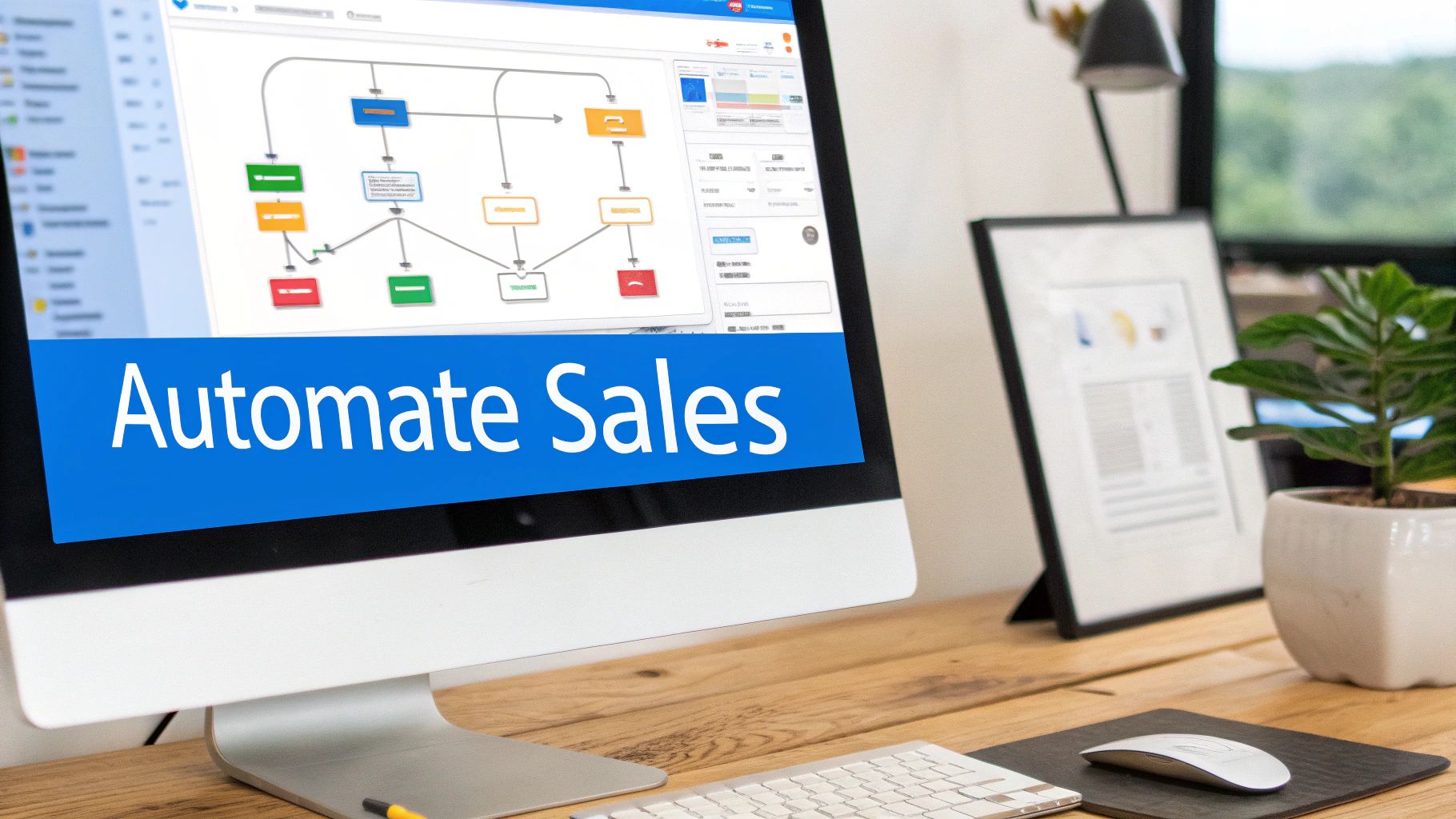
Bringing an AI sales assistant into your workflow isn’t just about adding another piece of software—it’s about fundamentally upgrading your entire sales engine. These tools do more than just speed up old processes. They introduce smarter, more efficient ways of working that were nearly impossible to pull off at scale before.
The biggest change starts with reclaiming your team's most valuable asset: time.
Think about all the low-value, repetitive tasks that eat up a sales rep's day. We’re talking about manual CRM updates, logging calls, sending generic follow-up emails, and weeding through lists of unqualified leads. An AI assistant handles these jobs with relentless precision. This frees up your reps to focus on the high-impact stuff: building relationships, strategizing on complex deals, and actually closing.
This shift from admin work to strategic selling has a huge impact on both productivity and morale. Instead of getting bogged down by data entry, your team can pour their energy into real conversations with prospects who are genuinely ready to talk.
Sharpening Focus with Intelligent Automation
Beyond just ticking off tasks, AI adds a layer of intelligence that sharpens your team's focus. It acts like a filter, making sure your reps only spend time on the most promising opportunities. This happens through a few key functions working together to streamline the sales funnel.
Here’s how it works:
AI-Powered Lead Scoring: The assistant analyses lead behaviour, company details, and engagement history to assign a priority score. This means your team always knows exactly who to contact next, which massively boosts their efficiency.
Data-Driven Personalization: By looking at past interactions and customer data, the assistant can help draft highly personalised outreach messages. This makes every prospect feel understood and drives up engagement rates.
Predictive Insights: Some of the more advanced systems can even spot patterns that show which deals are at risk or which accounts are perfect for an upsell, giving your team a serious proactive edge.
By automating the top of the funnel and providing deep insights, an AI sales assistant ensures that every minute a sales rep spends is a minute spent on revenue-generating activities. This leads to shorter sales cycles and higher conversion rates.
The Widespread Adoption of AI in Sales
The move to AI-powered sales isn't some niche trend; it’s quickly becoming the standard for any competitive revenue team. Recent survey data shows that the vast majority of sales teams are already using AI tools to get ahead.
In fact, only 24% of revenue organisations report not using AI sales assistants or similar tech. That number alone shows just how essential these tools have become for modern sales success. You can find more insights on the rise of AI in sales organizations on Mindtickle.com.
This widespread adoption sends a clear message: businesses that wait to get on board risk falling far behind competitors who are already reaping the rewards. By connecting these benefits to real business outcomes, the ROI of an AI assistant becomes undeniable. To see exactly how these tools boost productivity, check out our guide on AI sales tools for enhancing efficiency.
AI Sales Assistants in Action
Alright, let's move past the theory. It’s one thing to talk about what AI sales assistants can do, but it's much more powerful to see how they're already changing the game in the real world. These tools aren't just buzzwords; they’re actively streamlining day-to-day work and boosting revenue for businesses right now.
Think of them as the digital bridge connecting your marketing efforts to your sales team's conversations, making sure no opportunity falls through the cracks.
Let’s walk through a few scenarios to show you exactly how these assistants operate across different teams.
Automating Sales Workflows
For your average sales team, an AI assistant is a total game-changer. Picture this: the system automatically digs through your CRM, flagging leads that have gone silent after an initial chat. Instead of a sales rep spending hours manually drafting follow-up emails, the AI jumps in.
It kicks off a personalized, multi-step nurturing sequence to re-engage these prospects. The AI watches for email opens and replies, and the moment a lead shows interest again, it immediately works to get a meeting booked right on the rep's calendar.
This one workflow accomplishes three huge things:
It revives cold leads: You're breathing new life into opportunities that would have otherwise been lost in the shuffle.
It saves your reps' time: Salespeople are freed from tedious admin work and can focus on what they do best—closing deals with active, qualified buyers.
It speeds up the sales cycle: By handling the scheduling automatically, it cuts out all the frustrating back-and-forth emails.
For example, the data company Snowflake built an internal AI assistant that saves its sales team 10 to 15 minutes of searching for information per question. This gives reps instant access to answers during live customer calls, which makes them sound incredibly sharp and effective.
This is a perfect illustration of an AI assistant not just completing a task, but actually making the quality of sales conversations fundamentally better.
Qualifying Marketing Leads Instantly
Now, let's look at it from the marketing team's perspective. They pour a ton of resources into driving traffic and getting people to sign up for webinars or download whitepapers. In the old days, every single one of those sign-ups would land in a giant, unfiltered list for a sales development rep (SDR) to sift through.
With an AI assistant, the process starts the second someone fills out a form. The AI can instantly engage that person with a chatbot or a quick email, asking a few smart, targeted questions based on your ideal customer profile.
The assistant quickly sorts the hot leads from the "just browsing" crowd. Only the prospects who tick the right boxes—like company size, job title, and a clear need—get flagged as sales-ready and routed to a rep’s calendar. This is how you make sure your sales team spends their valuable time on conversations that actually have a shot at converting.
Our guide on using AI chatbots for effective sales lead generation dives much deeper into how this works.
The ripple effect of these automated systems goes far beyond just sales. To see how assistants can transform other parts of a business, just look at tools like an AI onboarding assistant that helps get new hires up to speed.
Your Step-by-Step Implementation Guide

Rolling out an AI sales assistant isn't just a tech project—it's a strategic business move. To get it right, you need a clear roadmap that connects the technology directly to your business goals. This turns what feels like a massive undertaking into a series of manageable, rewarding steps.
First things first: define what winning looks like. Before you even think about looking at different vendors, get your team together and pinpoint the exact problems you want this AI to solve.
Are you trying to slash response times for new leads? Maybe you want to put meeting scheduling on autopilot or get way more accurate with lead qualification. Whatever it is, setting clear, measurable goals is non-negotiable. This gives you a benchmark to measure success and gets everyone pulling in the same direction.
Building Your Foundation
With your goals locked in, it's time to look at your current setup. An AI sales assistant doesn't work in a silo; it has to plug into the tools your team already relies on every single day. This is where a quick audit of your tech stack is essential.
Your Customer Relationship Management (CRM) system is the big one. The AI has to be able to read and write data to your CRM to keep customer records fresh, log every interaction, and pull up past conversations for a personal touch. Check if potential vendors offer native integrations or can connect through a platform like Zapier.
Next up, get your data ready. An AI assistant is only as smart as the information you feed it. Start gathering all the resources you'll need for training:
Product documentation and your internal knowledge base articles.
Your best sales scripts and go-to responses for common objections.
Marketing materials like case studies, brochures, and whitepapers.
All the good stuff from your website, especially the FAQs.
Having this content organized and ready to go will make the training process worlds faster. It ensures your new assistant is giving accurate, on-brand answers from the moment you switch it on.
Launch and Optimization
Once you've picked a partner and the AI is trained on your data, it's go-time. But don't just flip the switch for everyone at once—a phased rollout is almost always the smarter play.
Start with a small pilot group of your most tech-savvy sales reps. They'll give you honest, valuable feedback and help you squash any bugs before you deploy the assistant across the entire sales floor.
A key lesson from major tech companies like NVIDIA is the importance of a user-friendly interface. If the tool is clunky or confusing, your team won't use it, no matter how powerful it is. Always prioritize a simple, intuitive platform.
After the launch, the work isn't done. A successful implementation is a cycle: you monitor, gather feedback, and constantly optimize.
Regularly check the conversation logs and analytics. See what's working well and where the AI might be getting stuck. Use those insights to tweak its responses, update its knowledge base with new information, and fine-tune its workflows. This continuous improvement loop is what turns a good AI sales assistant into an absolutely essential part of your sales engine.
How to Choose the Right AI Sales Assistant
Picking the right AI sales assistant is a huge decision. It's something that will directly impact your team's performance and, ultimately, your ROI. With the market exploding with options, it's incredibly easy to get distracted by flashy features that don't actually move the needle. You need a solid game plan to cut through the noise.
First things first: think beyond cool demos and prioritize deep, seamless integration. Your AI assistant has to feel like a natural extension of your team's existing workflow, not just another tool you have to log into. If it can’t talk to your Customer Relationship Management (CRM) system, it's going to create more headaches than it solves.
This means it must be able to automatically log conversations, update contact records, and sync lead statuses without anyone having to lift a finger. That kind of connectivity isn't just a nice-to-have; it's non-negotiable for keeping your customer data clean and reliable.
Evaluating Core Features and Customization
Once you've confirmed that the integration is rock-solid, it's time to dig into customization. A one-size-fits-all assistant just doesn't cut it in sales. Every business has its own unique voice, its own sales process, and its own way of talking to customers. The best tools give you fine-grained control over how the AI behaves.
Look for platforms that let you:
Define a Custom Persona: You should be able to tweak the AI’s tone and personality so it perfectly matches your brand. Consistency is key for a good customer experience.
Build Custom Conversation Flows: The ability to map out specific dialogue paths for different situations—like qualifying a new lead, booking a demo, or handling a common objection—is a game-changer.
Control the Knowledge Base: You need to tell the AI exactly what information it can and can't use. Can it pull from your website? Your product docs? Should it search the internet? This ensures its answers are always accurate and on-brand.
This level of control is what makes the assistant feel like a true member of your team, one that plays by your rules and upholds your standards in every single chat.
Prioritizing Scalability and Security
Finally, you have to think long-term. Your business is going to grow, and your AI sales assistant needs to be ready to grow with you. A platform that's great for a team of five should have a clear and simple path to support a team of fifty without lagging or becoming a management nightmare.
And just as important—maybe even more so—is data security. This tool will be handling sensitive information about your prospects and customers, so rock-solid security and compliance are essential.
When you're talking to vendors, don't be shy about asking for their security credentials. Look for certifications like SOC 2 and GDPR compliance. This is your proof that your data will be encrypted, stored securely, and managed according to the highest industry standards.
The market for these tools is growing like crazy. It was valued at over USD 2.9 billion in 2025 and is expected to blow past USD 20.5 billion by 2035, with cloud-based tools leading the pack. You can discover more insights about this market growth on Research Nester. This trend just highlights how important it is to choose a partner that's built for the future.
Vendor Selection Checklist for AI Sales Assistants
To make this process a little easier, here’s a quick checklist you can use when comparing different vendors. It covers the must-have features and shows how a solution like FastBots.ai stacks up against them.
| Evaluation Criteria | What to Look For | How FastBots.ai Delivers |
|---|---|---|
| CRM Integration | Native, deep integrations with popular CRMs like HubSpot, Salesforce, and Zoho. Should sync data automatically without manual workarounds. | Offers seamless, one-click integrations with major CRMs, ensuring all conversation data is logged and synced in real-time. |
| Customization | Ability to control the AI's persona, tone of voice, conversation flows, and the specific knowledge sources it uses for answers. | Provides granular control over bot personality, conversation logic, and knowledge base. You can restrict it to your data or allow web access. |
| Data Security | Compliance with major standards like GDPR and SOC 2. Clear data encryption, privacy policies, and secure data storage protocols. | Fully GDPR compliant with robust security measures, including data encryption at rest and in transit, to protect sensitive customer information. |
| Scalability | A clear pricing and performance path that supports growth from a small team to a large enterprise without performance degradation. | Built on a scalable architecture that handles thousands of concurrent conversations. The platform grows with your business needs. |
| Ease of Use | An intuitive, no-code interface that allows non-technical team members to build, manage, and update the AI assistant easily. | Features a user-friendly, no-code bot builder, making it simple for marketing and sales teams to create and deploy assistants in minutes. |
| Analytics & Reporting | Dashboards that provide clear insights into conversation volume, lead qualification rates, user engagement, and overall ROI. | Includes a comprehensive analytics dashboard to track key performance metrics, helping you measure effectiveness and optimize performance. |
Choosing the right partner is less about finding the most features and more about finding the right fit for your existing workflow, security needs, and future growth. A careful evaluation using these criteria will help ensure you make a choice that pays off for years to come.
Ready to Step Up Your Sales Game?
If this guide has shown you anything, it’s that AI sales assistants are no longer some futuristic gadget—they're a must-have for any sales team that wants to stay competitive. We've walked through what they are, how they slot into your daily workflows, and the practical steps to get one up and running. Sure, the future holds even cooler stuff like advanced predictive analytics, but the time to get started is right now.
So, what's your first move? Take a hard look at your current sales process.
Find the bottlenecks. Where are you and your team losing the most time? Is it lead qualification? Is it the endless back-and-forth of scheduling meetings? A quick audit will shine a light on exactly where an AI assistant can make the biggest splash.
It really boils down to this: waiting to adopt this technology means you're willingly leaving money, efficiency, and a serious competitive edge on the table. The tools are here, they’re accessible, and the ROI speaks for itself.
Once you’ve pinpointed your biggest headaches, the next step is simple: see it in action. Schedule a demo with a provider and watch how an AI sales assistant can genuinely change your team's day-to-day grind and boost your company's bottom line.
The initial time investment is tiny compared to the massive gains waiting on the other side. For any sales leader looking to get ahead, it’s a no-brainer.
Got Questions About AI Sales Assistants? We've Got Answers
Even when the benefits seem obvious, bringing in new tech always raises a few eyebrows. When leaders start looking into AI sales assistants, a few key questions pop up time and again around cost, the impact on the team, and how messy the setup will be. Let’s tackle these head-on so you have the clarity to make the right call.
This isn't just another line item on the expense report; it’s a strategic move to boost efficiency and drive growth. Getting in front of these common queries is the best way to get your team aligned for a smooth, successful rollout.
How Much Do These Assistants Cost?
Pricing for AI sales assistants almost always runs on a subscription model. What you end up paying usually depends on things like how many users you have, the number of conversations the AI handles each month, or the specific features you need.
But just looking at the price tag is a mistake. The real conversation is about the return on that investment (ROI). When an AI can handle thousands of routine chats and qualify leads on autopilot, it frees up your sales team to chase high-value deals. You have to weigh the subscription fee against the massive gains in efficiency, better conversion rates, and a faster sales cycle.
The best way to think about the cost is to see it as an investment in your team's productivity. By automating the grunt work, you're giving your best reps more time to actually close deals. The ROI usually becomes clear pretty quickly.
Will an AI Assistant Replace My Sales Team?
This is the big one, but the answer is a firm no. AI sales assistants are built to supercharge your human team, not replace them. Think of the AI as a powerful force multiplier that takes the most repetitive, mind-numbing parts of the job off your team's plate.
This frees up your sales pros to operate at a much higher level. Instead of getting bogged down in administrative tasks like data entry or scheduling meetings, they can focus their talent on what actually matters:
Building real relationships with key decision-makers.
Crafting complex deal strategies for big-ticket accounts.
Navigating tricky negotiations and closing major contracts.
The AI handles the repetitive stuff that can scale, while your team provides the human touch and strategic thinking that no machine can replicate.
How Hard Is the Integration Process?
Gone are the days of painful, months-long software rollouts. Modern AI platforms are built to be simple and fast. Many of the best AI sales assistants offer no-code, plug-and-play integrations with the tools your team already lives in.
This means you can connect the assistant to your CRM—whether it's Salesforce, HubSpot, or Zoho—in just a few clicks. The whole setup is designed to be intuitive, letting you get a fully functional assistant up and running in a matter of hours, not weeks. That quick deployment means you start seeing a return on your investment almost right away.
Ready to see how an AI assistant can overhaul your sales process without the technical headaches? FastBots.ai offers a powerful, no-code platform that lets you build a custom AI sales assistant trained on your own data in minutes. Start your free trial today and discover a smarter way to sell.