How an AI Chatbot for Your Website Boosts Engagement and Conversions
An AI chatbot for a website is your automated, 24/7 digital assistant. Think of it as an instant-response expert for your business, ready to answer questions, guide users, and capture leads without a human operator needing to be present.
Why Your Website Needs an AI Chatbot Now
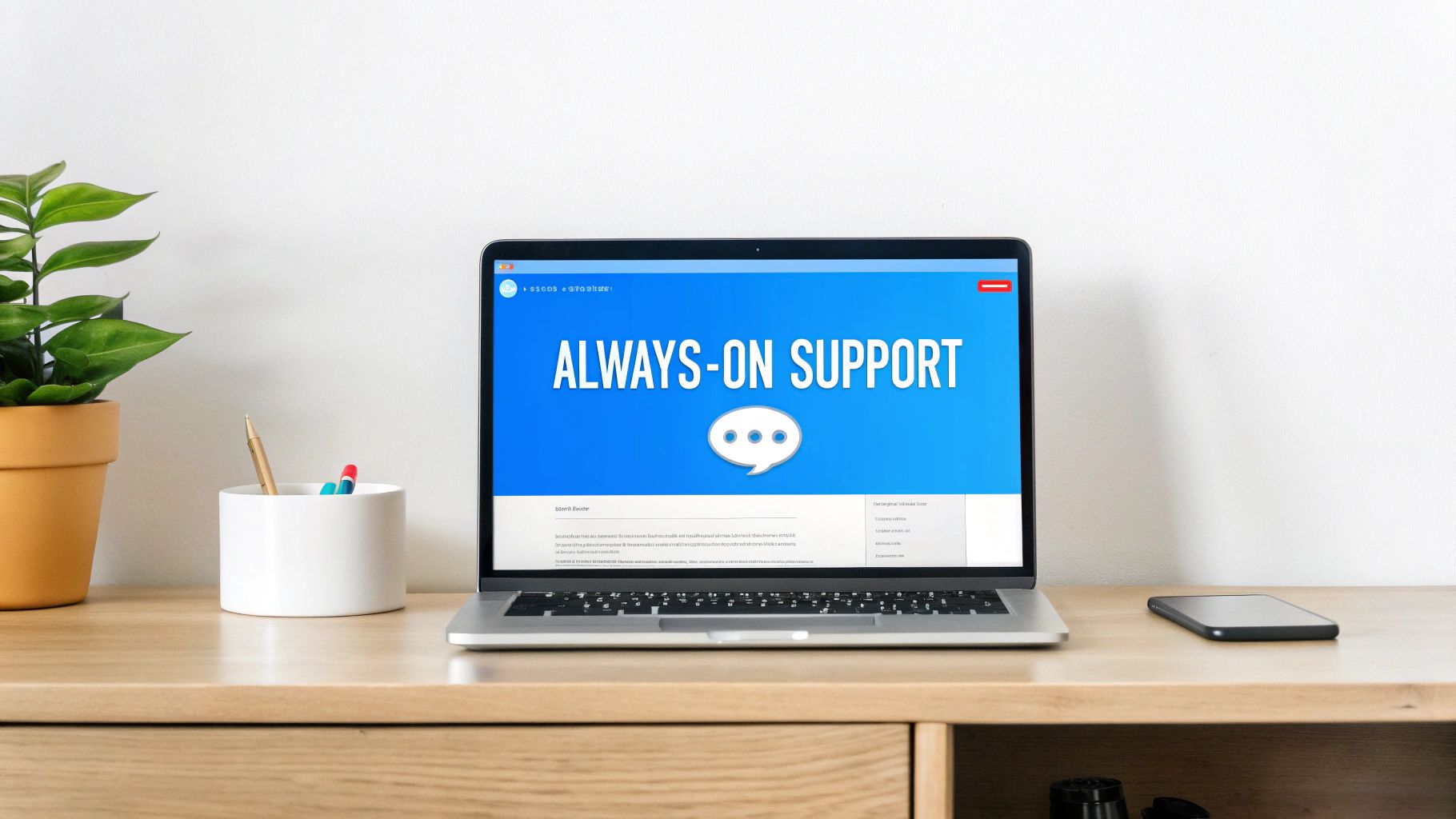
Are you staring at a high bounce rate or a growing backlog of support tickets? You're not alone. Many businesses struggle to engage every website visitor, often losing potential customers simply because a real person isn't available the exact moment a question pops up.
This is where an AI chatbot for your website steps in. It acts as your always-on digital concierge, ready to greet visitors, answer their questions, and nudge them toward a purchase or solution—around the clock. This isn't some futuristic gadget; it's a practical tool for solving some of today's biggest business headaches.
The adoption of this technology is taking off because the results are clear. We're seeing a major shift in how businesses handle online interactions, with many SaaS companies and larger enterprises integrating chatbots into their customer experience strategy.
Turning Browsers into Engaged Leads
A chatbot fundamentally changes the dynamic of your website. Instead of visitors passively browsing (and potentially leaving), you can offer them immediate, personalized help. That proactive engagement makes them feel heard and valued from the second they land on your page.
You can essentially transform your website from a static brochure into a lively, two-way conversation. The benefits of adding a chatbot to your website go beyond just support; they create a more satisfying journey for your users.
Typically, a well-trained chatbot can resolve over 70% of common customer questions instantly. This doesn't just make customers happier—it frees up your human support team to tackle the complex issues that really need a personal touch.
What Can an AI Chatbot Actually Do for Your Website?
Let's pull back the curtain on what makes a modern AI chatbot tick. It’s a huge leap from the clunky, scripted bots of the past. Think of it less like a rigid flowchart and more like your most dedicated employee—one who has memorized every single page of your company's knowledge base.
The magic behind this is a technology called Natural Language Processing (NLP). It’s what allows the bot to understand how humans actually talk, not just isolated keywords. So, when a visitor asks, "Hey, got any blue shirts in a medium?" the bot understands the intent, color, and size all in one go.
A good AI chatbot is packed with features designed to solve real business problems. It's not just about answering questions; it's about driving results. Here’s a look at some of the must-have capabilities.
Key Features of a Modern AI Chatbot
| Feature | What It Does | Business Benefit |
|---|---|---|
| Natural Language Processing (NLP) | Understands and interprets human language, including slang, typos, and context. | Provides more accurate, human-like answers, reducing user frustration and improving satisfaction. |
| Custom Knowledge Base Training | Learns directly from your website, PDFs, documents, and other business content. | Guarantees that all responses are accurate, on-brand, and based solely on your company's information. |
| Lead Qualification | Asks targeted questions to sort casual browsers from serious prospects. | Automatically filters and prioritizes leads, so your sales team only spends time on high-potential customers. |
| Seamless Human Handoff | Transfers complex conversations or high-intent leads to a live agent without losing context. | Creates a smooth customer journey and ensures important opportunities are never dropped. |
| Appointment Scheduling | Integrates with calendars (like Calendly) to book meetings or demos directly in the chat. | Reduces friction in the sales process, leading to more scheduled meetings and faster conversions. |
| Multilingual Support | Communicates with customers in their native language. | Expands your market reach and provides a better experience for a global audience. |
| Analytics and Reporting | Tracks conversation topics, user satisfaction, and lead capture rates. | Delivers actionable insights to help you understand customer needs and improve the bot’s performance. |
Trained on Your Business, and Only Your Business
One of the most powerful things a modern AI chatbot for a website can do is train directly on your own content. You can feed it your help docs, product pages, company policies, and even past customer support chats. This creates a secure "information bubble" that the bot operates within.
By doing this, you're making sure every single response is accurate, consistent, and perfectly aligned with your brand's voice. You’re essentially building a custom expert on your business, ready to help visitors 24/7.
For example, a local bakery could upload its menu, allergen info, and weekly specials. When a customer asks, "What gluten-free options do you have today?" the bot can give a precise, up-to-the-minute answer based only on the documents the bakery provided.
From Casual Chat to Solid Conversion
Beyond just providing information, these chatbots are built to guide visitors toward taking action. They can qualify leads on autopilot by asking the right questions, separating the curious browsers from the customers who are ready to buy.
Once a high-value lead is identified, the chatbot can smoothly hand them off to your sales team. This could mean booking a demo right on a sales rep's calendar or instantly transferring the chat to a live agent. To really see the impact, it helps to view this as a key part of your overall marketing automation for small businesses. This simple integration turns your website from a passive brochure into an active, lead-generating machine.
Putting Your Chatbot to Work: Use Cases That Drive Growth
So, how does all this technology translate into business results? Let's look at the real-world applications where an AI chatbot for a website makes a direct impact on your bottom line. These tools aren't just glorified FAQ pages; they're active, hardworking members of your team.
For an e-commerce store, think of a chatbot as a personal shopper. It can recommend products, answer quick questions about sizing, and even guide a user through checkout to help reduce abandoned carts. That little bit of hands-on help can be the difference between a lost sale and a happy, loyal customer.
Supercharging Sales and Lead Generation
If you run a SaaS company or a service-based business, a chatbot becomes your tireless sales assistant. Instead of a boring, static form, it can actively engage with potential leads. It asks the right qualifying questions to identify who's serious and then immediately takes the next step.
Imagine a bot that doesn't just say, "Thanks for your interest." Instead, it asks, "Would you like to book a 15-minute demo with our team right now?" and then helps get it scheduled on the spot. That simple, immediate action can significantly shorten your sales cycle time.
For example, a visitor lands on your pricing page late at night with a very specific question. The AI chatbot gives them an instant, accurate answer pulled from your knowledge base and then asks if they'd like to chat with a specialist. In that moment, it just captured a hot lead that would have otherwise clicked away and been lost forever.
Reinventing Customer Support
One of the most powerful ways to use a chatbot is in customer support. Many support teams spend a huge chunk of their day answering the same handful of questions. An AI chatbot can step in and instantly resolve a massive slice of these common queries—often handling over 70% of routine tickets.
This kind of immediate, 24/7 support keeps customers happy and has a huge impact on your team's workload. It frees up your skilled human agents to focus on the tricky, high-stakes issues that genuinely need their empathy and expertise. For more inspiration, you can explore a wide range of chatbot use cases across various industries to see what other businesses are doing.
Your Actionable Chatbot Implementation Checklist

Ready to get started? Launching an effective AI chatbot for a website is more about smart strategy than complex coding. A little planning upfront makes all the difference.
We've put together a straightforward checklist to walk you through the process. This isn't about getting bogged down in technical jargon; it's about setting your chatbot up for success.
Step 1: Define a Clear Primary Goal
First, decide on the single most important job for your chatbot. A common mistake is trying to make it do everything at once, which usually leads to a bot that's mediocre at everything. Instead, give it one clear purpose.
Are you trying to feed more qualified leads to your sales team? Is the main goal to reduce repetitive support tickets by 30%? A sharp, focused goal will steer every other decision you make.
Step 2: Gather and Organize Your Training Data
Your chatbot is only as smart as the information you feed it. Think of your content as the fuel for its AI engine—the better the fuel, the better the performance.
Start by pulling together your best and most accurate resources. This means your website’s knowledge base, detailed FAQ pages, product spec sheets, and even key blog posts that break down your services.
Step 3: Map Out Key Conversation Paths
You don't need to script every single possible interaction. But you should map out the most critical conversation flows. What are the top three to five questions visitors ask the second they land on your site?
For an e-commerce store, a key path might be "Where is my order?" For a SaaS company, it could be "How does your pricing work?" Nailing these common journeys helps you refine the bot’s initial training.
Step 4: Establish a Clear Human Handover Protocol
Let's be realistic: even the best AI chatbot will hit a wall. It might face a question it can't answer or a customer who simply needs to talk to a person. Planning for this moment is non-negotiable for a good user experience.
Decide on the specific triggers for escalating a chat to a live agent. This could happen after a user asks the same question twice, uses words that signal frustration, or flat-out requests to speak with "a human."
A seamless handover process ensures no one feels trapped talking to a machine, which is absolutely vital for building trust.
What to Watch Out For: Limitations and Considerations
An AI chatbot is a powerful tool, but it's not a magic bullet. To build real trust with your users, you need to go in with a clear-eyed view of the potential pitfalls and trade-offs before you flip the switch.
Putting an AI chatbot on your website requires a bit of strategic foresight. Thinking through these points now will help you build a smarter, more effective bot that genuinely helps your customers instead of creating new headaches.
The Quality of Your Training Data
A chatbot’s intelligence is only as good as the data it’s trained on. If you feed your bot incomplete, inaccurate, or just plain messy information, it will spit out unhelpful or flat-out wrong answers. This can crush customer trust far more than having no bot at all.
The Risk of Over-Automation
It’s tempting to try and automate everything, but some situations still need a human touch. For sensitive, complex, or emotionally charged customer issues, forcing someone to deal with a bot can lead to serious frustration.
Picture this: a customer is dealing with a tricky billing error or a faulty product. What they really need is empathy and creative problem-solving—two things bots aren't great at. Pushing them through an automated loop in these moments is a surefire way to lose them for good. You can learn more by exploring how to compare different AI chatbot platforms and their handover features.
Data Privacy and Security
Another huge piece of the puzzle is data privacy. This is especially true if your chatbot will handle personal information like names, emails, or order details. You absolutely must ensure your chosen platform complies with all relevant regulations, like GDPR in Europe.
This isn't just about ticking a legal box; it's about protecting your customers' information and earning their trust. Be transparent about what data you collect and why, and partner with a provider that takes security seriously.
Actionable Takeaway: Your Pre-Launch Data Audit
Before you train your bot, do a quick audit of your knowledge sources.
- Review for Accuracy: Are your FAQ pages and help docs actually up to date?
- Check for Contradictions: Does your pricing page say one thing while a blog post from last year says another?
- Remove Ambiguity: Make sure your documentation is clear and direct. If a human would get confused, an AI definitely will.
Choosing the Right AI Chatbot Platform
The market is flooded with options, so how do you pick the right AI chatbot for your website? Making a smart choice comes down to focusing on a few key things that line up with your business goals, technical resources, and budget.
You'll find yourself deciding between simple rule-based bots and more advanced generative AI. Rule-based bots follow a strict script, which is easy to set up but very inflexible. Modern generative AI platforms, however, can be trained in minutes by crawling your website, giving them far more conversational freedom and accuracy.
Key Factors to Compare
When you start looking at different platforms, keep your focus on these core areas. They’ll determine how easily the chatbot fits into your workflow and how well it helps your customers.
- Ease of Setup: Can you get this running in minutes without calling a developer? The best platforms today let you train and deploy a bot just by plugging in your website URL.
- Integration Capabilities: Does it play nice with the tools you already rely on? Think about your CRM or calendar. Smooth integrations are what turn a simple chatbot into an automation powerhouse.
- AI Model Power: Look under the hood. Platforms using advanced models are much better at understanding context, which leads to conversations that feel natural and genuinely helpful.
- Customization and Control: Can you tweak the bot's personality, set its tone of voice, and dictate what it knows? Your chatbot should feel like a true extension of your brand.
A common mistake is picking a platform just because it's cheap. A less capable bot that frustrates your visitors can do more harm than good. Instead, think about the value it delivers—like the hours it saves your support team.
Comparing AI Chatbot Platform Types
To help you figure out what's best, let's break down the different kinds of chatbot solutions available.
| Platform Type | Best For | Pros | Cons |
|---|---|---|---|
| No-Code Platforms | Small businesses, marketers, and non-technical teams who need a fast, simple solution. | Quick setup (minutes), easy to train with existing content, cost-effective. | Limited deep customization, may rely on the platform's core AI model. |
| Low-Code Platforms | Businesses that need more control and custom integrations without building from scratch. | More flexibility, API access for connecting to other tools, balances ease of use with power. | Can have a steeper learning curve, may require some technical know-how. |
| Developer Frameworks | Enterprises with in-house dev teams who need a fully custom, proprietary solution. | Maximum control and customization, can be tailored to unique, complex workflows. | Expensive, requires significant development time and ongoing maintenance. |
For a much deeper dive, it’s worth reading a direct comparison of AI chatbot platforms to see the pros and cons in action.
Common Questions About AI Website Chatbots
Thinking about adding an AI chatbot to your website? It's a smart move, but it’s natural to have a few questions. We hear the same ones all the time, so let's clear them up.
How Much Technical Skill Do I Actually Need?
You’ll be happy to hear that the days of needing a developer are long gone. Most modern chatbot platforms are built for non-coders. Getting started is often as simple as giving the platform your website's URL. When it's time to go live, you just copy and paste a single line of code into your site.
Will a Chatbot Mess Up My Website's SEO?
Quite the opposite—when done right, a chatbot can actually give your SEO a nice boost. A helpful AI chatbot keeps people on your site longer (increasing "dwell time") and stops them from leaving right away (lowering your "bounce rate"). Search engines see these as strong signals that your website is valuable and engaging.
How Do I Make Sure the Chatbot Gives Correct Answers?
Accuracy all comes down to the quality of the information you feed it. The best practice is to train your bot only on your own trusted content—think website pages, knowledge base articles, and official company documents. This ensures the chatbot can only pull answers from the approved material you've provided, so it won't go rogue and start making things up.
Ready to see what an AI chatbot can do for your website? FastBots.ai makes it incredibly easy to build a custom chatbot trained on your own content in just a few minutes. Start your free trial today and start turning more visitors into customers.