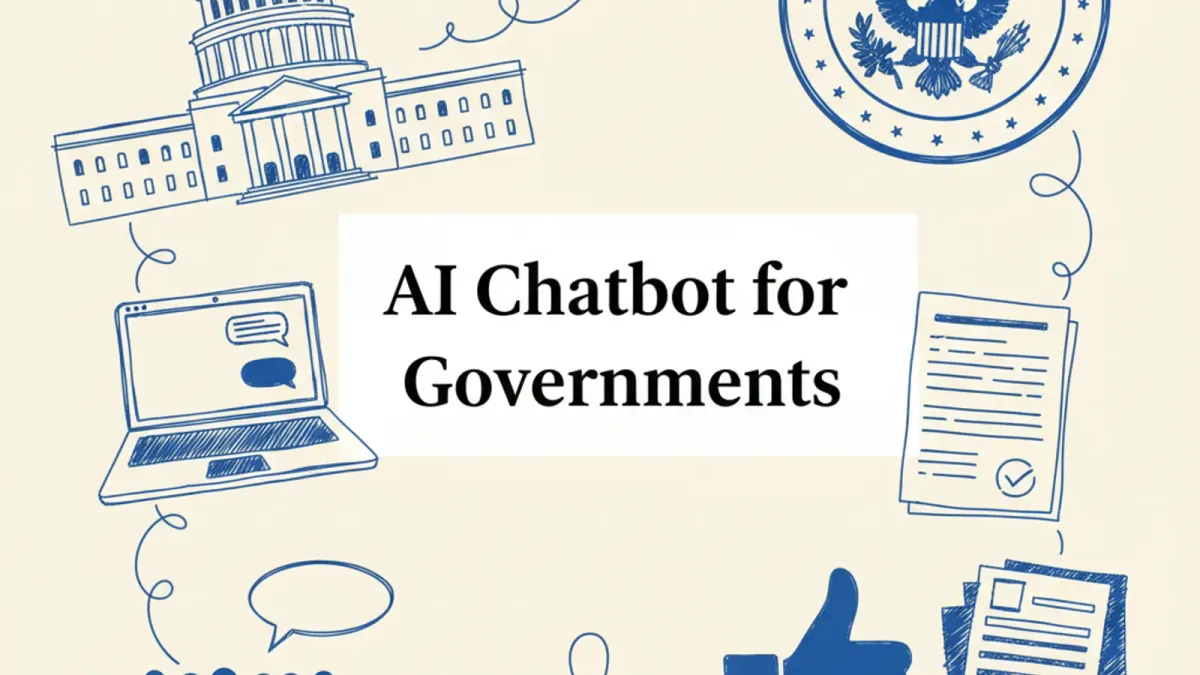
AI Chatbot for Governments: How to Modernise Citizen Services and Cut Costs
AI chatbots help government agencies provide 24/7 citizen services, reduce call volumes, and handle routine enquiries in multiple languages. Learn how to deploy one without enterprise-grade budgets.
Government agencies are under more pressure than ever to deliver faster, more accessible public services — with fewer resources. AI chatbots are emerging as a practical answer. They give citizens 24/7 access to information and services, reduce call centre wait times, and free up staff for complex casework that genuinely requires a human touch.
But deploying AI in the public sector comes with unique challenges: data privacy regulations, accessibility requirements, multilingual populations, and the simple reality that government services can't afford to get things wrong. A chatbot that gives incorrect tax advice or misroutes a benefits claim isn't just a bad user experience — it's a genuine failure of public duty.
This guide covers how government bodies at every level — from local councils to national agencies — are using AI chatbots to improve citizen services, what's working, what isn't, and how to get started without the six-figure enterprise contracts that traditionally gate-keep this technology. If you're exploring AI for your government department, council, or agency, you'll find practical guidance here rather than vendor-speak.
TL;DR: AI chatbots help government agencies provide 24/7 citizen services, reduce call volumes by 30–60%, and handle routine enquiries in multiple languages. Real-world deployments like Singapore's Ask Jamie (70+ government websites), Dubai's RAMMAS (698,000+ requests processed), and Phoenix's myPHX311 prove the model works. You don't need enterprise-grade budgets to get started — platforms like FastBots.ai let you build a government chatbot trained on your own documents and policies for as little as $29/month.
Why Government Agencies Need AI Chatbots
The gap between what citizens expect and what government services deliver has never been wider. People are accustomed to instant responses from their bank, their delivery service, and their streaming platform. Then they call their local council and wait 45 minutes to ask about bin collection schedules.
This isn't a technology problem — it's a resource problem. Most government agencies are chronically understaffed and dealing with increasing demand. According to Gallup, by Q4 2025, 43% of public-sector employees reported using AI at least a few times a year, with 21% using it daily. The adoption curve is accelerating because the need is acute.
The Core Benefits for Public Sector
24/7 availability without overtime costs. Citizens don't need help only during office hours. Permit questions, benefit enquiries, and service requests happen at 9pm on a Sunday just as often as Tuesday at 2pm. An AI chatbot handles these without adding night-shift staff.
Multilingual support at scale. Many government bodies serve diverse populations. Building a multilingual call centre is prohibitively expensive. AI chatbots can respond in dozens of languages automatically — FastBots.ai supports 95 languages out of the box, for example.
Consistent, accurate information. When 15 different call centre agents answer the same question, you get 15 slightly different answers. A chatbot trained on your official policies and documents gives the same correct answer every time.
Reduced call volumes and wait times. Routine enquiries — opening hours, document requirements, application status checks — typically account for 60–80% of government call volume. Automating these frees human agents for complex cases.
Data-driven insights. Every chatbot interaction generates data about what citizens are asking for, where they're getting confused, and what services are in highest demand. This is intelligence that phone calls rarely capture at scale.
Real-World Government Chatbot Deployments That Actually Work
Let's cut through the vendor case studies and look at what's genuinely been deployed and is operating at scale.
Singapore: Ask Jamie — The Gold Standard
Singapore's GovTech agency deployed Ask Jamie across more than 70 government websites. It's not a gimmick — it's the primary digital interface for citizen queries across departments. The chatbot uses natural language processing to understand questions in multiple languages and routes to the correct department information instantly.
What makes Ask Jamie notable isn't the technology — it's the governance model. Singapore treats the chatbot as a public service channel with the same quality standards as phone and in-person services. There's continuous training, regular accuracy audits, and clear escalation paths to human agents.
Dubai: RAMMAS — Processing 698,000+ Requests
The Dubai Electricity & Water Authority launched RAMMAS in 2017, making it one of the earliest large-scale government chatbot deployments. Available in English and Arabic across web, mobile, Facebook, and even Amazon Alexa, RAMMAS lets citizens check bills, make payments, and report issues around the clock.
The key lesson from RAMMAS: it works because it's genuinely transactional, not just informational. Citizens don't just ask questions — they complete tasks. That's the difference between a chatbot people tolerate and one they actually prefer to use.
Phoenix, Arizona: myPHX311
Phoenix created myPHX311 as a bilingual (English and Spanish) AI chatbot integrated into both their website and mobile app. It handles common 311 service requests — reporting potholes, asking about utility management, requesting neighbourhood services.
What's clever about the Phoenix approach is the integration with existing CRM systems. Requests submitted through the chatbot flow directly into the same workflow as phone calls, ensuring nothing falls through the cracks.
New Orleans: JAZZ — Crisis-Proof Citizen Services
Perhaps the most compelling case study is New Orleans' JAZZ chatbot (powered by Citibot). After COVID-19 caused a 350% surge in call volumes, NOLA-311 deployed JAZZ for web and text chat. During Hurricane Ida, when phone lines went down entirely, JAZZ continued operating through web and text channels — becoming an emergency communication lifeline.
This illustrates something crucial about government chatbots: they're not just efficiency tools. They're resilience infrastructure.
Midland, Texas: AskJacky — Small City, Big Results
You don't need to be a global city to benefit. Midland, Texas (population ~140,000) deployed AskJacky in 2024, integrated with SeeClickFix for digital 311 services. The chatbot handles non-emergency requests 24/7, automatically routing them into the municipal CRM. The result: reduced staff workload and faster issue resolution.

Key Use Cases for Government AI Chatbots
Citizen Enquiries and Information Access
The most straightforward use case — and often the quickest win. Train your chatbot on your website content, policy documents, FAQs, and service descriptions. Citizens get instant answers to questions like:
- "What documents do I need to renew my driving licence?"
- "When is my next bin collection?"
- "How do I apply for a building permit?"
- "What are your office opening hours?"
This alone can reduce call centre volume by 30–50%, based on deployments in comparable organisations.
Service Request Submission
Moving beyond information to action. Citizens can submit requests through the chatbot:
- Report a pothole or streetlight outage
- Request a council tax rebate form
- Book an appointment at a government office
- Register a complaint
The chatbot captures structured data and routes it to the correct department — often more reliably than a phone conversation where details get lost in translation.
Benefits and Eligibility Checking
One of the highest-value use cases. Citizens often don't know which benefits they're eligible for, and navigating government benefits systems is notoriously confusing. A chatbot can ask a series of qualifying questions and point citizens to the right programmes, documents, and application forms.
This isn't about replacing caseworkers — it's about ensuring citizens reach the right caseworker with the right information the first time.
Permit and Licence Applications
Planning permissions, business licences, event permits — these processes involve multiple steps, required documents, and specific timelines. A chatbot can guide applicants through the process step by step, check document requirements, and flag missing information before submission.
Internal Staff Support
Government chatbots aren't just citizen-facing. Internal chatbots can help employees navigate HR policies, IT support procedures, procurement processes, and training requirements. This is particularly valuable in large organisations where institutional knowledge is fragmented across departments.
Emergency and Crisis Communication
As New Orleans demonstrated with Hurricane Ida, chatbots provide a resilient communication channel when traditional systems fail. They can disseminate emergency information, direct citizens to shelters and resources, and capture situation reports — all without requiring additional staff during a crisis.
Choosing the Right Platform: What Government Agencies Should Consider
The government chatbot market ranges from enterprise behemoths costing six figures annually to accessible platforms that let you get started in days. Here's an honest comparison.
Enterprise Platforms
IBM Watson Assistant is the traditional go-to for government. It offers excellent security certifications (ISO 27001, HIPAA, NIST compliance), on-premises deployment options, and deep integration capabilities. The trade-off: it's complex to deploy, requires significant technical resources, and costs reflect the enterprise positioning.
Salesforce Government Cloud integrates AI chatbots with a full CRM platform. If you're already in the Salesforce ecosystem, this makes sense. If you're not, you're buying into an entire platform — not just a chatbot. FedRAMP High and DoD IL4 certifications make it attractive for US federal agencies.
Botpress offers an open-source option with more developer control. The Quebec Ministry of Health used it during COVID-19 for multilingual citizen support. It's flexible but requires technical skill to deploy and maintain.
The Accessible Alternative
Here's the thing most enterprise vendors won't tell you: for the majority of government chatbot use cases — citizen enquiries, service information, FAQ handling, document guidance — you don't need a six-figure platform.
FastBots.ai lets you build an AI chatbot trained on your own website content, policy documents, PDFs, and spreadsheets. It supports 95 languages, offers WhatsApp, Telegram, Slack, Facebook Messenger, and Instagram integrations alongside website embedding, and provides live chat handover when a human needs to step in.
Pricing starts at $29/month for the Essential plan, with the Business plan at $89/month including live chat handover — a fraction of what enterprise platforms charge. The data infrastructure is SOC2 and GDPR compliant, which covers the compliance requirements for most non-federal government bodies.
This isn't to say FastBots replaces IBM Watson for a federal defence department. But for a local council, a municipal government, a state agency handling citizen enquiries, or a public library system? It's a genuinely practical option that you can have running in an afternoon rather than six months.
How to Deploy an AI Chatbot for Your Government Agency
Step 1: Audit Your Current Citizen Enquiries
Before building anything, understand what your citizens are actually asking. Pull data from:
- Call centre logs (most common questions and topics)
- Website search queries
- Email enquiries
- In-person reception desk questions
- Social media messages
Categorise these into tiers:
- Tier 1: Simple factual questions (opening hours, document requirements, contact details)
- Tier 2: Process guidance (how to apply, what steps are involved, timelines)
- Tier 3: Complex cases requiring human judgement (appeals, complaints, sensitive situations)
Your chatbot should handle Tiers 1 and 2 and gracefully escalate Tier 3.
Step 2: Gather and Organise Your Knowledge Base
The quality of your chatbot depends entirely on the quality of information you feed it. Gather:
- Your website content (a platform like FastBots can crawl your entire website automatically)
- Policy documents and guidelines (PDF, DOCX)
- FAQ databases
- Service descriptions and eligibility criteria
- Forms and application guides
- Contact directories
Clean this content. Remove outdated information. Ensure consistency. This is the most labour-intensive step, but it's also the most important.
Step 3: Configure and Train Your Chatbot
With a no-code platform, this is surprisingly straightforward:
- Upload your documents and point the chatbot to your website
- Set the chatbot's personality and tone (professional, helpful, clear)
- Define what questions it should and shouldn't answer
- Configure escalation rules (when to hand over to a human)
- Set up multilingual support if needed
- Test thoroughly with real citizen questions from your audit
Step 4: Start Small, Then Expand
Don't try to automate everything at once. Start with one department or one service area — perhaps your most common enquiry category. Prove the model works, gather data, refine responses, then expand.
Actionable Takeaway:
- Week 1: Audit your top 50 citizen enquiries
- Week 2: Gather and clean your knowledge base documents
- Week 3: Set up and configure your chatbot on a staging environment
- Week 4: Internal testing with staff playing the role of citizens
- Week 5–6: Soft launch on your website with a feedback mechanism
- Week 8+: Review data, refine, and expand to additional departments or channels
Step 5: Monitor, Measure, and Iterate
Track these metrics from day one:
- Containment rate: What percentage of conversations does the chatbot resolve without human escalation?
- Accuracy rate: Are citizens getting correct information? (Sample and review regularly)
- Citizen satisfaction: Add a simple thumbs-up/thumbs-down rating after each interaction
- Volume deflection: How much has call centre volume decreased?
- Time to resolution: How quickly are enquiries resolved compared to traditional channels?
Data Privacy and Security: The Non-Negotiable Requirements
Government agencies can't treat data privacy as an afterthought. Here's what to insist on from any chatbot platform:
Compliance Standards
- GDPR compliance for any agency handling EU citizen data
- SOC2 certification for the underlying infrastructure
- Data residency options — know where your citizens' data is stored
- Data retention policies — configure how long conversation data is kept
- Right to erasure — citizens must be able to request deletion of their data
Security Architecture
- End-to-end encryption for all conversations
- Role-based access controls for staff
- Audit logging for all interactions
- Regular security assessments and penetration testing
- No training on citizen data without explicit consent
Transparency Requirements
- Clearly identify the chatbot as an AI (not a human)
- Provide easy access to a human agent at any point
- Explain what data is collected and how it's used
- Publish accuracy metrics and service standards
FastBots.ai uses SOC2 and GDPR-compliant infrastructure, with no credentials stored directly in code, secure OAuth2 mechanisms, and full conversation history that administrators can review, search, and export. For most local and state government applications, this meets compliance requirements — though federal agencies with specific security clearance requirements may need specialised platforms.

Common Mistakes Government Agencies Make with Chatbots
Trying to Boil the Ocean
The biggest failure pattern: trying to launch a chatbot that handles everything from parking fines to planning permissions on day one. Start narrow, prove value, expand.
Treating It as a Set-and-Forget Tool
Your chatbot needs ongoing maintenance. Policies change, new services launch, legislation updates. Build a process for regular content updates — monthly at minimum.
Ignoring the Human Escalation Path
A chatbot without a clear path to a human agent is worse than no chatbot at all. Citizens who feel trapped in an AI loop with no escape will lose trust in your entire digital service.
Not Training Staff on the New Workflow
Your call centre staff need to understand how the chatbot works, what it handles, and what gets escalated to them. Otherwise they'll undermine it ("Oh, just ignore the chatbot and call us directly").
Choosing Technology Before Understanding the Problem
Enterprise vendors love to sell technology solutions before the agency has clearly defined what problem they're solving. Define your use cases first, then choose the platform.
The Future: From Chatbots to AI Service Hubs
The most forward-thinking government agencies aren't just deploying chatbots — they're building AI service hubs. According to StateTech Magazine, the shift in 2026 is from chatbots that answer questions to integrated AI systems that let citizens complete entire transactions: renewing licences, submitting documents, making payments, tracking applications — all within a single conversation.
This is where the real transformation happens. Instead of a chatbot that tells you how to apply for a permit and then sends you to a different website to actually do it, the AI handles the entire process conversationally. You describe what you need, the system guides you through it, collects the necessary information, and submits it — all in one interaction.
We're not fully there yet, but the building blocks exist. Platforms that support integrations with external systems (via APIs, Zapier, Make.com) are already enabling this for simpler workflows. FastBots.ai, for instance, integrates with over 8,000 apps through Zapier, making it possible to connect citizen-facing chatbots to back-office systems without custom development.
FAQ: AI Chatbots for Government
How much does an AI chatbot for governments cost?
It varies enormously. Enterprise platforms like IBM Watson or Salesforce Government Cloud can cost tens of thousands per year. Accessible platforms like FastBots.ai start at $29/month, with the Business plan (including live chat handover) at $89/month. For most local government use cases, you don't need the enterprise tier.
Is it safe to use AI chatbots for government services?
Yes, with the right platform and governance. Look for SOC2 and GDPR compliance, data residency options, audit logging, and clear data retention policies. Always identify the chatbot as AI and provide a human escalation path.
Can government chatbots handle multiple languages?
Yes. Modern AI chatbot platforms support dozens of languages. FastBots.ai supports 95 languages automatically, which is particularly valuable for government agencies serving diverse communities.
Will AI chatbots replace government employees?
No. The evidence consistently shows that AI chatbots augment government staff rather than replacing them. They handle routine, repetitive enquiries so that human agents can focus on complex cases that require judgement, empathy, and nuanced understanding.
How long does it take to deploy a government chatbot?
With a no-code platform, you can have a basic chatbot running in days. A more comprehensive deployment — with proper knowledge base preparation, testing, staff training, and phased rollout — typically takes 6–8 weeks.
What about citizens who aren't comfortable with technology?
An AI chatbot should always be an additional channel, not the only one. Phone lines, in-person services, and email should remain available. The chatbot reduces pressure on these channels, making them better for citizens who prefer them.
Can chatbots handle sensitive government information?
Chatbots should be configured to handle general enquiries and process guidance, not sensitive personal data. For anything involving personal records, benefits decisions, or legal matters, the chatbot should escalate to a secure, authenticated channel with human oversight.
How do I measure the success of a government chatbot?
Track containment rate (conversations resolved without human help), citizen satisfaction scores, call volume deflection, accuracy rates, and cost per interaction. Compare these against your pre-chatbot baseline.
Getting Started: A Practical First Step
If you're a government agency considering an AI chatbot, here's the simplest way to test the concept:
- Sign up for a free account at FastBots.ai (no credit card required, 50 messages/month)
- Point it at your agency's website — it'll crawl and learn your content automatically
- Upload your top 10 policy documents as PDFs
- Test it with your 20 most common citizen questions
- Share it internally with colleagues for feedback
You'll know within a day whether an AI chatbot can handle your citizens' most frequent enquiries. From there, you can build the business case for a full deployment with real data rather than vendor promises.
The agencies that are getting this right aren't the ones with the biggest budgets. They're the ones that started small, measured results, and scaled what worked. An AI chatbot for governments doesn't have to be a massive IT transformation project. It can start as a simple experiment that proves its value — and grows from there.